• Home
  • Offerings
    • My Book
    • Magick Mail (It's Free!)
    • The Lunar Apothecary
    • The Tarot Apothecary
    • The Plant Ally Library
    • Solace: Herbs for Sensitive People
    • Begin With the Breath
    • The Green Bottle Method
    • Gatherings
    • Patreon
  • Blog
    • most recent
    • plant allies
    • astroherbology
    • moon studies
    • recipes + tutorials
    • magickal arts
    • tarot + divination
    • sliding scale
    • archive
    • search
  • About
  • FAQ
  • Search
  • More
    • Support the Work
    • Calls to Action + Resources
    • Recommended Reading
  • Home
  • Offerings
    • My Book
    • Magick Mail (It's Free!)
    • The Lunar Apothecary
    • The Tarot Apothecary
    • The Plant Ally Library
    • Solace: Herbs for Sensitive People
    • Begin With the Breath
    • The Green Bottle Method
    • Gatherings
    • Patreon
  • Blog
    • most recent
    • plant allies
    • astroherbology
    • moon studies
    • recipes + tutorials
    • magickal arts
    • tarot + divination
    • sliding scale
    • archive
    • search
  • About
  • FAQ
  • Search
  • More
    • Support the Work
    • Calls to Action + Resources
    • Recommended Reading

Worts & Cunning Apothecary | Intersectional Herbalism + Magickal Arts

Daring Bravely: Tarot and Tea for Leo Season

July 22, 2022  /  Alexis J. Cunningfolk

leo season tarot

Welcome to Leo Season!

This is my latest post on tarot practices and herbal allies for the twelve seasons of the zodiac and you can learn more about the whole series here.

The season of the Lion begins as summer slowly softens into the start of harvest season, where autumn still feels a long way off but we also know that summer's show is soon to end. In the southern hemisphere, the season of Leo is about the warming of the year as winter recedes and the promise of spring begins to come onto the stage. If Cancer is a season of (re)collecting and memory (whether under the bright exposure of a summer sun or within the long shadows of a winter night), the season of Leo is about learning how to fully express what has been found and has been defined as important, sacred, and necessary in our lives.

Leo is a fixed Fire sign which means that it intensely embodies the energy of a season. In other words, Leo helps us realize that we're here so how are we going to show up? Leo is one of those signs that often gets a less than flattering reputation but since all of us have all of the signs in our charts, I hope that we can expand the narrative of the Lion beyond dismissing its energy as needlessly dramatic. (1) Whether we're in the depths of summer in the northern hemisphere or winter in the southern hemisphere, Leo Season is a time to explore what has been dismissed (by ourselves and/or others) in our lives, what we've hidden away because we're afraid of shining too brightly, and what it's time to reveal.

Leo can ask us to do some brave (and scary) things like stand up for what we believe in, disrupt dangerous and harmful narratives, rewrite stories that no longer serve us, and help to create a stage in which more stories can be told. Leo energy helps us to recognize that everyone is putting on a performance of some sort and we're all in the process of performing from a place of greater authenticity and desire - so it's time to face what we're afraid of being seen as and have others see in us. When we learn how to work with Leo energy we learn how to thrive in our self-expression, help create and hold space for others to thrive as well, and learn how to perform from places of authenticity.

leo season tarot

Daring Bravely
Leo Season Tarot Spread

The guardian planet Leo is the Sun which defines how much energy we're comfortable holding and expressing. In other words, through the Sun we understand our capacity for doing and being in the world, what our limitations are, and where our energetic sweet spot lies. For Leo, the world's a stage, and understanding our Sun is to know where we are inherently most comfortable on that stage: Are we in the center performing a monologue? Behind the scenes styling props? Working with the audience or performers themselves? Writing the script? Doing building maintenance? Even though we have a solar sweet spot, throughout life we're not always where we want to be and it takes communication, honesty, and bravery to move about the stage to where we feel most at home. Leo energy helps us to define what it is we want to be guided by (i.e. writing a script that works for us, decorating our stage with props that support us, finding castmates we love and who love us) and grow our the expansive power of our hearts with that knowledge. But all that growing and heart-opening stuff can be scary.

Leo asks us "What are you afraid to express?"

Since there can be so much smoke and mirrors within a performance, it's important to know what is real and truthful, including what is you and what is someone's else's expectation of you. Leo is a skilled sorter of shadows and helps us to understand what truth we need to express about ourselves and when it's time to remove our masks. The following spread helps us to seek out our bravery through understanding our fear while at the same time reaching out to find our strengths.

Card 1. That Which Set the Stage

This card is an overview of the part of how supportive your life feels for being able to perform your story (i.e. show up in your life in the ways you are called to move through the world). Refer back to the Gemini Season spread if you need more insight on telling your story. You can choose to read this card as a general overview of your life's landscape or focusing on one particular area of your life (i.e. work life, a specific relationship, and so on). 

Card 2. That Which Is Feared

This card highlights the fear that is showing up in your life right now and appears to be an obstacle in your path. It is meant to help you name your fear out loud and see it for what it is instead of avoiding acknowledging it or growing it beyond proportion to reality. Sometimes this card can describe the mask you created for yourself in order to protect yourself from your fear coming to be.

Card 3. That Which Is Brave

This card helps you to recognize the strengths you carry and how acknowledging these strengths is a practice in cultivating bravery. 

Card 4. That Which Opens the Heart

This card suggests a path into heart-opening work, where you can begin to show up as the story you want to tell in the world, living beyond your fear and into your bravery.

Card 5. A Message for Leo Season

A general message, signs to pay attention to, and perhaps next steps to take as we move into Leo season. This card can highlight energy which you might bring more into your life during Leo season so that you are better able to connect with the energetic flow of the next month.

Bonus Card: That Which Guards the Heart

If you feel connected with the philosophy of astroherbology you can pull an additional card to help you understand the current energies of your heart, including physical experiences and energetic ones, what tension or wisdom you might be keeping there. I encourage you to take a somatic approach with this card - when you pull it and see the energy, follow the feelings and sensations that it evokes from your body to understand its meaning. 

herbs for leo season

image via @corinarainer

A Tea for Leo Season

How do we nourish the energy of Leo? We make beautiful teas with bold colors full of heart-opening herbs. Traditionally, Leo is a sign of the heart, the chest, and the movement of energy throughout the body (click here for a full list of traditional correspondences for Leo). I've chosen Rose (Rosa spp.) to bring a heart-opening energy into our tea and paired it with Hawthorn Berry (Crataegus monogyna) which acts both as a physical and energetic tonic to the heart body. Rosemary (Salvia rosmarinus) brings warmth and opens the chest, expanding energy from the heart outward. Rosemary is also helps to cultivate strength of will and courage in the body. Blended together, these plant allies create a sweet and bold brew ready to support all of your courageous endeavors.

  • 4 parts Rosemary (Salvia rosmarinus)

  • 2 parts Hawthorn Berry (Crataegus monogyna)

  • ½ part Rose (Rosa spp.)

These proportions are only suggested guidelines, so feel free to play around with them to your liking. As you make your tea, slow down, breathe deep, and infuse the blend with your intentions for the season (or whenever you’re drinking this tea to connect with the energy of Leo). If you’re looking for more breathwork practices to help you connect with the energy of the season, come this way.
leo season

image via @kent_pilcher

Seasonal Reflections

What does the land feel like, look like, smell like this season?

What is coming to the surface from within me?

What is receding within me?

What am I feeling grateful for?

What am I grieving for or feeling challenged by?

What am I feeling inspired and where is it calling me to this season?

What am I calling to me?

What am I called to give?

♌️

Want to learn more about the magick and astroherbalism of Leo? I’ve written a full profile on the sign for you to enjoy. You can also check out the rest of my seasons of astrology series.

Though I didn’t include them in this particular Leo tea recipe, Motherwort (Leonurus cardiaca) is one of my favorite Leo plant allies and heart tonics - I’ve written a full plant profile on them for you to explore. Want to learn more about beloved Rosemary (Salvia rosmarinus)? I’ve written an exclusive plant profile for my patrons.

And since Leo tends to bring the energy of gatherings and bringing folks together, here are some of my favorite plant allies to support social connections without burnout.

May your Leo season be bright and sweet, full of heart light and brave connectivity.

This post was made possible through patron support.
❤︎ Thanks, friends. ❤︎


We respect your privacy.

Thank you for signing up for Magick Mail! Once you have confirmed your subscription to the list you will gain access to our member's only apothecary.


Footnotes

(1) I feel like Leo, along with Scorpio, gets a lot of hassle as a sign as folks try to frame the Lion as a drama queen and Scorpio as wildly promiscuous. In the overculture, modern astrology is seen as the domain of women and those deemed too effeminate, so these little misogynistic narratives seep in to keep Leo's confidence in check and shame the sexuality of Scorpio (because confident, unashamed womxn and femmes are a threat to the powers that be).

The truth is that all the signs are prone to drama, just in different areas of life, but Leo Sun signs can tend to be more honest and unabashed about their needs and desires in public - which is a big no for womxn and femmes in our culture. Sexuality is a universal experience, too. Scorpio Sun signs are not more or less sexual than any other sign of the zodiac - they just happen to be intense creatures in relationships of all kinds, sexual or not, because they’re more often interested in the diving into the depths than surface matters.

Fortunately, astrology stories are being rewritten and expanded upon in beautiful ways these days, so these misogynistic binds will continue to be undone as kinder cultures emerge. But let's continue to disrupt these stories (and give our Leo and Scorpio stars some breathing room to grow into who they want to be) to strengthen our communities as we dream a new world into being.

3 Likes
categories / astroherbology, recipes + tutorials, tarot + divination
tags / leo, leo season, leo plant allies, astro seasons, seasons of astrology, medical astrology, astroherbology, astroherbalism, leo season tarot spread, leo season herbs, leo season plant allies, leo tarot, leo tea, rose, rosemary, hawthorn

3 Herbal Recipes to Support Your Lunar Return

July 01, 2022  /  Alexis J. Cunningfolk

lunar return herbs

Every month the Moon returns to place in the sign that you were born in - known as a Lunar Return - and it can be an auspicious time to nourish your inner worlds. The Lunar Return is, in fact, just the Moon version of your Solar Return (also known as your birthday) or a Saturn Return, though the energy and meaning of a Lunar Return is different than either of those. I write a lot about the Moon because in astrology and western esoteric practice, it is through working with our inner Moon that we understand our consciousness and cultivate the insights needed to work as healers and bring healing into our relationships (I even created a whole course about it). Lunar-centered herbalism plays a special role in my practice as an herbalist whether it is observing the healing rituals of the different phases of the Moon, creating Moon-inspired baths, learning more about the magick of Moon signs in my herbal preparations or making teas for my Lunar Return.

With all the ways one can practice medicine and magick by the Moon, I find the energy of the Lunar Return to be something special, moving and changing each month, calling us to step into a more spiral understanding of time and our experience of it. Your Lunar Return can be many things, including a time of reflection, of rebalancing or of reconnecting with some part of yourself, and I wanted to share with you three simple herbal remedies that I use for my own Lunar Return practice that'll hopefully support your own.

About the Recipes

I try to write about herbs that are easily accessible within the traditional western herbalism repertoire, but I've also included the herbal action of each herb that I'm focusing on to help you choose alternative herbs based on your needs. You are strongly encouraged to adapt each recipe to make it your own. The recipe portions listed are estimations and can be easily adjusted to your own taste needs and you can add any variety of preferred flavorful herbs to your own mix. While the recipes below are written with tea in mind you can use them as herbal baths, tinctures, flower essence blends, topical herbal oils, and more. 

Deck shown is The Gentle Tarot by Mari in the Sky

Reflection Moon Tea

Sometimes our Lunar Return is calling us home again through gentle reflection and dreamwork. I love working with my dreams with greater intention around my Lunar Return and the Reflection Moon tea blend helps to do just that. The blend helps to quiet the mind so that we can explore what's going on beneath the surface for us while also stimulating the dreaming part of our psyche. Reflection Moon tea is also helpful when it comes to awakening our inherent psychic gifs.

Medicinally, Reflection Moon can be a useful blend during and in the time around your Lunar Return if you're menstruating (Mugwort is a uterine tonic and all herbs have pain relieving qualities), looking to alleviating general tension especially when accompanied by headaches, and to help with slow and sluggish digestion.

  • 2 parts Skullcap (Scutellaria lateriflora): Nervine, sedative, and relaxant

  • 1 part Mugwort (Artemisia vulgaris): Relaxant and dream tonic

  • 1 part part Rose (Rosa spp.): Heart tonic

lunar return herbs

Deck shown is The Illuminated Earth Oracle by Claire Mack

Rebalancing Moon Tea

Your Lunar Return can be a beautiful time to slow down and reassess what needs balancing in your life. Whether you're feeling run down and sluggish, want to support the start of a new cycle or firm up some energetic boundaries, the Rebalancing Moon blend is nutritive rich and restorative. If I'm experiencing decision and/or compassion fatigue it this blend or some variation of this blend that I typically reach for.

In addition to being a nutritive rich blend, Rebalancing Moon helps with digestion, helps with issues of circulation, strengthens the blood (i.e. can help to alleviate anemia), protects against seasonal allergies, and is an excellent blend for taking after recovering from a period of illness or stress.

  • 2 parts Milky Oat (Avena sativa): Nervine and neurotonic

  • 1 part Nettles (Urtica dioica): Nutritive, digestive, and whole body trophorestorative

  • 1 part Spearmint (Mentha spicata): Digestive (carminative) and clears brain fog

lunar return herbs

Deck shown is the Heavenly Bodies Astrology Deck by Lily Ashwell

Reconnecting Moon Tea

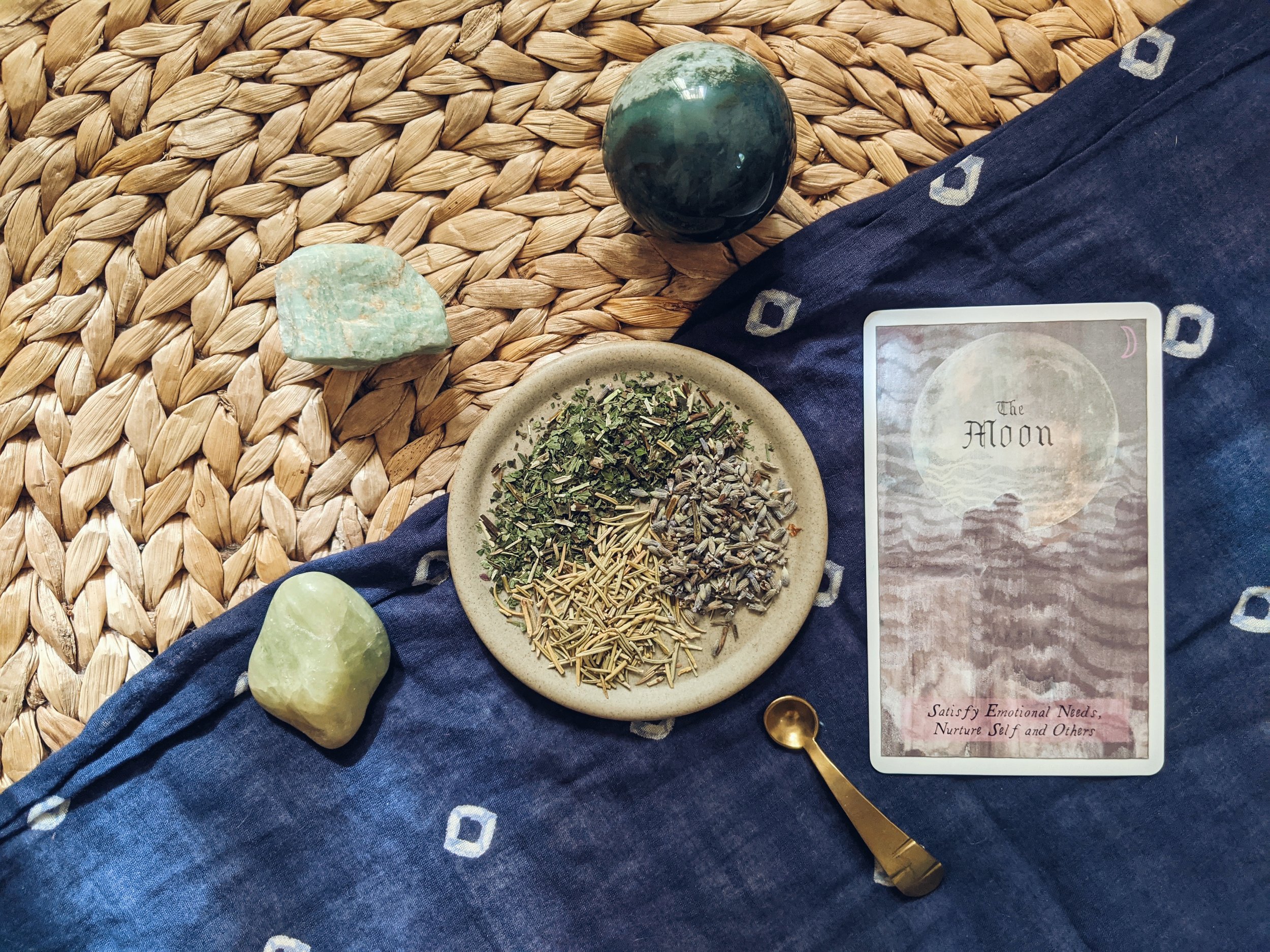
Sometimes it can feel like we're searching for something lost or not quite remembered about ourselves. Or we've set aside practices we'd want to be doing, things we want to be learning, and people we want to connect with because of the busyness and stress of our life. Reconnecting Moon can help to calm our nervous system and nudge us back into communion with our desires. It's the blend I reach for if I'm feeling out of sorts with my practice and like I'm doing less and less of what I want to be doing in my life for whatever reasons. 

Medicinally, Reconnecting Moon is a lovely tonic for the brain and nervous system, helping to support the lines of communication between what we're feeling-thinking. It's a good tea to share with others to help support clear lines of communication and to soothe frazzled energy.

  • 4 parts Lemon Balm (Melissa officinalis): Nootropic and nervine

  • 1 part Rosemary (Salvia rosmarinus): Nootropic and gentle nervous system stimulant

  • ½ part Lavender (Lavandula officinalis):  Nervine and circulatory stimulant

🌙

I hope that these recipes serve as a source of inspiration for your own practice. If you haven’t already, be sure to read my full post on what a Lunar Return is and why you might start observing it. For those of you who read tarot or oracle cards, I’ve written a tarot spread to support your lunar observations.

May you find what you’re looking for as you gaze into the mirror of the ever-changing Moon.

This post was made possible through patron support.
❤︎ Thanks, friends. ❤︎


We respect your privacy.

Thank you for signing up for Magick Mail! Once you have confirmed your subscription to the list you will gain access to our member's only apothecary.

2 Likes
categories / astroherbology, recipes + tutorials
tags / lunar returns, lunar return, lunar healing practice, lunar healing, moon medicine, moon herbs, lavender, rosemary, sage, mugwort, nettles, skullcap, rose, milky oat, spearmint, lemon balm

Defining Ourselves: Tarot and Tea for Cancer Season

June 20, 2022  /  Alexis J. Cunningfolk

Welcome to Cancer Season and my latest post on tarot practices and herbal allies for the twelve seasons of the zodiac (you can learn more about the series here).

The season of Cancer begins at Solstice - the longest day of the year in the northern hemisphere and the shortest day of the year in the southern hemisphere. There is an intensity to the energy of Cancer that isn't always as apparent at first glance, but there is a lot going on beneath the surface. If Gemini season has a tendency to stir things up, it's in Cancer season that we mull it all over. And then we might mull it over again. And then take a nap. And then remember that one time that was similar to the thing we're currently mulling over…

We've met the first three of the four sacred elements through the signs of Aries, Taurus, and Gemini, and now we meet our first water sign, Cancer. Cancer, like Aries, is a cardinal sign which lets us know that it marks the start of a new season and it is a sign that is actively engaged with the energy it embodies. For Cancer, that is engaging with our feelings and the depths of our emotional experience. Another way to understand Cancer energy is to think about being at the shoreline, looking out into the vastness of the ocean, ready to jump in.

One of the really magickal qualities of Cancer is its ability to straddle the worlds between. It is fitting then that the symbol of Cancer is the crab, a creature that can live both in water and on land, representing our ability to move between different states of consciousness, different points along our timeline (i.e. exploring our memories), and to move back and forth skills and wisdom gained in both our inner and outer worlds. With Cancer we have an opportunity to really feel out what it is we have perceived ourselves and our world to be, to honor the depths of our feelings, and to learn how to always find our way back to the comfort of the shoreline or the adventure of open waters.

Defining Ourselves
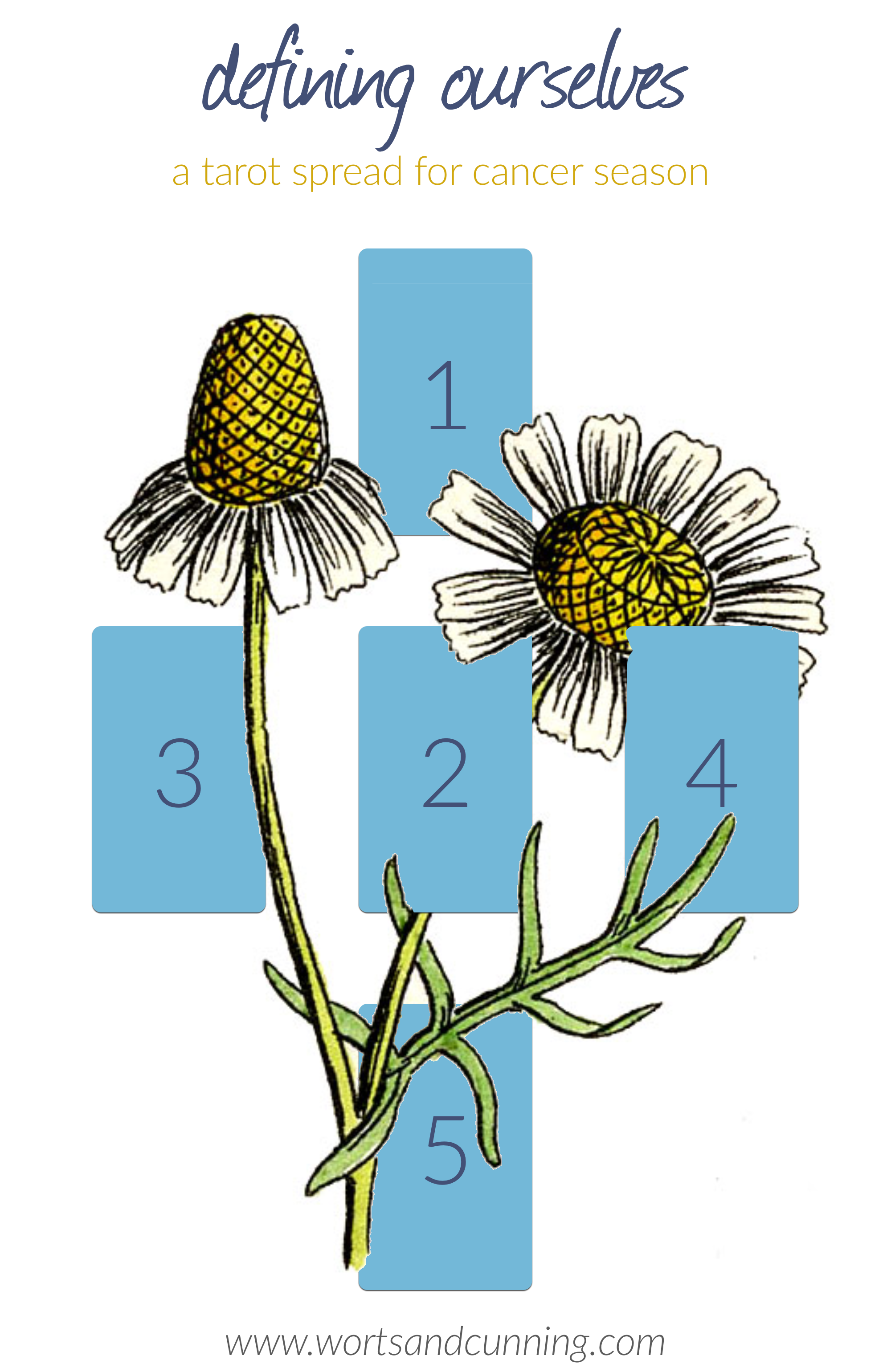
Cancer Season Tarot Spread

The guardian planet of Cancer is the Moon, which is a planet that helps us to understand and explore our experience of our consciousness, subconsciousness, and unconsciousness. While astrology has been Sun focused for many generations, it was actually the Moon which was the focal point of our most ancient forms of astrology because it is through the Moon that we understand ourselves. The Moon guards our most tender and honest truths and it is through the sign of Cancer that we can begin to understand where we might have hidden away and protected those stories of ours, as well as the places in our life where we might feel most guarded. For it is our feelings, our inner Moon, that defines how we experience the world.

Cancer asks us, "What do you feel defines you?"

The question of Cancer is not "what defines you" which can include all sorts of elements out of your control from class and ethnicity, gender and sexual identity, family and social cultures, and more, but what you feel defines you. The question is asked from a self-defining and felt perspective. The following spread helps you to walk between your inner and outer worlds, discovering what is known and unknown in order to help you better understand yourself. 

Card 1 . That Which Is Known

This card highlights something which you feel defines you and which you know defines you. The card acts like a mirror and an affirmation of something about yourself which you know to be true, even if you might struggle to acknowledge it or not give this part of your story much credit.

Card 2. That Which is Unknown

This card is like looking at the back of the mirror - it's something about ourselves that we don't quite understand just yet. It might feel connected to a certain memory or experience, but it doesn't have to be. Pay attention to the sensations, the feelings, that arise when reading this card.

Card 3. That Which Unsettles Us

This card acts similarly to an obstacle or challenge card in another spread - it is something that trips us up on our journey of self-knowing.

Card 4. That Which Shelters Us

One of the sweetest energies of Cancer is its ability to teach us about the things which feel comforting and sheltering. This card helps you to discern the places, practices, and/or people that help you feel secure and sheltered in the world, which is part of what defines you.

Card 5. A Message for Cancer Season

A general message, signs to pay attention to, and perhaps next steps to take as we move into Cancer season.

Bonus Card: That Which Guards the Cancer

If you feel connected with the philosophy of astroherbology you can pull an additional card to help you understand the current energies of your stomach, chest, uterus and ovaries (if you have them), including physical experiences and energetic ones, what tension or wisdom you might be keeping there. I encourage you to take a somatic approach with this card - when you pull it and see the energy, follow the feelings and sensations that it evokes from your body to understand its meaning. 

cancer season tea

image via @yoyoqua

A Tea for Cancer Season

How do we nourish the energies of Cancer? As a sign that has us deep in our feelings, it's important to support our body's ability to process what it is feeling. One of the parts of the body that Cancer traditionally guards is the stomach (click here for a full list of traditional correspondences for Cancer) so I've created a digestion tea to help support healthy digestion on both a physical and energetic level. Chamomile (Matricaria recutita) is a classic herb of digestion but also one which supports emotional wellbeing, helping us to process that which we're feeling. Robust Rosemary (Salvia rosmarinus) helps to bring us courage and the power of will as we journey through the season of Cancer and our own inner season of deep feeling whenever that may arise. I think that it's important to have a sweet remedy with us as an ally whenever we plumb the emotional depths which is why I've included Fenugreek (Feoniculum vulgare), another Cancer herb, in the blend.

  • 3 parts Chamomile (Matricaria recutita)

  • 1 part Rosemary (Salvia rosmarinus)

  • 1/4 part Fenugreek (Feoniculum vulgare)

These proportions are only suggested guidelines, so feel free to play around with them to your liking. As you make your tea, slow down, breathe deep, and infuse the blend with your intentions for the season (or whenever you’re drinking this tea to connect with the energy of Cancer). If you’re looking for more breathwork practices to help you connect with the energy of the season, come this way.

cancer season tarot

image via @hystad

Seasonal Reflections

What does the land feel like, look like, smell like this season?

What is coming to the surface from within me?

What is receding within me?

What am I feeling grateful for?

What am I grieving for or feeling challenged by?

What am I feeling inspired and where is it calling me to this season?

What am I calling to me?

What am I called to give?

♋︎

I’ve been writing about the intersections between plants, stars, and planets for years, so if you’re feeling inspired to keep reading about all things astroherbalism, check out the Cancer Astroherbology Profile as a great next step.

The energy of Cancer can be a very lunar one so if you’ve resonated with what you’ve read in this post or just want to learn more about ways that the Moon can help us understand ourselves, how about learning to make some lunar baths? Or if you’re ready to dive deep, check out The Lunar Apothecary.

May Cancer season provide you with illumination and inspiration, helping you walk steadily between and within all the worlds that are calling to you.

This post was made possible through patron support.
❤ Thanks, friends. ❤

 
magick mail newsletter

We respect your privacy.

Thank you for signing up for Magick Mail! Once you have confirmed your subscription to the list you will gain access to our member's only apothecary.

1 Likes
categories / astroherbology, recipes + tutorials, tarot + divination
tags / cancer, cancer season, cancer tea, cancer tarot, astroherbalism, astroherbology, astrological body, cancer herbs, cancer plant allies, chamomile, rosemary, fenugreek, astro seasons, seasons of astrology

Creating a Lunar Healing Practice That Actually Works for You

June 13, 2022  /  Alexis J. Cunningfolk

moon healing

If you've found yourself here, reading these words, it is likely that you're interested in some sort of Moon-based practice. Maybe you've always wanted to hold Full Moon rituals every month or want to explore the ebb and flow of time from a more lunar perspective. Perhaps you've heard about the benefits of working with the Moon when it comes to creating healing and wellness in your life or you've tried to have a lunar practice before and got bored or overwhelmed or some other stumbling block appeared on your path. Whatever has drawn you here, I hope to spend some time with you helping you explore your unique needs for a lunar practice and ways to create one that you'll actually show up to on a regular basis (whatever "regular" means to you). 

I'll start by suggesting some self-inquiry practices (i.e. asking you a question that you can write about or meditate on), help you figure out the structure that'll best support your practice, and then share some tools that I think are useful when it comes to supporting a lunar practice.

Ready? Let's start with the all important why.

The Desire for a Lunar Healing Practice

Before we're even able to start a new practice, an important first step is to know your "why" for wanting to make an effort to show up in the first place. Defining your desire for a practice helps you to recognize what needs are most present in your life as well as help you to connect with dreams and visions of your own becoming. Knowing our desire helps to motivate us to show up for our practice but it also helps us to shape what our practice might look like.

Now, some of you might be getting ready to scroll away or skip over this section because you feel like you know your why already and don't need to define it again or you want to get to the good stuff. But I'm going to encourage you to keep on reading and to spend some time answering the one question I propose about finding your why. 

​​I'll be honest with you - when I have taken courses and come across writing prompts or questions to consider during meditation I have found myself on more than one occasion hesitating to do them. I would tell myself that I wanted to get to the easy-to-measure practical stuff or I've asked myself a question like that before so I didn't need to do it again. 

However, I've never regretted actually making time to practice self-inquiry, especially through writing, and the one thing that helped me show up to the practice was making it into a special ritual. I make myself a cozy cup of tea, I grab something nourishing to eat, and light a candle. Sometimes I pull out a collection of colorful pens, but usually rely on a trusted favorite black ink pen as a favorite tool. Often I like to hold a stone in my hand for a few quiet moments, something that helps ground me and connect me to my edges, calling myself back home again to this moment and this place. Doing these things in a ritual manner starts to wake up the curious part of me that's interested in being asked questions and answering them in turn.

So I hope you'll stick with me and take time either now or later to participate in the lunar magick that is self inquiry.

lilifer tarot

Deck shown is Lilifer Tarot by Marion Constentin

Everybody's why is going to be different, though there are certainly similar needs that show up again and again when we're talking about Moon magick and healing work. I've gone ahead and listed out examples of desires underlying a need for lunar practice below to help inspire your own self inquiry.

  • I want to connect more deeply with lunar time as a way to break out of habits of overwork.

  • I want to awaken my intuitive gifts.

  • I hope to feel connected again to ancestral practices through connecting with the lunar calendar.

  • I want to dedicate time each month just for me and my spiritual practice.

  • I want to explore my inner world through shadow work guided by the Moon.

  • I feel called to develop my skills as a healer and I feel that a lunar practice would help me.

  • I feel called to the Moon and I want to understand why.

  • I want to gather together with my magickal friends for a Moon ritual each month.

  • I am working on creating feelings of wholeness in my life and the Moon feels like an appropriate symbol to help guide me.

Ready to explore your own why? You might have some very clear reasons or they may be more vague feelings, but wherever you're at in defining your desire, I encourage you to go ahead and answer the following question, whether spoken aloud, considered in meditation, or written down:

Why do I want a lunar healing practice?

Remember, no one is going to read or hear your answer to the above question unless you choose to share it (and you really don't need to share it unless you're called to share it with someone you love and trust). It's time to be honest with yourself and try to move out of the place, as much as you can, of comparison and performing-for-others-first space that has been hypercharged in our culture through social media, including amongst magickal practitioners. Get inspired by the magickal world, but don't get lost in the smoke and mirrors of the online world. In fact, being intentional and (at least initially) private about our desires around a lunar healing practice is in itself lunar healing work.

Working with the Moon is, in part, a process of understanding of our consciousness and subconscious realms beyond expectations of culture and peers, of trends and institutions in order to be able to show up to ourselves and in community as our ever-whole, ever-changing lunar self.

Once you have your why, let's talk about creating a structure that'll honor the rhythm of your needs, the ebb and flow of your magick.

moon healing magick

Deck shown is The Morgan-Greer Tarot by Bill F. Greer

The Circle That Supports Us

Within the magickal communities that I belong to, the most often used symbol of magickal space is the circle. Never-ending and all encompassing, at the beginning of rituals and gatherings, special care and attention is placed on creating (or really, recognizing) the holiness of the time and space we're in. Sometimes these circle preparations are longer than the actual ritual itself, which is a good indication for how a successful magickal practice, including a lunar healing one, might be structured. 

Being intentional and following our desires when it comes to creating a circle or structure for your practice to thrive in is important if you want to develop one that is long-term and sustainable. Below I've listed some questions to help you to define a structure for your practice that'll best support you. There are broad and general questions, but you can use many of them as starting points for deeper inquiries (i.e. you don't have a lot of time for a lunar practice as your life is right now, but you want to make big changes to your life to make more time, and want to ask yourself what sort of effort that'll take).

  • When you imagine a lunar healing practice, what does it look like to you? How does it make you feel?

  • What do you imagine achieving, realizing, releasing or other experience through a lunar healing practice?

  • How much time can you, reasonably and without hardship, make for your practice right now?

  • Where do you want to practice and what sort of physical space do you have for your practice?

  • What lunar phase do you feel called to work with? Learn more about the healing energies of the Dark Moon, New Moon, Waxing Quarter Moon, Full Moon, and Waning Quarter Moon phases.

  • What tools do you feel called to incorporate into your lunar healing practice, such as plant allies, a divination practice or devotional work with deity?

Let's start to put this all together by imagining that our friend, Magnolia, is excited about starting their own lunar healing practice. They are feeling called to this practice because they really want to develop their intuition after years of feeling like they kinda understand it, but are now interested in being intentional in their explorations. They feel like their intuition was dismissed a lot as a child and young adult which has led them to not listen to their intuition as much as they would like to. Magnolia wants to incorporate tarot into their lunar healing practice because they've been reading the cards for about a year and want to be able to rely less on their tarot books and more on their intuition when it comes to interpretations. 

Magnolia is called to work with the Full Moon during a monthly ritual. They made space in their bedroom for a little altar that they have already started meditating at in the mornings. When they were doing research on Moon rituals, they came across an old book by Margot Adler called Drawing Down the Moon and the cover inspired them so they've added a picture of it to their altar. (1) Magnolia decides to start with a simple structure for their monthly Full Moon ritual:

  • A simple ritual to create sacred space based traditions from their African and Irish heritage. 

  • A short meditation to awaken their intuition.

  • A simple tarot spread where they won't read from their tarot book at all, but only interpret the cards intuitively. They are thinking of doing a tarot spread based on the sign the Moon is in (i.e. a Aries spread for an Aries Full Moon and so on), but they're going to be flexible about it and not stress too much over finding the "right" spread.

  • Practice one psychic development game with the tarot.

  • A few minutes to journal about their experiences.

  • Closing up the space.

Through stating their desire and considering what it is that they hope to experience (re-awakening their intuition), Magnolia has created a very sweet and simple lunar practice. There are no fancy tools, just the items that they already have. They dream of being able to perform their Full Moon ritual on a beach like the image from Drawing Down the Moon, but that is something that they hope to draw towards them as they work with the Moon each month. There is plenty of space for them to innovate, add to or subtract from their practice as time and energy allows and mostly they feel inspired. Having a Moon altar in their room means that they get to see and be reminded of their intention every day, creating a path of connection between one Full Moon to the next. 

Magnolia is not trying to observe all the Moon phases every month (which would be every night because the Moon is always changing into a new phase) or trying to practice a multi-hour long ritual every New and Full Moon complete with an herbal bath consisting of dozens of herbs, three tarot spreads, thirteen candles that they hand-dip themselves each fortnight, and an elaborate ritual that includes a interpretative dance and costume change halfway through. Now, I'm not saying that this is not going to be the way that some of you want to practice, but for most of us this sort of effort is not sustainable for the long run and part of being in practice is being able to maintain a practice. Remember, a personal lunar practice is about being able to show up, not show off or be beholden to the expectations of others. (2) Good questions to ask yourself when you're developing your outline are:

  • Is this useful?

  • Will I be able to show up for this practice with as little hindrance as possible?

  • Do I actually want to do what I'm proposing?

What would the outline of your lunar healing practice look like? Go ahead and take some time to write it down now. If you like you can start with your most elaborate dreams of a lunar practice and then distill that into something that is much more achievable for you in this time and space. But like Magnolia, with their picture of Drawing Down the Moon on the altar, you can incorporate affirming and aspirational images to your practice space to help you feel inspired.

To help spark your inspiration and imagination, I've listed types of lunar healing practices that you might want to try or make your own below:

  • Cast a tarot spread each month during the Moon phase of your choice. I've created tarot spreads for the Dark, New, Waxing Quarter, Full, and Waning Quarter Moon phases.

  • Take a monthly bath during the Moon phase of your choice each month, perhaps incorporating sea salt and/or lunar herbs into the water.

  • Perform simple rituals of healing.

  • Observe your monthly lunar return in a special way.

  • Commit to learning a particular magickal skill at a certain lunar phase each month (i.e. crystal divination, trancework, charm making, psychic development and so on).

  • Dance, howl, and sing under the Moonlight.

  • Learn about and engage with lunar deities.

  • Moon bathe (i.e. get outside under the light of the Moon, preferably with some bare skin exposed) as often as you can and are called to do.

Hopefully at this point you're starting to form a clearer idea of what it is your lunar practice might look like and feel like. Next, I want to introduce you to a few useful tools to support your practice.

lunar healing altar

Deck shown is The Natural Ink Tarot by Martha Miller

Useful Tools for Your Lunar Practice

Writing down your lunar practice plans - whether in a planner, on a calendar, in your journal or book of shadows, or on a note stuck somewhere you'll see it all the time - is one obvious, simple, and useful way to show up for your practice. You can even choose to have a special notebook reserved for writing down reflections, tarot spreads, dreams, and rituals all relating to your lunar healing practice, but you can also just use what you have available (like a current journal - use a different color ink to help you easily find entries about your lunar healing practice - or a notes app on your phone).

Find a way to keep track of the phases of the Moon. The cheapest, (often) easiest, and most ancient way is to look outside up at the sky to see what phase the Moon is in. Now, light pollution and limited access to safe spaces to Moongaze might restrict your ability to do this, but actually being able to observe the Moon in the sky whenever you can (or being under Moon light and dark whether or not you're able to physically see the Moon), helps us to connect with the very old parts of ourselves and our species that have been watching the Moon for millenia. Of course, there are apps and websites that help us learn even more about the lunar phases, signs, and mansions that the Moon is in and these are a useful addition to physical observation. Astroseek provides a free and comprehensive Moon calendar and there are plenty of other apps that you can find for your devices. For my own practice, I like to use the We'Moon planner for helping me track lunar and celestial rhythms. 

For those of you trying to find your way back into practice after a fallow period or who are struggling to reconnect with your magick, might I suggest some pageantry? I know I warned against performing-for-the-other, but we can still perform for ourselves. Sometimes we don't feel able to show up to a practice because we're struggling to connect with someone we were before or we can't yet imagine what we're becoming. Perhaps we're struggling with feeling worthy of our magick or what the meaning of having a lunar or any sort of practice is. I feel you. Here is where we can practice a bit of ancient and effective magick: faking it til you make it. Get dressed up, create a soundtrack for your ritual, step into the role of a confident healer / witch / priest/ess, and perform. Stir your tea mug as if you're the Great Goddess Herself stirring the cauldron of life and death and rebirth. Swirl your skirt, draw sigils on your jeans, pretend to be an old hag of the wood who is deeply enamored with their own sense of curmudgeonly self. Speak your whole ritual in "ye olden english" and let a character of your own creation show up to the ritual first. It can be silly, but all ritual is silly and strange to some degree, and if it helps you to show up to a practice that you really want to show up to, it's not just silly but a very effective form of magick.

Here are a final few questions to help you discover the desire of your practice:

  • Who do I hope to become and/or feel through my lunar practice?

  • What do I hope to call home to myself through my lunar practice?

  • Where do I want to go with my lunar practice?

I hope you're feeling inspired and like you have some tools and ways of thinking about your lunar healing practice that'll help you show up to your practice. Through working with the Moon I hope you are able to know yourself as always whole and always changing and that you're able to set up practices in your life that make space for all of you to show up however you want and need to.

🌙

Discovering your monthly lunar return can be a very sweet way of starting a lunar healing practice. Or you might spend a year observing the lunar sabbats. If you're interested in learning more ways of including tarot in your healing practice, come this way.

There are so many ways to create a lunar healing practice that is all your own. For those of you called to learn more about your unique gifts as a healer through lunar-based rhythms and rituals, you're invited to join me in The Lunar Apothecary.

Wherever your journey with the Moon takes you I hope that helps you spiral home again and again to your own wild wisdom and the ways you are deeply interconnected with your community.

This post was made possible through patron support.
❤︎ Thanks, friends. ❤︎


We respect your privacy.

Thank you for signing up for Magick Mail! Once you have confirmed your subscription to the list you will gain access to our member's only apothecary.


Footnotes

(1) For my beloved readers who have balked at the thought of Drawing Down the Moon considered an "old" book by the current generation of young magickal folk, it was first published in 1979 which is 43 years ago and is sort of the equivalent of reading Dion Fortune's books in the 1990s (which were considered "old" books at the time by school age witches like myself). Seeing the new books I read as a young witch being touted as "vintage" by the younger generation is the main way that I recognize that I am becoming increasingly (thankfully) old. 

(2) Public ritual performances, on the other hand, can be a great time to show off! 

1 Likes
categories / enchanted life, magickal arts
tags / moon magick, lunar healing, moon witch, lunar healing practice, moon ritual, new moon magick, new moon ritual, full moon magick, full moon ritual, dark moon magick, dark moon ritual

Alleviating Suffering of Body & Spirit: Boneset Plant Profile

June 06, 2022  /  Alexis J. Cunningfolk

boneset plant profile

Now, friends, here is a plant profile that I’ve had on my list of “plant profiles to write” for quite a number of years. It remained on the list as opposed to be written because it’s not the most widely available plant and it’s rather specific, if effectively so, in its use. So Boneset (Eupatorium perfolium) waited on my ever-growing plant list as other plants were written about and my patrons requested specific profiles they were wanting to see.

And then the most recent global pandemic arrived and Boneset, along with other pandemic plant allies, and the people who used became something I was increasingly interested in.

To be clear, I am incredibly grateful for and supportive of all the interventions that we have developed as a species to keep ourselves and our communities healthy, including masks and vaccines. Also, the resources below are in regards to an influenza pandemic and not a covid-based one. I was simply curious about how our herbal elders of pandemics past used the plants they had available to support community health, alleviate suffering, and prevent unnecessary death.

The first resource I stumbled upon was the Influenza Encyclopedia created by the University of Michigan. It’s an extensive archive of reports, medical articles, and more about what life was like, the treatments provided, and health measures taken during the influenza epidemic of 1918-1919 in the United States. Here is where you can find articles from The Eclectic Medical Journal which discusses herbal treatments.

Then I came across Kathy Abascal’s excellent book Herbs & Influenza: How Herbs Used in the 1918 Flu Pandemic Can Be Effective Today. When my household and community was dealing with a robust strain of influenza a few years back, I learned about plant allies in this book that I hadn’t read about before that are now some of my favorite remedies when dealing with colds and the ‘flu.

All of this is to say that Boneset is an important very specific sort of ally that many would benefit from and has proven itself to be a plant that is useful during periods of significant human suffering.

So, let’s meet Boneset.

image via SB Johnny

Boneset
(Eupatorium perfoliatum)

Common + Folk Names : Agueweed, crosswort, feverwort, sweating plant, tedral, thoroughstem, vegetable antimony, wild isaac, hierba de chiva, ayapana, ogaakananiibiish

Tarot Cards : The Devil

Element : Water

Zodiac Signs : Capricorn (Guardian Herb)

Planets : Saturn

Moon Phase : Full Moon

Parts used : Aerial parts

Habitat : Native to wetlands of North America. 

Growing conditions : Grows in damp areas and wetlands. Prefers rich soil, damp conditions, and full to partial sun.

Collection : Harvest before flowering.

Flavor : Bitter, pungent

Temperature : Cold

Moisture : Dry

Tissue State : Heat/Excitation, Damp/Stagnation

Constituents : Sesquiterpene lactones, polysaccharides, flavonoids, glucoside, diterpenes, gallic acid, sterols, essential oils.

Actions : Aperient, antispasmodic, astringent, bitter, carminative, cholagogue, diaphoretic, emetic, expectorant, febrifuge, immunostimulant, laxative, peripheral vasodilator, stimulant, tonic

Main Uses

I remember having a fever as a child where it felt like my bones were breaking - it was miserable and I’m sure many of you have experienced such discomfort. So when I learned about an herb known to treat "bonebreak fever" I was curious (though not looking forward to) being able to use the herb myself when I experienced a similar fever again. A few years back another bonebreak fever arrived and I remembered that I had a bottle of Boneset tincture in my herb cabinet. The herb was a blessed ally to have and reduced the severity and time that I was in pain as well as helping to “break” or relieve my fever. It's now an herb that I gratefully recommend to my family and community when a bonebreak fever shows up for them. 

Boneset has long been used within Indigenous communities in North America and was introduced to European Americans herbalists and physicians who would use the plant during influenza pandemics (I highlight Anishinaabe knowledge of the herb below). The herb is regarded as a generally safe as long as it is not taken in high doses (in which vomiting may occur) and was highly valued by early twentieth century doctors and herbalists. (1) The herb alleviates pain, high fever, and acts as a valuable expectorant when there is a build-up of catarrh in the system. Boneset has a cleansing quality to it which means that in addition to reducing mucous caused by illness in the systems, it also helps to clear toxicity in the body such as infection as well as general congestion. 

As an expectorant, Boneset helps to open the airways and alleviate coughs. It is stimulating, too, which makes it a helpful ally to those who are too weak to cough strong enough to expel phlegm and are experiencing trouble breathing. The pulse indications as established by the Eclectics for Boneset are "patients with a full and large pulse, with the pulse current exhibiting little waves." (2) I can also attest to the traditional recommendation of giving Boneset frequently at the earliest onset of symptoms to reduce or avoid influenza altogether. I often combine Boneset with Pleurisy Root (Asclepias tuberosa) and this has historical precedence as a frequent combination for influenza patients. In the 1930s Maude Grieve (or her editor, fellow herbalist Hilda Leyel) noted that Boneset was used by African American communities in the American South for fever "as well as its tonic effects." (3) I've given the traditional recommended dosage and recipe for Boneset in the dosage guidelines below.

Anne McIntyre recommends using Boneset as a body wash which can be a good way to administer the remedy to children. (4) In addition to fever, Boneset is useful for alleviating respiratory infections especially when it is taken at first indication of infection and when there are accompanying aches and pains. Boneset is immunostimulating helping to protect the body against bacterial and viral infections and it has also been shown useful in alleviating the pain of autoimmune conditions.

One of the other traditional uses of Boneset is as an herb to take when a bone has been broken. Anishinaabe elder, teacher, and ethnobotanist, Keewaydinoquay taught that "[B]oneset's chief virtue is that it is specific for the periosteum tissue around the outside of a bone. When a bone is broken this tissue may be cut. For the bone to regrow properly, this tissue has to be mended, and this plant helps the body do that." (5) To support the healing of a broken bone, the herb should be ingested in tea form and Keewaydinoquay's apprentice, Mary Siisip Geniusz recommends combining the Boneset with calcium rich Nettles (Urtica dioica) for best results. The herb should also be applied topically as a poultice to aid healing according to Keewaydinoquay's teacher, the mashkikiiwikwewag, Nodjimahkwe. (6)

Boneset also has use as a digestive aid as its bitter flavor helps to regulate the bowels and aid the process of digestion. As with helping to clear congestion from the lungs, Boneset clears a "congested" digestion. Look for signs of slow digestion and constipation as indications that Boneset might be useful. 

image via @nagaranbasaran

Magickal Uses

Connect with the herb as ally when exploring the energies of and pathworking The Devil card in tarot. Use in Saturnian rituals and acts of magick. Scott Cunningham records the use of Boneset as an herb of protection and exorcism which align with the herbs medicinal qualities as well as being a plant of Saturn. (7)

The Boneset Personality

Those who would be aided by working with Boneset, especially in essence form, are often suffering under oppressive and untended to trauma (imagine a bonebreak fever of the spirit). They show signs of unending exhaustion and, on an energetic level (and sometimes a physical one, too), they struggle to take a deep breath. They are laboring under a congestion of the spirit and working with Boneset can help to clear out some of that stagnant energy. One of the aspects of healing that can feel particularly treacherous to Boneset folks, is having to find themselves in a position of vulnerability and being cared for by community and by those folks who have their welfare in mind. Boneset can help folks to repair their ability to feel empowered in giving consent and establishing healthy boundaries. Much of the work of Boneset healing is Saturnian in nature - foundations are being formed, skillsets are being tested, and resiliency established. It’s a useful herb for many during a Saturn Return. On the other side of a healing crisis, Boneset folks can emerge feeling energized and able for the first time in a long time.

Contraindications : Large doses can lead to vomiting and diarrhea. Use no more than five days consecutively and then take a break.

Drug interactions : None known.

Dosage : Standard dosage. Frequent doses of Boneset, especially when combined with Pleurisy Root (Asclepias tuberosa) for influenza is a traditional remedy and I've given a full description of a influenza pandemic doctor's recommendations as below for reference:

A physician who saw ten to 35 influenza patients during the epidemic began treatment by mixing two teaspoons of boneset and one teaspoon of pleurisy root in a cup of hot water. This was given immediately with a second does 15 minutes later, a third half an hour later, and a fourth dose an hour after the first dose. He reported that this treatment typically reduced a fever of 103 - 104 degrees by three to four degrees in a few hours. (8)

🌿

I hope this exploration of the healing gifts of Boneset not only proved useful for your own practice but was enjoyed by those of you whose Venn diagram of herbal medicine and history is a circle.

If you’re interested in learning more about herbs for cold and ‘flu season, check out my post on creating a winter wellness apothecary. If you’re interested in learning more about the modern community health response to our current pandemic with an herbal focus, check out my resource page.

This post was made possible through patron support.
❤︎ Thanks, friends. ❤︎


We respect your privacy.

Thank you for signing up for Magick Mail! Once you have confirmed your subscription to the list you will gain access to our member's only apothecary.


Footnotes

(1) Kathy Abascal, Herbs & Influenza: How herbs used in the 1918 Flu Pandemic can be effective today (Vashon, WA: Tigana Press, 2006), 63.

(2) Abascal, 63.

(3) Maude Grieve, A Modern Herbal: Volume I (New York: Dover Publications, 1971), 119.

(4) Anne McIntyre, Dispensing with Tradition: A Practitioner's Guide to using Indian and Western Herbs the Ayurvedic Way (Cheltenham: Artemis House, 2012), 57.

(5) Mary Siisip Geniusz, Plants Have So Much To Give Us, All We Have To Do Is Ask: Anishinaabe Botanical Teachings, (Minneapolis: University of Minnesota Press, 2015), 213.

(6) Geniusz, 214.

(7) Scott Cunningham, Cunningham's Encyclopedia of Magical Herbs (St. Paul, MN: Llewellyn, 2001), 63.

(8) Abascal, 65.

0 Likes
categories / plant allies
tags / boneset medicine, boneset plant profile, Eupatorium perfoliatum, Eupatorium perfoliatum uses, boneset healing, herbal treatments for influenza, eclectic tradition, eupatorium perfoliatum
Newer  /  Older

© 2010 - 2026 Worts & Cunning Apothecary | All Rights Reserved | Disclaimer | Land Acknowledgement
. live your magick .