• Home
  • About
  • Offerings
    • My Book
    • Magick Mail (It's Free!)
    • The Lunar Apothecary
    • The Tarot Apothecary
    • The Plant Ally Library
    • Solace: Herbs for Sensitive People
    • Begin With the Breath
    • The Green Bottle Method
    • Gatherings
    • Patreon
  • Blog
    • most recent
    • plant allies
    • astroherbology
    • moon studies
    • recipes + tutorials
    • magickal arts
    • tarot + divination
    • sliding scale
    • archive
    • search
  • Contact
  • Search
  • More
    • FAQ
    • Support the Work
    • Calls to Action + Resources
    • Bookshop
  • Home
  • About
  • Offerings
    • My Book
    • Magick Mail (It's Free!)
    • The Lunar Apothecary
    • The Tarot Apothecary
    • The Plant Ally Library
    • Solace: Herbs for Sensitive People
    • Begin With the Breath
    • The Green Bottle Method
    • Gatherings
    • Patreon
  • Blog
    • most recent
    • plant allies
    • astroherbology
    • moon studies
    • recipes + tutorials
    • magickal arts
    • tarot + divination
    • sliding scale
    • archive
    • search
  • Contact
  • Search
  • More
    • FAQ
    • Support the Work
    • Calls to Action + Resources
    • Bookshop

Worts & Cunning Apothecary | Intersectional Herbalism + Magickal Arts

Big Strength : The Super Moon in Taurus

November 14, 2016  /  Alexis J. Cunningfolk

The following is an excerpt from my exclusive bi-monthly newsletter for the Lunar Apothecary. Each month I explore moon signs, mansions, and phases, herbal remedies, and magickal practices. And because Worts + Cunning Apothecary is grounded in the work of social justice, we talk about healing with a wide-hearted view of healing the personal, the cultural, and our planet as a whole. Enjoy!

2016. Damn.

The world is rumbling. Unions between nations are coming undone. Hatefulness no longer attempts to hide itself behind the falseness of civility in the politics of my home country (and, let's be real, the politicians in the USA haven't even been doing that good of a job at holding on to what scrap civility was left in politics for a long while). 

And yet, are we surprised?

Let's get Taurean about this for a moment. Taurus is the sign of the long haul, not the short cut. It's guardian is Venus - a planet invested in harmonious relationships between all beings gained through fairness and justice. For Taurus Moonfolk, their energy in times of crisis can be about waiting it out, storing up for a long winter, and making sure that the greenhouse is in good shape. You see, archetypal Taurean energy has already been prepared for the possibility of an unapologetic bigot in one of the most powerful political positions in the world. Because they have watched the way that the garden has struggled to grow in the soil of poisoned policies and rhetoric. How the water is drying up as politicians and people around the world deny the urgency of climate change. How the continued disenfranchisement of the poor has led to the easy path of hatred of the "other."

Taurus embodies the phrase I've seen over and over again to describe feelings about the results of the USA election: disappointed but not surprised.

image by chelsea bock

image by chelsea bock

Taurus promises strength through getting grounded and preparing for the long journey ahead. Typically, when the Moon is in Taurus it is an ideal time to practice grounding and centering magick and planting seeds into the earth. But the upcoming Full Moon in Taurus has a number of interesting aspects that change-up the grounded certainty of the Bull.

First, the Full Moon is the second-to-last Super Moon of 2016. But, what is a Super Moon? It signifies when the Moon's position is closer to the earth than is typical, which means that our beloved Luna appears bigger and brighter in the sky. The Taurus Super Moon will be the biggest and brightest since 1948 and it won't be this size again until 2034 (check out NASA for further details). So already there is an expansion of energy with this Moon. Second, the Full Moon will be in the Fifth Mansion. The Fifth Mansion straddles the last part of Taurus into the next sign, Gemini. While Taurus likes long stubborn silences, Gemini is interested in talking it out. The Fifth Mansion pulls the energy of Taurus up from the its comfortable seat of garden-groundedness into big celestial vision. 

Lunar Apothecary Hashtag Header.png

In fact, the Fifth Mansion embodies the energy of grieve and then organize. Shed your tears and then rise up. For it is our tears water the soil of our resistance and run like blood through the heart of our fight. And that is what it looks like when Taurus and Gemini get together to make change happen. That is your invitation, Luna, for this most wondrous of Super Moons in a time of upheaval - cast the net of your vision wider than the familiar scope of your garden without forgetting your love of your feet upon the earth. This Taurus Super Moon teaches us that the bigness our strength emerges not from hunkering down and turning the curve of our back into a shield, but in throwing wide our arms and embracing our vision of ourselves as whole and seen and heard.

Ask yourself this Super Moon: 

What vision gives you strength?

image by gor davtyan

image by gor davtyan

So, let's talk about remedies for folks who are feeling traumatized and re-traumatized by world events. 

Bach Rescue Remedy is amazing. I keep multiple bottles on hand to give to folks. (If you don't know already, the Rescue Remedy essence that you by in shops is a stock bottle meaning that you can use it to create dosage bottles.) Milky Oat (Avena sativa) is my go-to nervine. Skullcap (Scutellaria lateriflora) is another good one, especially when someone is running through the same thoughts over and over again. Ashwagandha (Withania somnifera) has become my favorite adaptogenic herb. It is especially wonderful in the evenings mixed with some milk of choice and sweetened with honey (or vegan alternative). Use it to help mellow out the overactive adrenaline responses so many are having as minds and bodies go into flight-or-fight survival mode. Rose (Rosa spp.) always for times of heartbreak. The Rose is a Venusian herb and therefore, a Taurus one, too. The Full Moon in Taurus is a good time to create your emotional first-aid kit, so consider doing so under the rapture of the Moon's glow.

If you're looking for inspiration for an emotional first-aid kit why not start with the Plant Ally Project: Indispensable Herb List? You can also learn more about the astroherbology of Taurus, including the parts of the body that Taurus guards and recommended herbs. And if you're looking for a healing space to call home while learning herbal medicine and magick, you should check this out.

Wishing you big strength on this most bright of super moons.


We respect your privacy and will not share your information with anyone no matter how super their moon.

Thank you for signing up for Magick Mail! The digital owls have been dispatched. Once you have confirmed your subscription to the list you will gain access to our member's only apothecary!

0 Likes
categories / astroherbology
tags / taurus, supermoon, super moon, full moon, full moon in taurus, astrology, astroherbalism, astroherbology, milky oats, rose, skullcap, bach rescue remedy, ashwagandha

How to Support an Herbal Call-to-Action

November 12, 2016  /  Alexis J. Cunningfolk

Edit: Since I wrote this post I’ve created an ongoing resource on herbal call-to-actions and other community organizing needs.

I've enjoy sending (and bringing) herbal remedies to protests and community apothecaries. Answering an herbal call-to-action is a simple way to support community and grow the revolution towards a more kind and more just society. Many of my herbal peers do the same, but this summer there was some of the largest outpouring of herbal support that I have seen in recent years. There were call-to-actions spurred on by the Orlando Grief Care Project in response to the Pulse massacre, multiple for local Black Lives Matter groups, and later by the needs of the ongoing Standing Rock Camp.

First, let's take a moment to appreciate the time, energy, and sheer will of organizing that the Orlando Grief Care Project continues to maintain. The original call for donations to create herbal care packages for friends, family, first responders, and other community members in the wake of the the Pulse nightclub shooting has transformed into the Herbal Action Network (you should join!). I'm really excited to see the direction that the Herbal Action Network is headed in and hopefully it means that there is an easier and more effective way to alert the vast, diverse, and awesome herbal community of call-to-action needs.

Read the Call to Action Carefully

Communities know what they need and if they have put together a specific list of requests as well as instructions for proper packaging, mailing, etc. then please make their jobs that much easier by following their guidelines. The healers and medics at Standing Rock Camp, for example, requested alcohol-free remedies to support the rules of the camp. The Orlando Grief Care Project requested Bach Rescue Remedy and Rose-based remedies. Our work as herbal support is to reduce the amount of work that the organizing team is having to do. Pay attention to the details!

Choose Accessible + Appropriate Remedies

If you have read the call-to-action, then hopefully you will know what sort of situation your donations will be headed to. Is it a mobile street medic operation? A long-standing clinic? Is the purpose to have clients come and see herbalists or for herbalists to go out and distribute remedies to the community? When I have donated to up-and-coming or already established location-based apothecaries I'll send larger 4 to 8 ounce jars of liquid extracts or bulk bags of herbs. If, in the case of the Orlando Grief Project, I know that the remedies are being put in care packages, I made sure to prepare and send easily distributed remedies in individual-use packaging.

Unless requested, I don't send herbs that require greater attention and expertise regarding dosage such as Lobelia (Lobelia inflata) or Wormwood (Artemisia absinthium). I stick to herbs that are generally considered safe such as Milky Oat (Avena sativa), Elder (Sambucus nigra), Yarrow (Achillea millefolium), Rose (Rosa damascena) to name just a few.

Hot Tip! Whenever making good first-aid and crisis care type remedies for yourself, your business or community, make a few extra to keep on hand to mail out quickly when a call-to-action arises.

Limit Packaging Waste + Keep It Organized

Regarding packaging waste, be mindful of where you are sending your box. If you're sending it to an encampment with limited trash management capabilities, be as streamlined and minimal in your packaging as possible. Write letters of support on the inner flaps and walls of the box, for example, so as not to include access paper waste.

If I am sending multiple packages at once I will label the outside of the boxes "Box 1 of 3" and so on, so that the organizing team has a quick visual clue that they should be expecting more than one package from me. It it also nice for when boxes are being quickly organized and stored.  

I know what it is like to receive a well-packed and organized package for an event versus a chaotic cacophony of stuff. Remember that we are wanting what we send to feel supportive, inspiring, and help the organizing team feel good as well as serve those who need help.

Label Clearly

Poorly labeled remedies are such a waste and add extra work to the organizing team. Employing clear labeling practices is an easy way to prevent a lot of confusion. Here is what a clear and useful label should contain:

  • Name of remedy

  • Common and latin binomial name of every herb contained

  • Any additional contents such as type of alcohol, water, glycerin, etc.

  • Date made and best used by date

  • Brief instructions on use

    • Sometimes this does not fit on a label, so I will include a handout (or handouts if herbal care packages are being made) on recommended use.

  • Your name and contact information (such as a website)

Hot Tip! Have a base label ready to go either printed out for you to fill in by hand with all of the above information or one that can easily be filled out on your computer and printed. 

Promote!

Whether or not you send remedies, promoting the call-to-action is vital in making sure that the herbal community knows that help is needed and for those who need help to know that they have resources they can access. You don't have to be an herbalist to promote and it is of immense help to those of us who have less time to do it because we are actively making remedies to send.

One great way of promoting and making remedies to send is to have a remedy-making party. Invite over friends and family, educate them about the call-to-action and then teach them how to make a simple remedy that everyone can then recreate then and there in bulk. It is a fun community-building way to educate and disseminate resources!

Have any other tips for supporting an herbal call-to-action? Leave your hot tips and insights in the comments below!


We respect your privacy and will not share your information with anyone no matter how sweet their call-to-action.

Thank you for signing up for Magick Mail! The digital owls have been dispatched. Once you have confirmed your subscription to the list you will gain access to our member's only apothecary!

0 Likes
categories / revolution, recipes + tutorials, path of the herbalist
tags / call to action, queercare, queer care, orlando grief care project, #nodapl, standing rock camp, milky oats, rose, lobelia, wormwood, black lives matter, grief and healing, grief care, community herbalism, buil

The Herbs + Astrology of Samhain (Celebrating Lunar Samhain)

October 14, 2016  /  Alexis J. Cunningfolk

I am the hallow-tide of all souls passing,
I am the bright releaser of all pain,
I am the quickener of the fallen seed-case,
I am the glance of snow, the strike of rain,
I am the hollow of the winter twilight,
I am the hearth-fire and the welcome bread,
I am the curtained awning of the pillow,
I am the unending wisdom's golden thread.

Song of Samhain
from Celtic Devotional: Daily Prayers and Blessings by Caitlin Matthews

I love Samhain. I love the season of growing dark and increase of candle light. I love the thinning of the veil which helps each of us to travel between the worlds with greater ease. I love the possibilities of the future showing up in our dreams. I love the opportunity to set out a feast for the living and the dead. I love the smell of mulling spices and black candles burning. And I love the break from the busy outgoing energy of the bright half of the year to the welcome retreat of the dark. And I love Lunar Samhain, too!

Of course, Samhain is only one holy day within the modern Pagan calendar (blessed be the Pagan love of celebrating the ongoing revelation of the sacred through all parts of the year). Within the modern Pagan wheel of the year there are eight major sabbats and each are tied not only the the earthly cycle of harvest and the mythological cycle of the God/dess/es (if that is your cup of tea), but the astrological wheel of stars. The eight sabbats are separated into two primary groups: the quarter sabbats and the cross-quarter sabbats. 

The quarter sabbats are the four equinoxes and solstices of the Spring Equinox, Summer Solstice, Autumn Equinox, and Winter Solstice.

The cross-quarter holidays (also known as the fire festivals) fall between the quarter sabbats and include the festivals of Imbolc, Beltane, Lughnasadh, and Samhain. While most folks are familiar with the fact the the quarter sabbats are observed when specific astrological markers occur, not everyone knows that the same happens for the cross-quarter sabbats as well. The cross-quarter sabbats are generally celebrated on fixed dates. Samhain, for example, is celebrated on October 31 each year. But, there is an astrological measurement for Samhain, too!

Samhain falls in the season of Scorpio. Scorpio is a fixed water sign which means it has a steady elemental energy that acts more like a place of energy than the passing of energy like at the quarter sabbats (which take place in the seasons of cardinal signs of beginning). The mysterious scorpion is a sign that is interested in the depths of any given matter, especially if it involves secrets, mysteries, and serious contemplation. When the Sun moves into 15 degrees of Scorpio or the mid-point of the sign, astrological Samhain occurs.  15 degrees Scorpio is the exact midpoint between 0 degrees Libra (aka the Autumn Equinox) and 0 degrees Capricorn (aka the Winter Solstice). Don’t you feel a bit more clever and magickally sophisticated understanding the astrological measurements to determine the dates of our beloved sabbats? 

In 2016, astrological Samhain is on October 30 which is delightfully close to the modern celebration of Samhain on the 31st. You should make sure to read up on the astroherbology profile of Scorpio to get a more in-depth understanding of the sign, season, and sabbat.

But there is even more fun to be had!

In college I was introduced to the celebration of Lunar Samhain and my Moon-centered heart was delighted. I was already excited to learn that I could extend the celebrations of my favorite sabbat to its traditional astrological date (which can be as far into the first week or so of November), but there was also a lunar celebration!

So when is Lunar Samhain?

I have seen Lunar Samhain calculated in two ways. The first is by finding the New Moon closest to the October 31 celebration of Samhain. The second way is by finding the New Moon in the sign of Scorpio which will be closer to the Sun’s position at 15 degrees of Scorpio. Using the latter calculation, in 2016, we’ll have a real treat, in that the New Moon closest to the Sun entering 15 degrees Scorpio will happen on October 30. Next year, Lunar Samhain could be as early as October 19 (using the first method) or as late as the New Moon in Scorpio on November 18 (which is my preferred calculation). 

Samhain is the traditional celebration of the New Year within Celtic culture and since the Celts considered both solar and lunar signs for their calendar, the New Moon at Samhain marked the true beginning of the New Year. 

I’ve celebrated the dual holidays of Halloween and Samhain for years. Halloween is a cultural celebration with fun community celebrations and I love dressing up on the 31st as well as getting together with my extended family of Pagan kin for spiritual celebrations. Lunar Samhain is when I celebrate with my smaller community of Pagan family to mark the new year, share stories of our ancestors, and cast divinations for the year ahead. Both celebrations feature a variety of herbs chosen for their magickal and ancestral significance. I've listed some of my favorites below.

image source

image source

Rosemary (Rosmarinus officinalis)

Rosemary for remembrance goes the old saying and so it is a useful herb for remembering and connecting to our ancestors. Magickally, Rosemary is a wonderful smudge for protection and clearing space for magick. Burn to bring good health for the new year and invite in vitality. Create a rosemary charm bundle to attract the Good Folk to you and mix with Thyme (Thymus vulgaris) to be able to see them. It is also a traditional incense to burn at funerary rights to honor the dying and the power of death as the great renewer of life. Rosemary, as with Mugwort discussed below, has an association with womyn’s culture. It is said that it grows in front of the house where womyn are in charge - I make sure to always have Rosemary growing in my front yard for that reason. A bath of Rosemary is an excellent way to prepare the temple of the body for a Samhain rite and help to awaken the long dormant memory to lost rituals of magick.

image source

image source

Blessed Thistle (Cnicus benedictus)

Blessed Thistle is an herb of Scorpio and a very protective herb one at that! The herb can be used in all sorts of charms and rituals for protection, warding, and making safe people and places. It is an herb of manifesting dreams into reality by creating firm boundaries and has an affinity for students both for its medicinal use for clearing brain fog and its magickal properties in awakening the inner spark of inspiration. Plant in gardens and keep in the home to protect against thievery, unkind spirits, and hexes. Use Blessed Thistle in rituals assisting spirits to move on from our realm into the next. It is an excellent uncrossing and hex-breaking herb. Blessed Thistle also bestows blessings as its name implies and can be used in healing work. In his Cunningham’s Encyclopedia of Magical Herbs Scott Cunningham recommends the following ritual to call spirits: 

…place some thistle in boiling water. Remove from heat and lie or sit beside it. As the steam rises call the spirits and listen carefully; they may answer your questions.

image source

image source

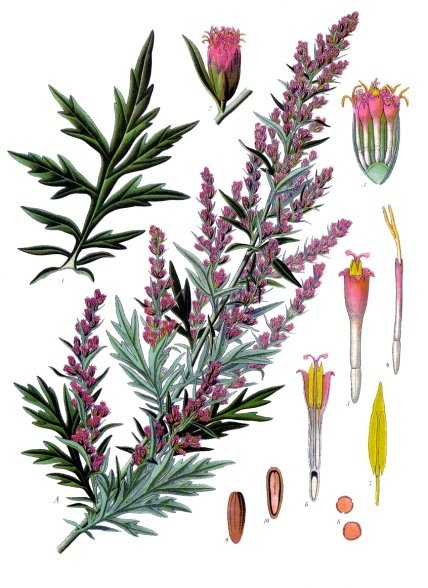
Mugwort (Artemisia spp.)

As a profoundly magickal herb, you find Mugwort showing up again and again at sabbat celebrations. As a magickal herb, Mugwort brings on visionary states whether through dream or trance. Use it in dream sachets and visionary teas. The herb has a special affinity to womyn and womyn’s rituals and communities, especially in rites of Artemis. Use in charms to bring those who have acted violently towards womyn to justice and offer healing to those harmed. Remember, too, that Mugwort is an herb freed from the confines of womyn as gender making it delightfully disruptive to the gender binary. Wash your scrying mirrors and crystal balls with a strong infusion of Mugwort and Wormwood (Artemisia absinthium) for consecration and blessing. Add it to traveling charms (including trance traveling charms) and use it in your shoes to protect against weariness. Burn as an incense when your home is threatened by impending danger or simply needs to have its wards reinforced.

Ancestral Herbs

What herbs these might be depend on your ancestral and cultural lineage. Rue, for example, is a sacred plant for Italian witches as well as Mexican curanderas. Elder is the Goddess embodied in Northern European myth. Kava is a powerfully sacred plant in many Polynesian cultures. Take some time to learn about the ancestral plants of your lineage. Decorating your altar with ancestral plants and consuming them in brews can be a powerful way to connect with those who have gone before. Working with plants at Samhain can be especially powerful when there has been ancestral trauma due to separation or forced migration - the names and stories that we might have forgotten or never known are never forgotten by the plants. 

Make sure to read the Scorpio Astroherbology Profile for even more inspiration for working with herbs and healing during the season of the scorpion. Cast some cards with the Samhain tarot spread and get settled in to the season of spooky. Wherever your revelries take you, I hope that you find yourself in midst of enchantment and wonder as the dark calls the song from your starry-hearted spirit.


We respect your privacy and will not share your information with anyone no matter how much they love Samhain.

Thank you for signing up for Magick Mail! The digital owls have been dispatched. Once you have confirmed your subscription to the list you will gain access to our member's only apothecary!

5 Likes
categories / astroherbology
tags / samhain, lunar samhain, halloween, hallows, all hallows day, all hallow's eve, rosemary, mugwort, blessed thistle, scorpio, astrology, astroherbalism, astroherbology

Herbs of the New Moon

September 29, 2016  /  Alexis J. Cunningfolk

By the light of the New
we renew and grow...

With the popularity of my Making Medicines by the Moon post, I thought I would follow-up with a series of posts exploring herbs of each Moon phase, staring with the New. I've also added a very brief look at the original Greek Medicine Energetics which informs some of the ways that Traditional Western Herbalists categorize herbs by the Moon. Looking for a deep dive into the energetics of Traditional Western Herbalism? Come this way.

Herbs of the New and growing Crescent Moon are excellent for most any remedy-making endeavor as the power of the brew will grow with the Moon’s waxing. Remedies such as stimulating brews, warming bitters, energizing nervines, restoratives, alteratives, and remedies for new beginnings, for children, and to jumpstart vitality are especially auspicious. 

Traditionally, the New Moon is a time of hot and moist herbs. The tradition I am referring to is Greek medicine with its four element system of earth, air, fire, and water and its corresponding qualities (or energetics) of cold, dry, hot, and moist. The Moon was linked to the seasons of the solar year. The New Moon, representing a time of birth, youth, and vigor, straddled the season of spring into summer which moved from the time of water (represented in the west as the time of spring) to the time of fire (represented in the south as the time of summer).

Side note: If you’re a modern Pagan (like myself) who works with the common elemental correspondence system where east is the direction of spring and air and west the direction of autumn and water you’ll have to do a bit or rearranging in your brain to grasp this system.

greek four elements energetics

When I correspond herbs to Moon phases I don’t rely solely on the traditional categorization of herbs by their temperature and quality. Instead, I incorporate my knowledge of the magick of each herb as well as its medicinal uses and the energetic signature of each Moon phase, which you can learn about in my original post on making medicine by the Moon.

I also work with the six tissue states of Traditional Western Herbalism (TWH) which builds upon the Greek system while incorporating Galenic (as in the Roman herbalist Claudius Galenus), Culpeperian (made that term up, but I am referring to English herbalist Nicholas Culpeper), and the United States physiomedicalism tradition (aka reformed Thompsonianism which was begun by US American herbalist Samuel Thompson and refined by Dr. Alvah Curtis and further codified by Dr. Joseph M. Thurston). I highly recommend studying Matthew Wood’s The Practice of Traditional Western Herbalism: Basic Doctrine, Energetics, and Classification for an in-depth understanding of tissue states. The six tissue states have various names, but I use the following combination names which link back to the original Greek quality system while incorporating more modern physiomedical actions. I will also include the other names that you might find these tissue states referred to in your studies.

The Six Tissue States of Traditional Western Herbalism

  • Hot/Excitation (Irritation, Choleric)

  • Cold/Depression (Melancholic)

  • Dry/Atrophy (Atrophic, Sanguine)

  • Damp/Relaxation (Lax, Atony)

  • Damp/Stagnation (Torpor, Torpid, Bad or Impure Blood, Phlegmatic)

  • Tense/Constriction (Wind, Sanguine)

Since I also work with the tissue states and Lunar magick, I am interested in experimenting with the tissue states in correspondence with the Lunar phases. It is an ongoing process, and I am not seeking hard rules but general guidelines. Here are my following New Moon tissue states correspondences:

The New and growing or waxing Crescent Moon strengthens the Hot/Excitation and Damp/Stagnation tissue states.

The New and growing or waxing Crescent Moon alleviates the Cold/Depression and Dry/Atrophy tissue states.

I wrote about the tissue states briefly in Morning Mischief, but I’m currently writing up a tutorial that I have been teaching to my offline students on using the six tissue states of TWH and incorporating astroherbology for the Lunar Apothecary. It has been a really fun ongoing experiment and one that has proven useful again and again in my practice.

Herbs of the New + Waxing Crescent Moon

Milky Oats (Avena sativa) : Oats are not generally associated with the moon, but as a warming and moistening nutritive tonic that builds the blood and alleviates nervous exhaustion, I find Oats to have a special affinity for the New Moon. As the New Moon calls us to begin a cycle of emergence and to slowly expand our energy after a period of waning contraction, Oats are richly nutritious, lending us foundational strength for the work ahead. The generous nutritive qualities of Oats give us a hint to its magickal uses, too, which are primarily for prosperity and abundance rituals. Read the full Milky Oat plant profile.

image via botanical.com

image via botanical.com

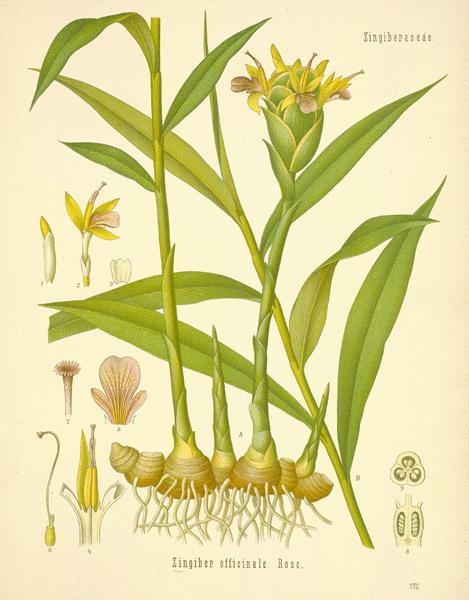
Ginger (Zingiber officinalis) : Ginger root stimulates an underperforming circulatory system, moving blood and heat throughout the body. Ginger awakens the senses and calls the body to action! It clears out lingering colds, damp conditions, clears catarrh, and lifts the spirits wherever dourness or melancholy might dwell. If you want to use the heating properties of Ginger, but are someone who already runs dry, reduce the Ginger content of your brew while adding in moistening herbs like Milky Oats or Angelica.

Blessed Thistle (Cnicus benedictus) : Blessed Thistle can be a great choice when you want to take advantage of the clarifying and clearing energies of the New and growing crescent Moon. The eliminatory powers of Blessed Thistle act as a purifier of the blood. In combination with its skin-opening diaphoretic properties, Blessed Thistle helps to re-establish balance or homeostasis in the body. The herb is also a nervine and can be used to relieve spastic pain and headaches, especially when brought on by nervous tension. Blessed Thistle relieves brain fog and has a markedly uplifting effect, perfect for greeting and working with the energies of the New Moon. 

image via botanical.com

image via botanical.com

Lavender (Lavandula officinalis) : I love Lavender for all phases of the Moon, but for the New Moon I think of it as a great nervine for the performance anxiety that the energy of the New Moon can bring on. For some of us new beginnings are a welcome change of pace, whereas for others it is a big cave o’ uncertainty. Wherever you may fall, Lavender can soften the sharper edges of the Moon’s slicing crescent energy, helping us to focus on what needs to be done without getting overwhelmed by the details.

Angelica (Angelica archangelica) : Angelica is another example of an herb that falls under the traditional interpretation of a New Moon herb as hot and moist. Angelica is more warm than hot but were still in the same neighborhood. I’ve posted a full plant profile on Angelica as part of my Plant Ally Project: 30 Day Challenge.

Need more Moon medicine and magick in your life? Heck yeah! Join me and a circle of starry-hearted magick-makers in the Lunar Apothecary.

Look for my posts on each phase of the Moon and their herbal correspondences in the coming months. In the meantime, have fun reading up on the art of astroherbology or making your own herbal remedies.


We respect your privacy and will not share your information with anyone no matter how new their Moon is.

Thank you for signing up for Magick Mail! The digital owls have been dispatched. Once you have confirmed your subscription to the list you will gain access to our member's only apothecary!

2 Likes
categories / astroherbology
tags / moon, lunar wisdom, lunar apothecary, moon wisdom, moon magick, lunar herbs, moon herbs, astroherbology, astroherbalism, medical astrology, astrology, oats, milky oats, ginger, lavender, angelica, blessed thistle

Sustaining the Spirit : Elecampane Plant Profile

September 16, 2016  /  Alexis J. Cunningfolk

How could I resist sharing with you an herb which possesses the common name of Elfwort?

I can't resist, so I won't. 

There are herbs that work better over the long-run (such as Hawthorn Crataegus monogyna) and there are herbs that work very effectively in a short amount of time. Elecampane is one of those quick-acting herbs (as quick and sudden as an elf shot, perhaps?) and when someone is struggling with chronic congestion, Elecampane is one of my go-to allies. 

The magick of Elecampane is not often as celebrated as other herbs which is strange considering its common name of Elfwort is a big ol' rainbow flag sign of its enchantment. It is the type of herb that I find I use again and again in my practice because of the type of folk that I often work with - those wild-ones and edgewalkers who sometimes have difficulty resettling in their bodies (my beautiful fae, wonderkin, and changelings). 

So enjoy learning about the healing qualities of Elecampane and be sure to share your own Elfwort stories in the comments below.


Common + Folk Names : Elfwort, Elf Dock, scabwort, horseheal, horse elder, velvet dock, marchalan, wild sunflower, raiz del moro, helopia

Planet : Mercury, Sun, Uranus

Element : Earth

Sign : Gemini (Guardian Herb), Aquarius (Remedy Herb), Pisces (Remedy Herb)

Moon Phase : Waxing Quarter (Learn more about making medicine by the Moon)

Parts used : Roots (predominantly), leaves, and flowers.

Habitat : Perennial native to Europe and Russia. 

Growing conditions : Prefers poorly drained sites such as damp pastures, roadside ditches, and waste spaces.

Collection : Collect the roots during the fall.

Flavor : Bittersweet, pungent

Temperature : Hot

Moisture : Dry

Tissue State : Damp/Stagnation, Cold/Depression

Constituents : Calcium, magnesium, inulin, mucilage, azulene, camphor, helenin, lactones, sterols, sesquiterpenes.

Actions : Alterative, analgesic, anthelmintic, antibacterial, antifungal, antiparasitic, antiseptic, antispasmodic, antiscorbutic, antitussive, antivenomous, aperient, aphrodisiac, aromatic, astringent, bitter, bronchial dilator, cardiotonic, carminative, cholagogue, diaphoretic, digestive, diuretic, emollient, emmenagogue, expectorant, febrifuge, hemostatic, hepatic, immune stimulant, pectoral, restorative, stimulant, stomachic, vulnerary.

Contraindications : Avoid during pregnancy and breastfeeding. Large doses may cause gastric spasms, vomiting, diarrhea, and allergic hypersensitivity. Some rare cases of temporary paralysis.

Drug interactions : None known.

Recommended Dosage : 2 tablespoons root decocted per 1 cup water, 1 - 3 cups daily. 3 - 30 drops (Fresh root, 1:2 or Dry Root, 1:5, 60% alcohol) three times daily.

image source

image source

Main Uses

A traditional Latin prescription for Elecampane reads “Enula campana reddit praecordia sana” or Elecampane will sustain the spirit. One of the supreme lung tonics in Traditional Western Herbalism, as well as a deeply antiseptic and antibacterial herb, Elecampane root is extremely useful stimulating expectorant for cases of chronic lung complaints, especially when infection is present. Use for chronic imbalances of the lungs including tuberculosis, asthma, pneumonia, catarrh, general congestion, respiratory infections, and coughs. The herb is a powerful astringent and expectorant, helping to loosen phlegm and catarrh from the respiratory system and then pull it from the body. Elecampane has long been used in the treatment of tuberculosis and specifically inhibits the growth of tubercle bacillus. Whether or not infection is present, one of the signs that Elecampane may be useful is a stubborn and spasmodic cough. Look also for yellow and green mucus (a sign of infection) and a cough that is worse at night from lying down. A nervous Aquarian cough which is spasmodic, coming and going. I sometimes wonder if the powerful and painful spasmodic cough may not be the “elf shot” that older herbals warn of and Elecampane is supposed to be protective against. Be aware that the power of Elecampane is to produce a deep and powerful cough to help expel gunk from the lungs - which can seem like the condition has temporarily worsened when, in fact, deep healing is occurring. 

Other respiratory complaints that Elecampane is useful for include pleurisy (another contender for the definition of “elf shot”), shortness of breath, sinusitis, whooping cough, hay fever, and laryngitis. Best suited for cold coughs as opposed to hot ones as the herb is warming. In cases of colds and fevers, Elecampane induces sweating which lowers the temperature. 

The herb is warming and clears out build-up not only of phlegm and catarrh, but general excess moisture and waste throughout the body. It is well suited for individuals who would be considered kapha in Ayurvedic medicine and of a Damp/Stagnation persuasion with tendency to Cold/Depression in TWH.  Elecampane is also useful in relieving stagnant pain such as rheumatism and similar arthritic conditions. If a condition is stuck, tending to coldness, and creating unwanted build-up, consider Elecampane.

As a warming bitter, the herb strengthens weak digestion which is troubled by excess moisture. Look for signs of bloating, belching, and fullness caused by excess mucus and edema. Elecampane helps with the metabolism of fat as well as generally enhancing digestive circulation. The high inulin content of Elecampane helps to manage blood sugar as well as being a tonic to the pancreas. Inulin is a very nourishing polysaccharide, assisting the restoration of an exhausted body through nourishment. Works to clear out nematode and protozoan infestations including roundworm and giardia. The root has also been used in the treatment of candida and other systemic imbalances, as well as restoring the health of someone suffering from chronic poor health and nutrition. Elecampane’s powers of expulsion are also useful in bringing on delayed menses, helping with labor, and birthing the placenta.

The plant has an interesting aphrodisiac affect. While some cite its use for increasing libido my experience with Elecampane is that its powers as an aphrodisiac lie in its ability to help bring the heart spirit to the body. I especially see this when folks are caught between the worlds for whatever reason - they are in the period of a great transition, they were born a bit between or they have stumbled too far into the realm of the Good Folk. Read more about the story of Helen of Troy, of whom Elecampane takes its Latin binomial, to learn more about the spiritual pain that Elecampane is well-suited for relieving. 

Topically, use as an insect deterrent both on the person and hung around your space. Elecampane will also relieve the sting of Nettle (Urtica dioica). Use in baths and steams for relieving congestion and pain. Create a facial wash for acne and facial pain. Since Elecampane helps to clear toxicity from the body, it works internally, too, to help alleviate skin conditions such as acne, eczema, and psoriasis. 

image source

image source

Magickal Uses

Russian name for Elecampane is de-via-sil which apparently means “magic power” but as my Russian is non-existent I can neither deny nor confirm this fact. What it does suggest is that Elecampane’s reputation as a magickal herb, especially one associated with the Good Folk, is far flung. Use to awaken the second sight and lines of communication between you, the Good Folk, and local land spirits. The herb is strongly protective and can be worn as an amulet. The root can be burned as a protective incense and to neutralize negative energy. Elecampane is specifically protective against the elusive but powerful elf shot.

It's Mercurial nature lends itself well to trancework and shifting shapes. Since it is an herb of Mercury it is also associated with the Magician card in Tarot. Given the trickiness of the Magician (who sometimes appears as one of the Good Folk pretending to be a humyn and hiding behind a stage act of magick to disguise themselves), I find this association apt.

The herb enhances psychic powers, especially the ability to perceive the Good Folk. Traditional use in love charms as well. The herb is also associated with horses and so can be used when connecting to the power of our equine kindred. Herbalist and astrologer, Elisabeth Brooke, recommends Elecampane for connecting with the transpersonal will. Use in baby blessings and connecting with the inner child. Create a homecoming charm with Elecampane to call lost things and people home.

The Elecampane Personality

The Elecampane person has an undernourished spirit in addition to an undernourished body. It may be that they are eating wonderful foods or imbibing in beautiful spiritual practices, but there is so much undigested or un-expelled physical and spiritual decay in their system that they are wallowing instead of feeling fulfilled. They are not quite here. Sometimes this manifests as dullness of the body and spirit. Other times this manifests as a low-level but constant irritation (they have a thorn in their side, so to speak, perhaps an elfshot). Very often, the condition of the Elecampane personality seems quite permanent. But it is not. Elecampane is a heartening plant. There is no infection of the spiritual system that it fears. The herb will help one come home again after a long and arduous journey away from oneself. It restores a lightness of being and warms the cold and distant heart.

image source

image source

Elecampane Recipes

A Popular Combination | Thomas Bartram

Decoction: mix equal pasts; Yarrow, Marshmallow root and Elecampane root. 1 oz (30g) in 1 pint (500ml) water simmered 20 minutes. Dose: half-1 cup, 2 - 3 times daily. In the absence of any one ingredient substitute Wild Cherry bark.

Billie Potts Preparations of Elecampane
from Witches Heal: Lesbian Herbal Self-Sufficiency

{Elecampane} combines well with expectorant herbs such as comfrey or sage. I often use it by preparing a tea of comfrey or coltsfoot or mullein-sage and put 3-5 drops of elecampane tincture into the tea. For dealing with pneumonia infections I’ve had good results with elecampane and echinacea augustifolia tinctures in a comfrey or comfrey-sage tea. Any combination of an entrenched bacterial nature needs a “course” of treatment.

Elecampane Syrup | Nicholas Culpeper

The fresh roots of Elecampane preserved with sugar or made into a conserve, or a syrup, are very effectual to warm a cold windy stomach and stitches in the side, caused by the spleen and to relieve coughs, shortness of breath and wheezing of the lungs.

How will you be using Elfwort in your practice?

Maybe it will become one of your indispensable herbs? Or part of your winter wellness regimen? It is a great herb to make friends with, especially if working with local land spirits is part of your practice.

Signature Summer 2019.png
 
MagickMailAd 2019 hag.png

We respect your privacy.

9 Likes
categories / plant allies
tags / plant profile, plant ally, plant medicine, herbal medicine guide, herbal medicine, elecampane, elfwort, astroherbology, astroherbalism, medical astrology, inula helenium, elf wort, magickal herbology, magickal herbalism, magickal properties of elecampane, medicinal uses of elecampane
Newer  /  Older

© 2010 - 2025 Worts & Cunning Apothecary | All Rights Reserved | Disclaimer | Land Acknowledgement
. live your magick .