
Winter's Herbal Magick: Making Traditional & Modern Folk Charms
I've lived through all sorts of winters - from the mild winters of the southlands to the deep winters in the northeast kingdom and a lot of winter lands in-between. It's in these winter months that some of my most cherished memories have been made - from the way that gatherings feel like a triumph in a snow-dense city to mild sunny days of exchanging gifts to the exhilaration of the most familiar places becoming something new and unfamiliar beneath a layer of frost. Winter reminds me of how dependent we are on one another - and that feels like an empowering spell of connection that I'm always eager to learn more from.
In the fourth part of my Seasonal Magick series we'll be exploring three folk spell traditions, incorporating plant allies of winter to aid us in our magick. From a witch's ladder that connects us to our ancestors to a witch's bundle to invite in rest and a witch's bottle for growing hope, these three herbal charms are easy to make, tap into our legacy as magickal practitioners, and help us to connect with the energy of the season. To find the full introduction to this series and why I love simple folk magick so much, including additional insight into each of the three traditional charms we'll be exploring, come this way.
So let's explore how we can create witch's ladders, bundles, and bottles as one of the ways to connect with the seasonal rhythms of the year and our beloved plant allies.
The Witch's Ladder
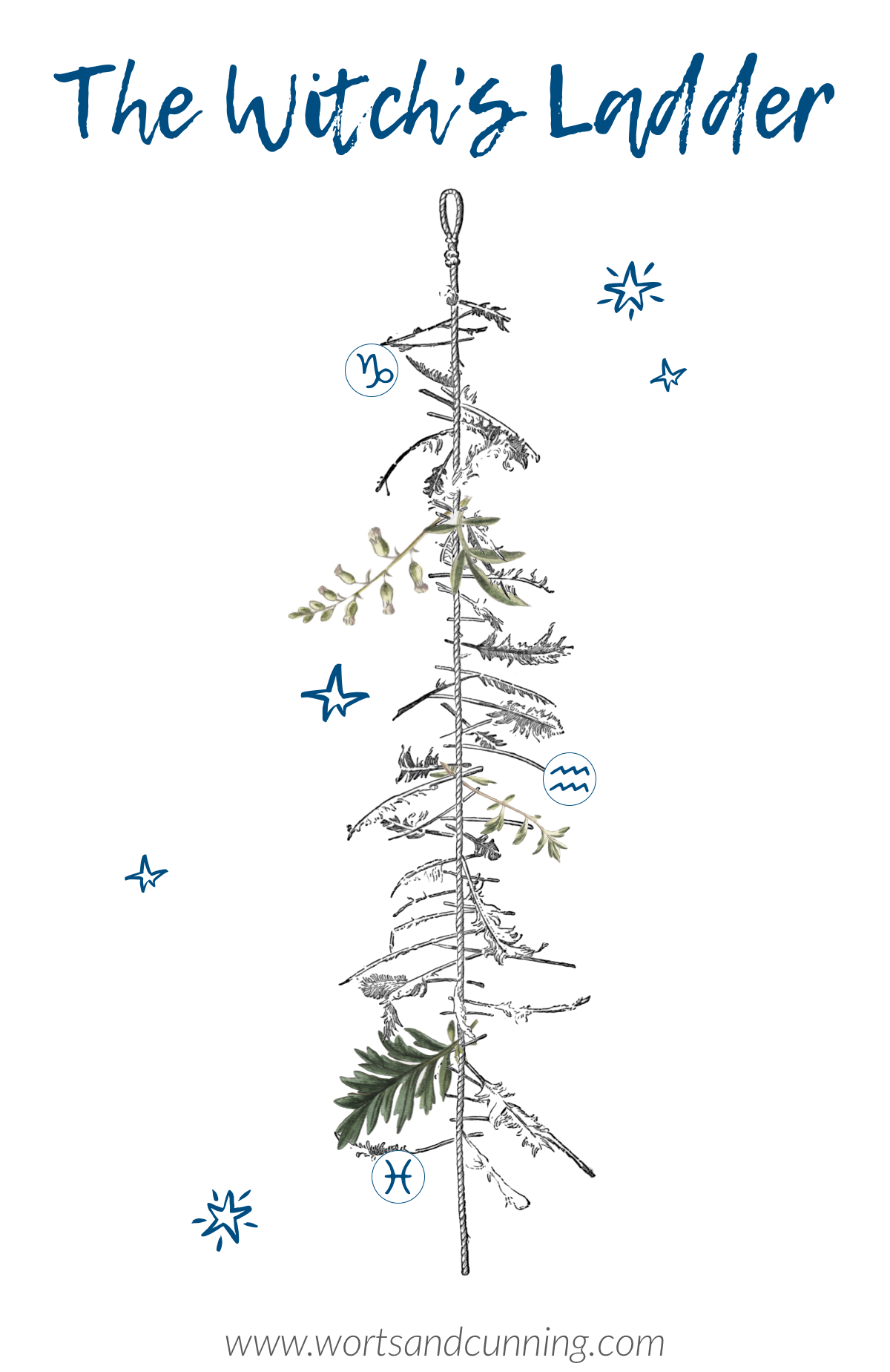
Traditionally made of woolen cord, rope, woven thread or hair and knotted with items like feathers, holed stones, sticks and bits of metal, witch's ladders are a beautiful form of magick that combine charm-making with knot magick and weaving spells. The witch's ladder has remained popular among modern practitioners, supported in part by the Priestess Doreen Valiente's Spell of the Cord, an inspired modern variation of older forms of spoken knot magick. Energetically, they can act like a net, gathering up energy to hold in place and to either be drawn upon (in the case of beneficial energy) or released elsewhere (in the case of baneful energy).
A Witch's Ladder To Honor Ancestors
Winter starts with the end of the bright half of the year at Samhain, where the land of the living and the lands of the dead mingle. For the next few weeks, the wild hunt rides the sky, finding lost souls and bringing them to the feast table at Midwinter - reminding us that no one is ever truly lost and that there is room for all at the table. I embrace the ways that the dark days of winter can make it easier to connect with those who have gone before and my favorite style of witch's ladder for winter is one that reminds us of our connections to our ancestors.
In the Anglo-Saxon tradition, of which the traditional western herbalism that I practice partially descends from, Mugwort (Artemisia vulgaris) is honored as "Una, oldest of herbs."¹ An herb of dreams and visions, Mugwort is primarily used as a uterine tonic in traditional western herbalism, a place that sits at the crossroads between life, death, and renewal in the body. For ancestral practice, working with Mugwort feels like tugging at the web of life and to feel your ancestors tugging back. Of course, if there is a significant ancestral herb in your practice that you'd rather incorporate than Mugwort, please do, or incorporate it alongside Mugwort.
I love the silver and feathery leaves of Mugwort, how they mimic the feathers traditionally used in witch's ladders of generations past, but if you are only able to find the crushed herb simply tie it up in bundles to tie to your ladder.
A Mugwort Charm
Una, eldest
Ancestors wise
Hearts connect
For the soul never dies
As already mentioned, in addition to Mugwort I encourage you to use herbs from your ancestral line. Other ancient plants, which act as collective ancestors to our species, include Rose (Rosa spp.) and Ginkgo (Ginkgo biloba). You can also bring in the colors of winter, including red berries and green leafy branches of Uva Ursi or Bearberry (Arctostaphylos uva-ursi) and other evergreens. Consider adding charms that connect you to specific ancestors (both mighty and beloved) as well as cultural traditions your ancestors would've been familiar with.
Creating Your Ladder
To create a witch's ladder use cord, thread or yarn to braid or not your chosen objects into a long hanging cord. How long you make your witch's ladder is up to you, but I find that they work better when shorter when being hung outside and can be a bit longer when keeping it inside. I like to start by laying out all objects I'll be tying into my witch's ladder before me on my altar, blessing them with the four elements of fire (candle light), air (incense), water (water infused with flower essences or salt), and earth (sprinkling herbs over the items or laying the items on a stone surface). I like to use some variation of a cord charm when knotting my items, like Valiente's or the one written above, changing the language for my needs.
Once all items are added, the witch's ladder can be hung up by an altar, window or door. For a spring witch's ladder I like to make ones that'll either hang just outside my door or beside a window, so that the ladder is able to dance in spring's winds.
You can add extra magick to your summer witch's ladder, by placing it in a sunny spot at the height of noon for a few minutes to charge up - better yet is it is surrounded by a circle of quartz crystals. Over the next year, I like to use pass my witch's ladder over my deck of tarot cards or other divinatory tool before doing a reading when I feel like I need an extra boost of illuminating clarity.
The Witch's Bundle
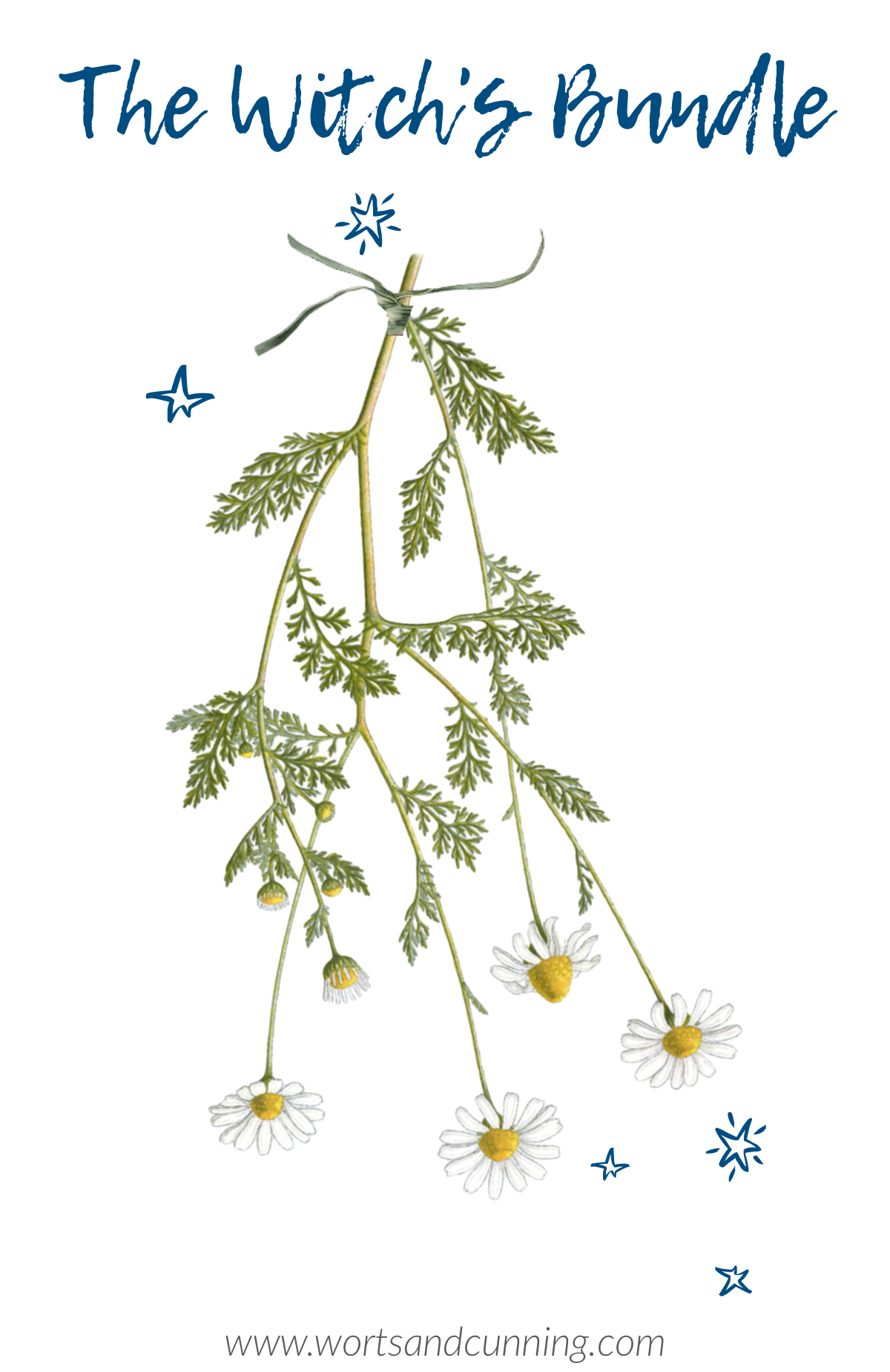
The simplest of our three traditional folk magick charms, a witch's bundle is a collection of exclusively or mostly plants with other items (such as old skeleton keys, a nice stick, a hunk of rock) tied up together and hung up above a door (or bed or other auspicious place). Witch's bundles, like all of the magickal crafts listed here, can be endlessly personalized to match your need, your aesthetic preferences, and reflect your relationships. If you're studying a particular plant ally you might include them in your witch's bundle (if the herb has already been dried and processed, you can add some into a little pouch and tie it to your bundle). If you are working with a deity that is fond of one particular color, choose that color of cloth or string to tie up your bundle. If you're a cool goth witch, add the skulls and gothic crosses to your bundle of dried Rose (Rosa spp.). Let yourself enjoy the process of finding your creative magickal expression - it helps you understand better what it you're using magick for in the first place.
The Witch's Bundle To Invite In Rest
Learning how to work with the tides of magick flowing through the year, is to work with the flow of seasonal energy, softening the edges of counter-current in our life as much as possible. Winter is a time of rest, of long nights filled with longer stories, and finding one another in the dark. For winter, I like to create witch's bundles that help me invite rest into my life as an honored guest instead of trying to outpace them through overwork.
Chamomile (Matricaria recutita) is an excellent plant ally for the overworked, the overtired, and the cranky - and given that many of our winters can be filled with an excess of social obligations, it's a great ally for the season. One of the healing gifts of Chamomile is its relaxing influence on the nervous system, making it a popular before-bed tea (the fact that it's an excellent post-meal digestive aid helps, too). I love that Chamomile looks like sweet little suns, a perfect addition to Midwinter festivities of welcoming back the tiniest star of light during the longest night of the year. Chamomile, as a plant ally of rest, helps us to soften habits of pushing past our limits of rest to find ourselves irritated, angry, and exhausted and draws us towards reconnection to our inner cues for rest.
A Chamomile Charm
Every night, every day
I honor rest along my way
Every blossom, every light
I call in rest each day, each night
Additional herbs to consider include Lavender (Lavandula spp.) and Lemon Balm (Melissa officinalis). Adding items that help you feel restful and relaxed, from cozy scents to using restful colors, as well as including symbols like moons, stars, and other objects that represent rest and stones that exude a restful aura like Moonstone and Amethyst.
Creating Your Bundle
Bless all your objects as described in the above section "Creating Your Ladder." Once you've collected all of your items (such as a few sprigs of Rosemary), use a colored thread or ribbon of choice to tie up your bundle. I like to tie the top part and leave the rest loose, but you can tie up everything from top to bottom. The advantage of the latter technique is that you can tie larger objects inside the bundle, even hiding them from view if that's your preference. Once tied up, hang the bundle above an altar, door, or window.
The Witch's Bottle
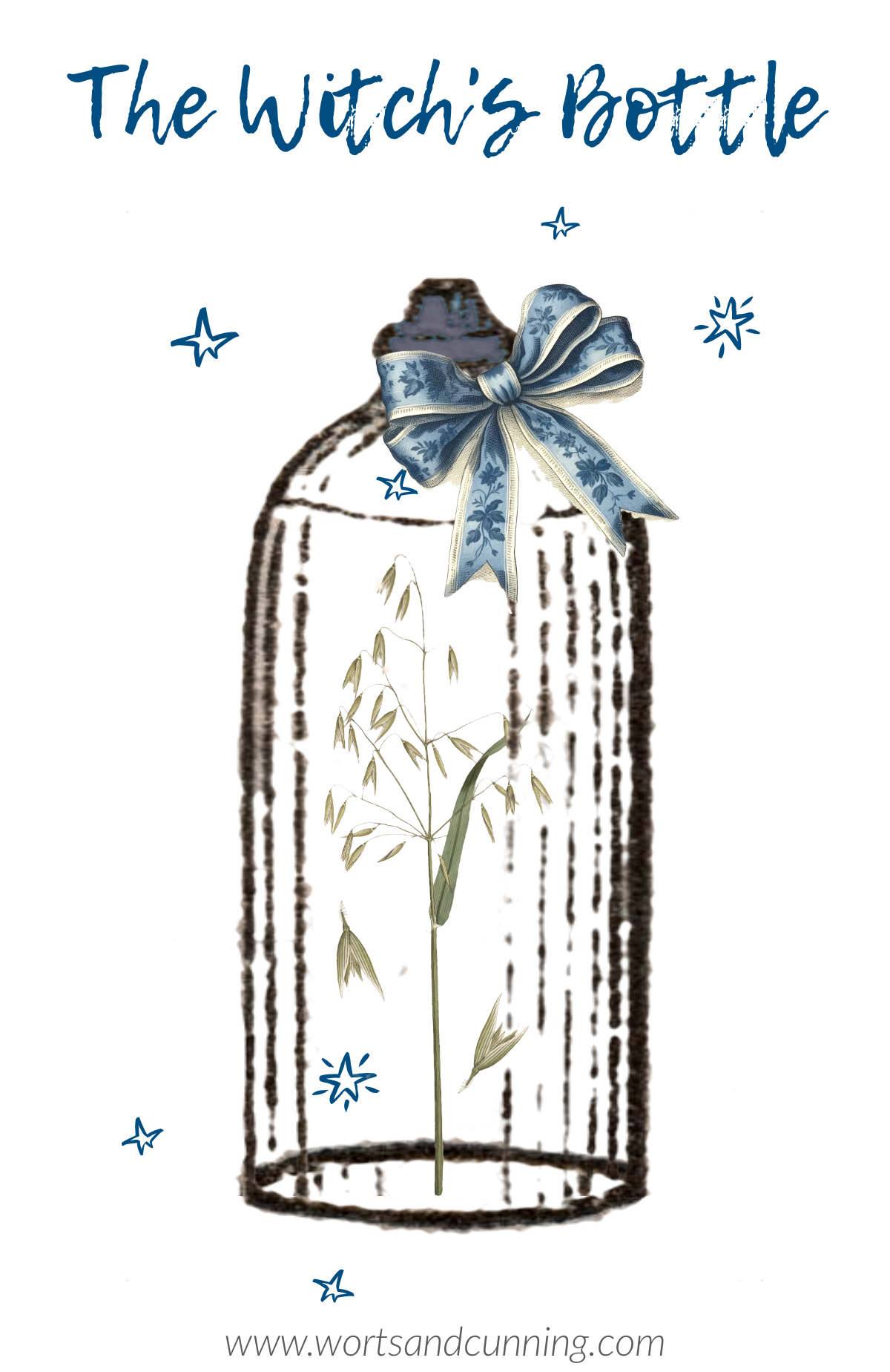
Traditionally, witch's bottles or jars were buried or hidden away from view in the back of cupboards, sometimes even between walls, beneath floors, or high up in the attics. They embody the magickal practice of doing the work and then letting it be, allowing the magick to continue to unfold in its own time. Sometimes jars are made for a short period of need (such as a honey jar for attracting a job) and then the contents are offered back to the earth, while others are more permanent and meant to be mostly forgotten. Other times, jars and their contents can be renewed on a regular basis (such as at the Full Moons or the sabbats). Energetically, witch's bottles tend to act like generators, helping to generate an outcome or a specific type of energy.
A Witch's Bottle To Grow Hope
The long dark of winter can be a stark reminder of how vulnerable all of us and all the places and people we love are. It feels especially challenging to try to cultivate hope during times we are living through (fighting through, struggling through) right now. There isn't any single magickal herb that can force hope to grow in our exhausted spirits. But hope is a practice, and plants are allies, and we can create reminders around and within us to practice our hope, connect with allies - plants and beyond - and let hope flow through us and into the lives of others as the infinite resource that it is.
Milky Oat (Avena sativa) is not just one of my favorite nervous system tonics, it is one of my most beloved plant allies for hope. The common herb is one of the best nervines I know, helping to restore the nervous system after a period of stress - it is probably one of the most commonly recommended herbs in my practice - and it has been used for centuries within traditional western herbalism to help alleviate suffering brought on by emotional and mental distress. Working with Milky Oat feels like carrying seeds of possibility in our hearts, helping us to connect with our resilience, and in its wild wisdom, drawing us towards the people and places that have the most space for us.
A Milky Oat Charm
A wild seed of hope
planted in my heart
Fed with the nectar of love
Every darkness bright
With the promise of a star
Held up with the strength of love
Other herbs to consider are Linden (Tilia x europaea), Motherwort (Leonurus cardiaca), and Hawthorn (Crataegus monogyna). I love adding stones and flowers and anything into this jar that makes me smile and makes me want to pause and spend a moment in gratitude (a hope-generating practice).
Creating Your Bottle
Bless all your objects as described in the above section "Creating Your Ladder." Make sure you have a tight sealing bottle or jar so to prevent items from leaking out if you are using any fluids or from pests getting in. Add your herbs and charms in one-by-one, naming their purpose as you go, and then you can seal your jar with wax or tie it up with ribbon to seal in or bind up the magick. Once completed choose where your bottle is going to live, whether in the house, mode of transportation, place of school or work or buried (especially good for banishing magick, though make sure all items are biodegradable).
🌻
For more herbal inspiration for your summer, how about creating your own winter wellness apothecary? Or a might-do list for the Winter Solstice? I also explore more of winter’s plant allies, healing paths, and magickal ways over here. I’ve also written about some of my favorite plant allies for winter travels.
Check out the rest of the seasonal folk magick series:
Spring's Herbal Magick: Making Traditional & Modern Folk Charms
Summer’s Herbal Magick: Making Traditional & Modern Folk Charms
Autumn's Herbal Magick: Making Traditional & Modern Folk Charms
I hope you’ve found inspiration for your own winter magickal practices and feel a little more connected to season of slowing down and exploring within.

This post was made possible through patron support.
❤︎ Thanks, friends. ❤︎
📚
Footnotes
1. J. S. Hopkins, "Nigon wyrta galdor, popularly known as the Nine Herbs Charm: a new annotated and illustrated translation," 2020, https://www.mimisbrunnr.info/nigon-wyrta-galdor (accessed July 2022).
