
The Gifts of Summer: An Herbalist’s Perspective
Every season holds a song, each of us carrying a basket-full of lyrics gathered from where we’ve been, pulled from dreams of what we might become. Our lyrics are gathered from cultural wisdom, spiritual tradition, family inheritances, friend-group celebrations, national holidays, and more. Sometimes we don't know how something ended up in our seasonal basket, other times we know exactly when and where we carefully placed a word in our bundle.
As I was writing The Apothecary of Belonging: Seasonal Rituals & Practical Herbalism, I thought a lot about the stories that shaped me in my early days of not-quite-a-teen witchcraft and early herbal practice. They were stories full of wildcrafted words that described gatherings of magickal folks, ruminations of druids, mythmaking of queer witches, discordian glitter rituals, and the power of ritual as resistance. Working within a word count (what tis a word count? I wondered, adding yet another podcast, nary a thought to words or their counting) and trying to write a book that felt relatively cohesive, I eventually decided to focus some of my effort on a handful of words to draw upon for each season. These words like gratitude and shelter are ones that inform my personal herbal practice but felt broad enough to both work for many and, more importantly, inspire folks to rummage through their year-wheel baskets for the lyrics of their own seasonal songs.
What follows is one part from the summer section of my book, where I explore a theme of the summer season that shapes how I work as an herbalist and magickal practitioner with an earth-centered practice. My hope is to inspire folks to spend time reflecting on the roots of their own practices, the lyrics, ideas, and myths of each season that they've inherited through their upbringing, and the underlying energies which support their longevity as practitioners.
So, friends, join me on the path of gratitude as we wonder through the heat and shade of summer, meeting ancestral plant allies, and finding reverence for our interconnectedness.
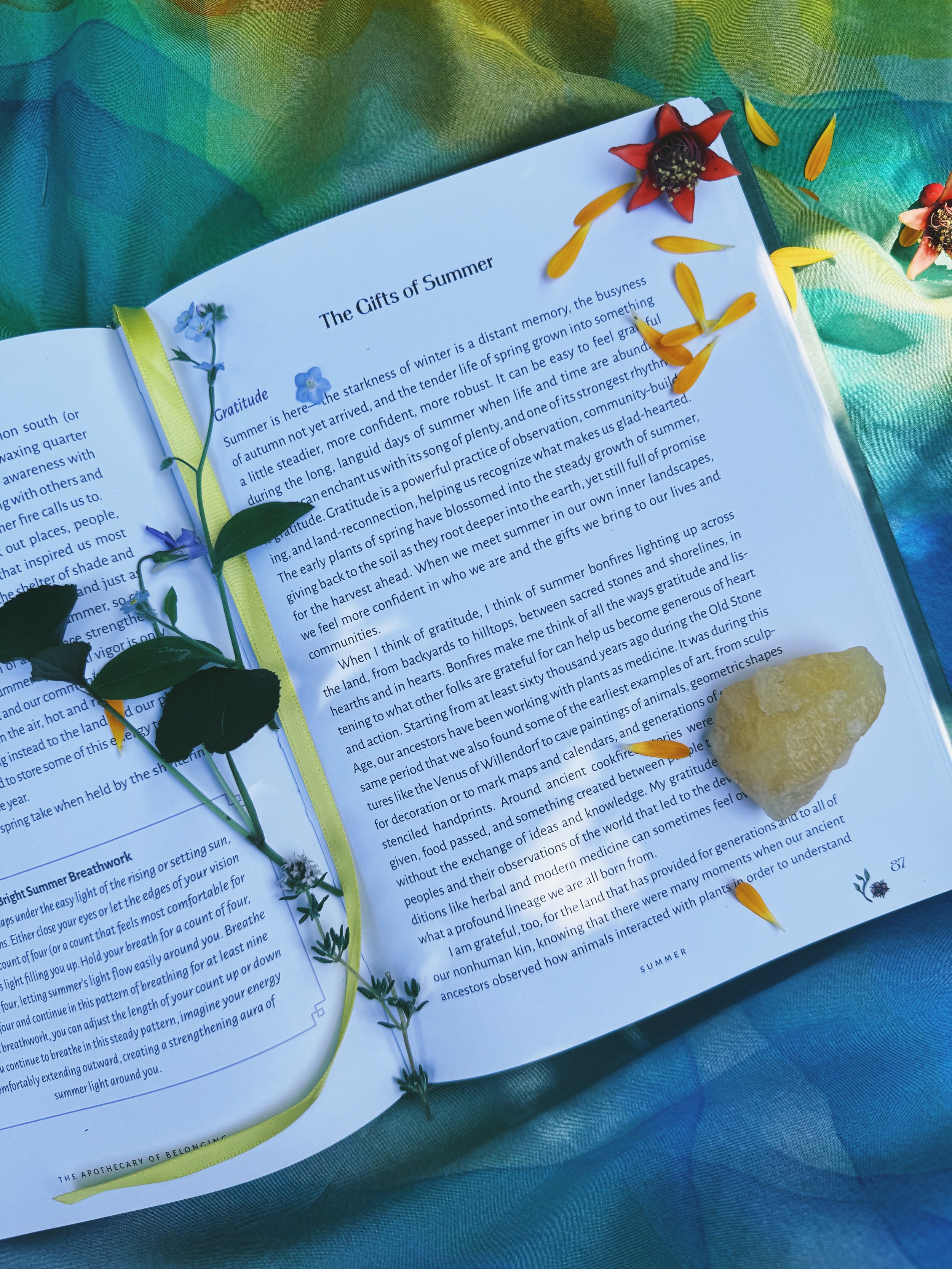
Book shown is The Apothecary of Belonging
Gratitude
Summer is here - the starkness of winter is a distant memory, the busyness of autumn not yet arrived, and the tender life of spring grown into something a little steadier, more confident, more robust.
It can be easy to feel grateful during the long, languid days of summer when life and time are abundant. Summer can enchant us with its song of plenty, and one of its strongest rhythms is gratitude. Gratitude is a powerful practice of observation, community-building, and land-reconnection, helping us recognize what makes us glad-hearted. The early plants of spring have blossomed into the steady growth of summer, giving back to the soil as they root deeper into the earth, yet still full of promise for the harvest ahead. When we meet summer in our own inner landscapes, we feel more confident in who we are and the gifts we bring to our lives and communities.
When I think of gratitude, I think of summer bonfires lighting up across the land, from backyards to hilltops, between sacred stones and shorelines, in hearths and in hearts. Bonfires make me think of all the ways gratitude and listening to what other folks are grateful for can help us become generous of heart and action. Starting from at least sixty thousand years ago during the Old Stone Age, our ancestors have been working with plants as medicine. It was during this same period that we also find some of the earliest examples of art, from sculptures like the Venus of Willendorf to cave paintings of animals, geometric shapes for decoration or to mark maps and calendars, and generations of stamped and stenciled handprints. Around ancient cookfires, stories were shared, advice given, food passed, and something created between people that wouldn’t exist without the exchange of ideas and knowledge. My gratitude for these ancient peoples and their observations of the world that led to the development of traditions like herbal and modern medicine can sometimes feel overwhelming - what a profound lineage we are all born from.
I am grateful, too, for the land that has provided for generations and to all of our beyond-human kin, knowing that there were many moments when our ancient ancestors observed how animals interacted with plants in order to understand their uses. It is incredible what knowledge has survived, shared first by storytelling and in the libraries of cave art. Cultivating a gratitude practice is a powerful act of ancestral healing, and it can help to work with plants that have been on our planet for millennia, such as Rose (Rosa spp.) and Ginkgo (Ginkgo biloba), when trying to connect with our long human legacy.
image via @jessicafadel
I was first introduced to the practice of gratitude as a teenager, reading in one of my books on magick about how gratitude was recognizing the abundance that already existed in your life in order to grow more of it. Every evening before bed I would link paper clips, each representing something I was grateful for that day. These long lengths of little metal clips helped me notice and hold in my hands - and begin to feel in my body - those things that held me in my life, softening the shoulders of teenage angst, giving myself some perspective, and eventually leading me to explore the world of class, access, and the politics of labor throughout my youth and young adulthood. Gratitude is a skill that can be developed, giving people of all ages, but especially younger ones, the space to get to know themselves as individuals while recognizing cohesive family and community structures for them to thrive in as interconnected and beloved members of a greater whole.
For too many of us, though, the closest we got to a gratitude practice was through being instructed (mostly by older folks in positions of authority) to be grateful for whatever it was they provided. Being “grateful” in these circumstances was a way to force conformity rather than an invitation to an actual connection. In its more pernicious form, demands for gratitude from those around us can take on an air of toxic positivity or be a thin excuse for abusive situations. Untangling the “you should be grateful” pattern is an important part of developing a true embodied gratitude that protects us from developing a hostility towards sharing the abundance of our ocean planet. A gratitude practice should be an invitation to expansiveness and a way for the land of our bodies to experience the vital wellspring of summer’s long-lasting hope.
Sometimes, the idea of a gratitude practice feels less like a gentle summer stroll and closer to feeling exposed under the scorching midday sun. Gratitude can be a challenging practice because it is an exercise in observation, recognition, and naming, leading us to consider our inner and outer worlds with more nuance, recognize what feels abundant and lacking in our life, and name why that is. For folks just starting to explore the dynamics of access and oppression, institutional and interpersonal systems of power, and our many identities - all of which are necessary for creating an enduring healing practice - I encourage developing a gratitude practice because it can be all too easy to get lost in an ocean of guilt, despair, and/or shame when we don’t have sight of the shoreline.
And all these brave explorations, these complex experiences of inheritance and lived experience, and these generations of trauma intermingled with generations of wisdom can be a lot to hold. Even though our ancient ancestors passed down wisdom, not everything old is good, so traditions need to be renewed through cyclical and collective reexamination. Plant allies like Rose (Rosa spp.), Milky Oat (Avena sativa), Hawthorn (Crataegus monogyna), and Motherwort (Leonurus cardiaca) can help us navigate our experiences and refine our discernment while soothing our heart and nervous system.
image via @a_d_s_w
Gratitude is our sightline, reminding us why we get into the work of restorative healing. With all of its mystery and uncomfortable vulnerability, it is through gratitude that we remember why we are doing all this. Looking out over the land in summer, it can be easy to spot abundance, and just like in the cold depths of winter, under the shadeless heat of summer we can easily identify any lack. Summer is a time of pausing and planning. We can pinpoint where resources are lacking, what needs to be built for the dark of the year, and move together in a spirit of gratitude that helps us to see what skills we already have, while carrying the stories of our ancestors alongside the bold, unhindered wisdom of our youthful descendants. What gratitude in your life helps you keep sight of the shoreline and your safe harbors?
I know so many folks called to the path of healing and restorative justice because of their deep gratitude for the people, places, and nonhuman kin who were there at their most vulnerable moments. Gratitude is hope in action and the foundation of reciprocal relationships, guiding us through some of our most challenging conversations. In my own practice, the opportunities for gratitude are endless! I’m grateful for the trees and hedges that sheltered me as a kid, the people who’ve done this work before me, who taught me how to listen, speak my heart, and spot places for connection. I’m grateful for those who’ve shown up in my consultations and classrooms asking for help and seeking knowledge and those who have made space for me to show up in all my unsteadiness and for being shown when I need to get out of the summer’s glare and into summer’s shade. In my practice of gratitude I try to answer the question: What are the ways that I am showing reverence and gratefulness to the land, the people, and beyond- human kin who I am interconnected with?
🌻
Physically, at the end of spring and beginning of summer, we might need to rebuild our energy after a season of allergens has left us depleted and run-down. Many summer herbs are not only nutrient-dense but reenergizing for our body systems, helping us store vital energy for the rest of the year. Incorporating, as well as making remedies of, nutritive nervines, cardiotonics, and adaptogens can help us flow through summer with ease as well as protect us against illness during colder months.
Find more resources for your summer practice:
☀️ The Plant Allies of Summer: How to Create a Summer Wellness Apothecary
☀️ Sweet Spring, Bright Summer: Herbal Remedies for the Waking Season
☀️ Joyful Summer, Golden Autumn: Herbal Remedies for the Bright Season
☀️ Why Swamp Tea is the Best Tea for the Summer
☀️ Bonfire Offerings: A Summer Solstice Tarot Spread
🌻
I hope you’re inspired to explore the ways you experience summer (or any season) and how this shapes your perspective as an herbalist or plant folk or magickal practitioner. If you like this sort of writing and want to explore more seasonal practices with me, consider checking out my book.
Friends, I hope your summers are sweet and gratitude illuminating life around you with its golden, dreamy glow.

This post was made possible through patron support.
❤︎ Thanks, friends. ❤︎
