• Home
  • About
  • Offerings
    • My Book
    • Magick Mail (It's Free!)
    • The Lunar Apothecary
    • The Tarot Apothecary
    • The Plant Ally Library
    • Solace: Herbs for Sensitive People
    • Begin With the Breath
    • The Green Bottle Method
    • Gatherings
    • Patreon
  • Blog
    • most recent
    • plant allies
    • astroherbology
    • moon studies
    • recipes + tutorials
    • magickal arts
    • tarot + divination
    • sliding scale
    • archive
    • search
  • Contact
  • Search
  • More
    • FAQ
    • Support the Work
    • Calls to Action + Resources
    • Bookshop
  • Home
  • About
  • Offerings
    • My Book
    • Magick Mail (It's Free!)
    • The Lunar Apothecary
    • The Tarot Apothecary
    • The Plant Ally Library
    • Solace: Herbs for Sensitive People
    • Begin With the Breath
    • The Green Bottle Method
    • Gatherings
    • Patreon
  • Blog
    • most recent
    • plant allies
    • astroherbology
    • moon studies
    • recipes + tutorials
    • magickal arts
    • tarot + divination
    • sliding scale
    • archive
    • search
  • Contact
  • Search
  • More
    • FAQ
    • Support the Work
    • Calls to Action + Resources
    • Bookshop

Worts & Cunning Apothecary | Intersectional Herbalism + Magickal Arts

Illumination: A Moon Sign Tarot Spread

January 24, 2024  /  Alexis J. Cunningfolk

Having written about what the Sun represents in our birth chart and how we might explore our energy through a solar perspective, it's time to turn our attention to the other luminary of the birth chart: the Moon. If you want a better understanding of how the Moon, the Sun, and the Ascendant or Rising Sign interact with one another, creating a powerful triad of insight in your birth chart, be sure to check out my first post in this series.

With the Moon we begin to feel our stories, our myths, and our truths. Within the birth chart, the Moon represents the filtering of our consciousness from the deep well of the subconscious, unconscious, and collective consciousness. The Moon represents our earliest experiences of feeling held, sheltered, and nourished (as well as the absence of these experiences), shaping how we view and seek out feeling at home in ourselves in the world. 

I grew up with texts on astrology that far too often dismissively presented the Moon as a weak place of feeling in the birth chart, almost always contrasted in a false dichotomy to the vigorous, unchanging logic of solar thinking. The Sun in our chart could be easily hindered by the Moon's unwillingness to sit still and stop changing - our feelings were something to be fixed so that they didn't disrupt "logical" forward progression. And yet, feeling is the foundation from which thought emerges. Thought emerges not as a refinement of feelings that we should be trying to pull away from, but as an interconnected expression of feeling that helps us to better understand our experiences. 

It is good to be friends with your Moon, to let yourself feel your way to your story.

The Moon is a great symbol of consciousness, feeling, and personal narrative. While the Moon is always full in the sky, we perceive it to be ever changing in light and form, stretching out an invisible influence over big patterns of nature, including the tides and cycles of growth. We have an opportunity to ebb and flow, expand and contract, pull away and draw in as we explore who we are and what we feel about who we are. We don't know how experience will change us, but we know we will be changed. When we sit with our Moon, we sit with the cyclical power of change and renewal as a symbol of hope for what is possible. 

Approaching the Moon in our birth chart as a place of illumination, we can begin to appreciate who we are in the stories we tell, changing them when we need to, and learning more about how we protect our feeling body as much as our mental or physical one. 

Illumination
A Tarot Spread for Your Moon Sign

Begin by pulling the Moon card out from your tarot deck and set it out before you. If you like you can place candles around it and build a lunar altar full of items representing Moon energy and your own Moon sign. You might include lunar plant allies like Mugwort (Artemisia vulgaris), Milky Oat (Avena sativa), Lemon Balm (Melissa officinalis), Passionflower (Passiflora incarnata), and Jasmine (Jasminum spp.). Focus on creating a space that feels good and supportive to you.

Card 1: Illuminated

This card describes your inherent lunar energy and the place from which you filter experience into consciousness. This card might illustrate the emotions you find yourself most comfortable in being in. The card’s elemental correspondence can be helpful to pay attention to: cards of Fire (Wands) often describing quick and heated feelings, maybe even anger, Water cards (Cups) showing us a place of deep feeling and empathy, Earth cards (Pentacles) suggesting a longer journey to figuring out, much less showing, how one is feeling, and Air cards (Swords) typically describing someone who is quick to feel and move on and feel again. These are incredibly broad guidelines, meant to give you a starting point to describe your inner lunar landscape of felt experience.

Card 2: On The Surface

Referring to the original illustration of the river for our Sun, Moon, and Ascendent, this card represents how we appear on the surface to ourselves and others. If this surface level presentation is challenging for us, that might be reflected in the card. Or the card might illustrate an archetypal energy we seem to most easily connect to in our public persona (i.e. we might be the Knight of Wands whose always showing up to defend our friends). 

Card 3: Deep Within

This card reveals your lunar energy that is kept deep below the surface, usually hidden from most of the world besides those people, places, and creatures you are closest to. Sometimes our Deep Within card is in stark contrast to our On The Surface card, other times they are closely aligned. Often there is a story happening between these two cards that can be interesting to explore.

Card 4: Homecoming

This card illustrates the ways you feel most at home and supported in the world. There are often suggestions within this card for how you can call home those parts of yourself that deserve to be felt. A challenging card in this position might suggest that you're struggling to access feeling at home in yourself, and this struggle to access your own feelings can be for so many complicated reasons, and sometimes the wounds are very old. Some of the deepest wounds are hidden away in our inner Moon and you deserve to be supported in all the ways that help you heal, including therapeutic services by mental health professionals - be sure to check out the resources below. Any card here suggests ways to start telling the story of how we find our ways home again. 

Card 5: Intuitive Knowing

This final card highlights what might be considered our psychic gifts and shows us how we draw on our deep well of feeling and experience to know something before we know it.

🌙

I'm writing this while sitting outside in the (relatively) cool air of (very nearly early winter) late autumn, thinking of the patterns handed down to us through the generations - knitting patterns, woodworking patterns, star maps, and seeds. How these patterns help us continue the story of being dwellers on an ocean planet without getting lost in the vast sea; growing patterns where we another stitch, another word, another drawing to the story of all we've ever known, knowing that there is still more to discover. It's an incredible, complex, haunting, and uplifting legacy, and there is just so much to feel about it.

Since our Moon is about our feeling body, it's important to recognize that Moon work can be a space that feels too hard and challenging to access on our own - which is why you shouldn't have to go this work of knowing yourself alone. A lot of Moon work can be done within a therapeutic setting with culturally-competent mental health professionals. Your story deserves the space to be explored in a way that feels empowering. 

If you feel like you're not the type of person that does something like therapy, whether you feel like you should be "strong enough" to do without or it's not something anyone in your family does or whatever reason you've come up with, I ask you to consider this bit of ancestral lunar magick. The Moon represents not just feeling, but the full fruition of ourselves into our being, and our ancestors had ways of honoring that need through rituals and community support that is not so dissimilar to many forms of modern therapeutic practice. The Moon also represents change, including changing modalities of healing to whatever ones keep us alive and thriving, something our ancestors were constantly seeking in order to protect their beloveds, including us, their descendants.

I'm rooting for you and if you feel like it might be time to access therapy, here are a few resources to check out: 

  • If you are currently in a state of crisis or just really want to talk to someone right now the Crisis Text Line, RAINN, and The Trevor Project are all available right now and for free to support you.

  • Inclusive Therapists is a site dedicated to helping you find a therapist that celebrates your identities. There are so many resources on this site!

  • The Loveland Foundation provides financial assistance to Black girls and women seeking therapy.

  • Mental Health Liberation focuses on BIPOC mental wellness.

  • Asian Mental Health Community

  • Latinx Therapists

I hope that you find the people that love your Moon, love your changing, love your stories - may we be Moon-bodied people finding each other in the dark. You deserve all of that and more.

This post was made possible through patron support.
❤︎ Thanks, friends. ❤︎

 
magick mail newsletter

We respect your privacy.

Thank you for signing up for Magick Mail! Once you have confirmed your subscription to the list you will gain access to our member's only apothecary.

3 Likes
categories / tarot + divination
tags / tarot, moon sign, moon sign tarot, tarot astrology, milky oat, lemon balm, jasmine, passionflower, the astrological apothecary, the astroherbalism apothecary

A Might-Do List for the New Moon

December 12, 2023  /  Alexis J. Cunningfolk

new moon esbat ideas

Every month the Moon cycles through phases of newness and fullness, representing our ability to shift and change in our own lives.

Humans have been measuring time for thousands of years by the Moon, so it is no surprise that many of us feel drawn to do something around the Full or New Moons. For my personal practice, I enjoy observing the esbats as part of my lunar healing work. The esbats are lunar-focused celebrations practiced by some magickal folk in some contemporary traditions of Paganism (most notably Wicca) and witchcraft. Having already written a might-do series for the sabbats and a might-do list for the Full Moon esbat, I wanted to follow-up with a New Moon list to continue to support your seasonal and lunar celebrations.

The New Moon is a time of possibility and promise, representing the release of what was to embrace what might be. With just a sliver of crescent in the sky - having emerged from darkness and growing steadily towards fullness again - the New Moon is an auspicious time for planting the seeds of intention and what we hope to bring into our lives. It is a time where energy feels sharp and brisk, untethered by old stories of the past cycle, and tumbling headlong into the new. There is a momentum in the air that many a folk draw upon for their magickal work and healing practice, something which you can do, too.

So if you're curious about developing a New Moon practice, here's a list of nine things you might-do for your esbat celebrations. 

image via @joshyb_

Refresh Your Altar

When I feel a need to refresh the energy of my inner and outer spaces, I take some time to refresh my altars.  The New Moon is a particularly fruitful time to practice an altar refresh because we can tap into the energies of newness, possibility, and focus that the New Moon offers. I tidy up any wax or ash, dust surfaces and objects, sometimes choose new altar art, and take some time to connect with my spiritual path through the items I use to represent this central part of my life.

After tidying, I’ll often light a candle and practice some simple devotional work before returning to the busyness of my day. Taking care of an altar, where all sorts of mystical and healing rituals take place, helps us to connect with the lovely truth that spiritual practice is both magickal and mundane, and paying attention to the needs of one aspect of our practice helps to support the other.

Clean Your Spaces

In addition to tidying your altar, you can also clean and cleanse your living spaces including your home, your workspace, and any modes of transportation you own and frequently use. Physically cleaning the space, maybe in a way that is more robust than a normal tidy session, helps to free up energy for the new lunar cycle and also provides us with the very practical benefits of a clean space.

I like to follow up a New Moon clean with an energetic cleanse. What an energetic cleans looks like for you will depend on your personal practice, sensory needs, and cultural framework. Some like to cleanse with the smoke of burning sacred herbs, others prefer candles, and others still choose sound based forms of cleansing like bells, songs, and/or drumming. You can choose the type of energetic cleansing based on the sign that the New Moon is in, perhaps cleansing by burning herbs when the Moon is in a fire sign or by asperging with water in the Moon is in a water sign. 

Draw a Lunar Bath

A bath blessed with lunar herbs, perhaps a bit of sea salt, and a spell sung over the water is not only a wonderful way to relax, but a beautiful way to wash away unwanted energy and invite in a feeling of renewal. Whether or not you use lunar bathing herbs or plant allies of your choosing, herbal baths are wonderfully customizable. You can add in Moon water either from the New Moon or the Full Moon, flower and gem essences, water-safe stones, fresh flower petals, and more.

image via @sayakbala

Burn, Bury, Banish

While the New Moon brings a promise of new beginnings, it is also a time to sweep out old unwanted energy. Writing down energies and experiences you want to banish from your life and burning it is a burn safe container can be deeply carthartic. Instead of burning, you can bury the paper, planting seeds over it to represent the power of earth to transform something old into something new. Burying is a particular good technique when you're trying to transform one type of experience into another (i.e. my stage fright is transformed into stage joy). There are also all sorts of banishing rituals that can be performed with the scythe-like energy of the New Moon, clearing the way for the abundance you seek to be drawn in with the growing light of the coming cycle.

Turn the Tides In Your Favor

As the Moon pulls the tides, so do folks who rely on the sea seek to pull Her favor. An old Hebridean chant to the New Moon goes: 

Hail to thee, thou new-lit moon,
I bend the knee, thou queen so fair;
Through the dark clouds thine the way be,
Thine who leadest all the stars;
Though thy light e'en find me joy-filled
Put thou flow-tide on the flood
Send thou flow-tide on the flood.¹

I love this charm, this simple Moon prayer, and it can be easily adapted to call in whatever sort of favorable energy you're seeking, from luck to love to peace and prosperity. If you're interested in learning more about Scottish traditions of charms like these, the Carmina Gadelica by Alexander Carmichael is a good place to start, including charms and the rituals surrounding them like these.

Cast A Healing Spell

For healing to happen, change is needed. The New Moon is a beautiful time to call in the change needed for the healing you are seeking to begin (or begin again or change directions). It can be as simple as intention setting or a more complex ritual to welcome in the energy of healing. I've written a series of healing rituals for each sign of the New Moon (you'll find the full archive of the New Moon Healer's project over here) and if you're looking for a place to start, how about calling in a healing temple? You can also, with permission, work healing magick at the New Moon for your loved ones, especially if they are starting on a new part of the healing journey and/or seeking some answers for where they should be headed next. The energy of the New Moon swoops in with clarity and hope, two things very much needed for any sort of healing work.

image via @contentpixie

Make A Wish

Making a wish at the New Moon is an old form of witchcraft in the British Isles, but one that you’ll find in cultures around the world. A New Moon wishing practice can be as simple as looking up at the New Moon blowing Her a kiss and making a wish. Or you might recite a charm like:

Blessed New Moon
Sharp and bright
I cast a wish
That you might
Bless me well
Seven-fold
Blessed New Moon
Bright and bold

Another New Moon wishing practice that flows into techniques of manifestation magick is to write down up to nine wishes on a piece of paper or in a journal at every New Moon. These wishes can repeat each month until they or something better comes to pass, or you might tie the theme of your wishing to the sign the Moon is in. Speaking a wish the first night a New Moon takes to the sky feels like it is a remnant of a much older form of ancestral lunar observation and a simple one for modern magickal folk to observe.

Offer Good Fortune

Take stock of the good fortune of the previous month (including, when times are tough, just being able to make it through) and consider the ways you can make sure the current of good fortune continues to flow by offering it on. Charitable donations are often what comes to mind when it comes to passing on good fortune, but you can also make offerings of time, skills, and attention.

Offering good fortune is a way not only of benefiting those people, places, and creatures in your life, but to recognize that you are a fortunate, needed being with meaningful things to offer community. So much of magickal and healing work is internal and invisible, so it is good to integrate regular community-oriented works into your practice to remind us that we are not only trying to return home to ourselves but to each other. 

Peek Into the Future

To quote tarot scholar Mary K. Greer "Tarot helps you meet whatever comes in the best possible way."² You've cleansed your space, your personal energy, and set some intentions, now is a ripe time to use divination to help set you up for ease and inspiration for the coming cycle. While my divination tool of choice is the tarot, I often like casting lots of some sort for New Moon divination - something about the action of throwing ogham feda or stones feels energetically aligned with the quickening energy stirred up by the New Moon. Check out a whole range of tarot spreads over here and if you're focusing on energies of renewal, you can easily adapt this annual spread for a monthly one.

🌙

If you're looking for more lunar inspiration, check out my full archive of astroherbology posts, many of which are Moon-centered. You can also learn how to find your Moon sign in your birthchart (as well as understand how the current Moon shows up in your chart). You can also find the rest of my might-do lists for the lunar esbats below:

  • A Might-do List for the Dark Moon

  • A Might-do List for the Quarter Moons

  • A Might-do List for the Full Moon

For my newsletter subscribers they get access to over 100 rituals and recipes tied to the phases of the Moon - sign up to get free access. If you are a fellow herbalist or healer looking to incorporate more lunar wisdom into your healing practice, I invite you to join The Lunar Apothecary.

This post was made possible through patron support.
❤︎ Thanks, friends. ❤︎

📚

Footnotes

1. From The Road to The Isles Kenneth Macleod accessed via Graham King, The British Book of Spells & Charms (London: Troy Books, 2014), 251.

2. Via her resource rich website: https://marykgreer.com/

 
magick mail newsletter

We respect your privacy.

Thank you for signing up for Magick Mail! Once you have confirmed your subscription to the list you will gain access to our member's only apothecary.

7 Likes
categories / enchanted life, astroherbology
tags / might-do list, new moon ritual, new moon, new moon magick, new moon plant allies, new moon herbs, new moon rituals, new moon esbat, new moon witchcraft, moonfolk, moon wisdom, might-do list for the moon phases

Plant Allies for the Winter Holidays

December 03, 2023  /  Alexis J. Cunningfolk

There are so many ways that we can support ourselves and our beloved community during the winter holidays. From preparing our home apothecaries with remedies for the season or practicing winter rituals to help us settle into the darkest days of the year, we have tools both well-worn by generations as well as ones newly imagined that can help us to thrive.

So much of herbal practice is about practice and preparing - we practice ways of healing that help us feel whole and holy while preparing as best we can for the expected and the unexpected as we move through our lives. During the winter season, and all the fun and busyness and feelings that can come with the holidays, there are all sorts of plant allies to turn to to help us feel steady within ourselves as well as strengthen our immune system, lift our spirits, and weaken the affects of the all too common cold.

For our time together, though, I want to focus on the ways that herbs and flower essences can support our feeling body as we negotiate family dynamics (both biological and chosen), cultural expectations of what we “should” be doing during the holidays, and how we can help joy run through us unhindered as we travel (physically, emotionally, mentally) through the season. 

For my recommendations below, I've focused on the emotional indications of each herb to help you start to figure out what plant ally might best meet your needs. Once you find a plant that resonates with you, or whenever you're considering incorporating a new plant into your routine, you should always work with an herbalist or pull out your favorite materia medicas to reference contraindications and healing guidelines.

flower essences for winter

image via @sixteenmilesout

Ebbing & Flowing: Plant Allies for the Nervous System

Our nervous systems are precious things, helping to make sure that all of our body systems are functioning well as we navigate our inner and outer environments. Nervines or nervous system tonics are plants that help to nourish and support the work of the nervous system from alleviating stress, promoting energetic adaptability, and bringing in deep states of rest, too. A nervous system plant ally helps us to feel energized when we want to, rest when we need to, and interrupt cycles of stress and anxiety so that we can feel more safe and secure in our bodies.

The following nervines are some of my favorites and they can also be great options for folks who struggle with the change of seasons and the dark half of the year, working as adjunct allies to additional forms of therapeutic and community support. These plants are also some of my favorite nervines for highly sensitive people who feel the world more intensely than their non-highly sensitive peers - a beloved community that I work with often.

Also, if you are subscribed to my newsletter, you can access a free printable chart of nervous system herbs and essences, with their key qualities and indications listed, for quick reference during the busyness of the holidays.

Milky Oat (Avena sativa): If you are unsure of where to start, begin with Milky Oat. My absolute favorite nervous system tonic, Milky Oat has an incredible ability to retrain our nervous system from existing in a highly reactive and overwhelmed state to a state of resilient adaptability and softness. One of the emotional indications for Milky Oat is feeling incapacitated by all of the choices that need to be made, all the interesting things to learn, and all of the expectations of those around us. Milky Oat is also good for folks experiencing exhaustion and struggling to feel rested. If you are are burnt out or are recovering from burnout, Milky Oat can be a great ally to work with. It’s important to work with Milky Oat for an extended period of time (a few months at least) to really appreciate its full affects. Milky Oat is one of the few tinctures I carry with me when traveling (though I like to bring Milky Oat in a tea blend, too) and I always use some before heading out to a big gathering. 

Skullcap (Scutellaria lateriflora): One of the classical descriptors for Skullcap in traditional western herbalism is as a remedy for "nervous exhaustion." In more modern terms, nervous exhaustion would be considered a form of burnout, where a person has depleted their energetic and physical resources (i.e. the aftermath of intensive mental processing combined with staying up night after night studying over an extended period of time). Restless, noisy thoughts that prevent someone from falling asleep or at a heightened level of anxious stress throughout the day can be indicators for Skullcap. Sometimes folks try to match the energy of their busy thoughts through busy lives, but that sort of overwork can't be maintained for long. What is so lovely about Skullcap is that the herb helps to slow hurried thoughts without compromising the beauty of the Skullcap mind - one that is able to make connections, find patterns, and delight in diversity. 

Lemon Balm (Melissa officinalis): Lemon Balm is one of my favorite herbs for helping us to maintain our sense of self amongst the noise of the collective, helping us to connect with our beloved community instead of feeling isolated. Increasingly, Lemon Balm is the herb that I turn too when a client is struggling with social media scrolling (as well as pointing them in the direction of mental health services is the scrolling is tipping into compulsive and/or addictive behavior). The added benefit of Lemon Balm during the holidays is that it is antiviral and antibacterial, helping to protect us from the collective of germs we may encounter during our travels and at gatherings. Lemon Balm is my favorite ally to call on to support our ability to be in spaces with the cacophony of family noise, from the good and welcoming to the challenging noise, without feeling overwhelmed. 

herbs for winter wellness

image via @maemu

Finding Our North Star: Flower Essences for the Winter Holidays

Flower essences are an interesting sort of magick. They function on an energetic level, containing no plant material, yet they are infused with something intangible and useful. They are easy to make and even easier to work with and the process of choosing a flower essence, which asks us to identify our current emotional state, is a healing practice in and of itself. Using flower essences, alongside their affirmation, acts like an guiding light through all sorts of encounters through the holidays and beyond, reminding us of how we are choosing to center ourselves.

Below, I've listed some of my favorite flower essences for social situations and family dynamics. Each description includes a current state of emotional experience followed by a transformed state of emotional being. If you resonate with any of the statements it can be a strong indication that a flower essence is appropriate for you.

I recommend choosing and working with one flower essence at a time, but they can be fun to combine, too. They are an easy sort of plant magick to experiment with as they operate on a solely energetic level without contraindications, so I encourage you to have fun making your own winter holiday potion.

Pine (Pinus sylvestris)
Current State: I feel guilty for burdening others with my sensitivity & asking for accommodations.
Transformed State: I can ask for what I need and know that it is not too much.

There are so many expectations during the winter holidays: friends and family want to gather, activities are planned, sleeping and food arrangements made, and a flurry of emotions can lead us to feeling like we've been swept up into any number of situations we'd rather not be in. Or we just need some simple modifications and accommodations to thrive (i.e. choosing to do one outing a day with family instead of two or more). As an essence, Pine helps us to put our requests into perspective - we are not being unreasonable but are either asking or doing for ourselves what we know will help us show up with greater presence with those around us. Pine helps us to trust in our self-knowing, the skills we've developed and are developing to thrive in our lives, and our confidence to state our needs.

Crab Apple (Malus sylvestris)
Current State: I reject my needs as weaknesses and character faults - I feel ashamed that I have them.
Transformed State: I love who I am and I embrace all of my complexity.

Sometimes when we return home for the holidays or just find ourselves with a busier social calendar than usual, old narratives of how we should act, what we should be doing with our lives, and how we have grown and changed, embracing beautiful parts of ourselves that we may have had to hide away before, make people around us uncomfortable. Crab Apple is an excellent ally for helping to quiet these old stories that we were brought up with and make space for new, more interesting, and more true stories to come forward. Crab Apple often has the ability to awaken the part of us that recognizes that we would never speak to someone else the way we are speaking to ourselves, helping us to recognize the healing therapies, relationships, and communities that revel in our thriving. 

Oak (Quercus robur)
Current State: I push myself even when exhausted.
Transformed State: I have healthy boundaries and know when to stop and rest.

It can be so easy to overdo it during the winter holidays, whether driven by our own fear of missing out or the expectations on our time made by others. Sometimes we do a lot and feel tired, but that's ok because we know we'll have time to rest and recover. But for folks that are in need of Oak, they have a chronic habit of pushing themselves beyond their limits over and over again. They race away from resting and they tumble towards the next state of busyness, often driven by a force that feels beyond their control. Oak helps folks to slow down without inducing feelings of stagnation, to grow sturdy boundaries, and to stretch out of their comfort zone just enough that they can hold a boundary, feel the initial reaction of guilt or fear of missing out, and then move on. 

image via @micheile

A Winter Wellness Practice

While all of us have different healing needs in our lives, the following are my general recommendations for working with nervines and flower essences during the winter holiday season.

Start working with your nervous system plant ally a few weeks before the holidays begin. For me, this looks like a daily tea with a blend of nervines, but many nervines can also be enjoyed as herbal powders, alcohol and glycerin extracts, and as herbal baths. 

During this time period you can also make sure that you have your winter remedies prepared because it feels so much better when you're sick to be able to easily grab a ready made remedy from your cupboard than to have to groggily make one when you're feeling unwell. 

I love working with a flower essence for a full lunar cycle before I know that I have a big gathering or travel happening. Flower essences like having time to stretch out in our systems and by giving ourselves a period of reflection before rushing into the fray can help us find our center faster than if we haven't already been practicing our emotional resilience. But even if you only have a few days or hours before a big winter thing, go ahead and take a few drops of your essence. Be sure to bring whatever flower essences you are working with along with you during your travels and at gatherings.

Alongside plants remedies and flower essences, I practice breathwork, work with my healing team, cast cards, read good books, knit a lot, and spend lots of time outside everyday. These are some of my practices for feeling well, no matter the season, and it’s taken a long while for me to learn to honor the simple things that are far too easy to set aside when I need them most. Take note of the simple ways that you feel good and grounded and allow yourself time and space to practice them.

᠅

Friends, I hope that you’re feeling reminded and inspired to reach for the practices and skills that you know work for you, play around with ones you feel called to try, and seek out the bright moments of the season under the beautiful dark.

As you create your own winter traditions, I also encourage you to dream of ways that your winter can be a healing and joyful one. What would a nourishing, slow-paced, radical-rest-solstice gathering look like with your friends? Or a high energy ritual dance party that involves as much care in raising energy as it does in grounding it? What has been missing from your Solstice celebrations that you want to call in this year?

If you suspect that one of the reasons the winter holidays might be a struggle for you is because you might be more sensitive than your peers (or you work with sensitive people), you might be interested in my Solace: Herbs & Essences for Highly Sensitive People course.

If you're looking for more winter holiday inspiration, I have a no-pressure might-do list for the Winter Solstice season to check out (and for my southern hemisphere friends, here is my might-do list for the Summer Solstice).

Winter is a dreaming time and I hope that you can dream yourself into your community, your world, your lovely life, a little deeper, a little softer, a little freer.

Be well, friends.

This post was made possible through patron support.
❤︎ Thanks, friends. ❤︎


We respect your privacy.

Thank you for signing up for Magick Mail! Once you have confirmed your subscription to the list you will gain access to our member's only apothecary.

0 Likes
categories / recipes + tutorials
tags / plant allies, winter plant allies, winter herbalism, seasonal herbalism, winter, winter wellness, nervous system herbs, herbs for the nervous system, milky oat, pine, skullcap, lemon balm, crab apple, oak, flower essences, winter flower essences, flower essences for the nervous system

Finding The Pattern: The Major Arcana & the Tarot Court

November 22, 2023  /  Alexis J. Cunningfolk

understanding the tarot court cards

The tarot is a fascinating tool of communication and clarity, where we build trust in our own stories through the mythic archetypes presented to and invented by us in the cards.

When I held my first tarot deck and saw all the patterns spread out before me in the images of the cards, I was completely enchanted and continue to be enchanted by the cards all these decades later. While there is plenty of esoteric mystery to explore with the cards, the tarot, at its roots, is simply pointing out patterns of common experiences. From the pain of a broken heart, the pride of a skill well-developed, the boredom we all experience from time to time, the way grief changes us, and how we feel open and brave we can feel when we are able to be who we really are in the world - all these stories and so many more are told in the tarot. Storytelling is one of the ways we develop empathy and curiosity about ourselves and others, and the tarot is a storytelling tool.

One of the structures of story found in the tarot is the delineation between the Major Arcana, which are cards signifying major life events and patterns, and the Minor Arcana or cards that represent day-to-day experiences. Within the Minor Arcana is the tarot Court which are a set of sixteen characters that have an interesting relationship to the Major Arcana, helping us to find big patterns in small moments.

Knowing that the tarot court cards are ones that readers struggling with again and again (myself included!), from their hierarchical structure to sparse traditional meanings and more, I wanted to share the ways that I have come to understand the tarot court in a way that brings meaning to my own, and hopefully your, healing practice. I started earlier this year by exploring the often difficult to decipher tarot Court through the lens of healing ritual (check out part one and part two).

Now, I want to explore the tarot court in a way that's a bit more experimental and intuitive.

One of the fascinating aspects of the tarot Court cards are the way that they act like a more subtle expression of the energy and archetypes of the Major Arcana cards. Major Arcana cards often represent big energy and patterns in our life that are showing up over an extended period of time, whereas the Minor Arcana, including the Court, represent smaller energetic patterns and day-to-day insights. Yet, the deep patterns of the Major Arcana are reflected in the everyday experiences of the Minor Arcana, especially in the Court.

The Neutral Vibes Tarot

When I see the Page of Swords show up in a reading, for example, I am reminded of the energy of the Magician. While the Page of Swords has achieved some level of skill and self-control, they are are still developing their confidence and knowledge. Their body, however, has already begun to mimic that of he Magician, directing them to the wisdom of “As Above, So Below.” For me, the Page of Swords hints at the energy of the Magician, but in a more subdued and developing way. We are not meant to be gazing at the mysteries with intensity everyday (the Magician), but we are still living in a world of those mysteries (Page of Swords). In other words, the mysteries as profound are represented by the Magician while the mysteries as profane are represented by the Page of Swords.

While not every day is a profoundly meaningful sort of Major Arcana day, the energy of the Major Arcana and profundity is always at play. Through the Court cards we are a way to spot some of those deep currents of mystery represented by the Major Arcana. One of the ways these correspondences work in readings is by helping us understand our relationships with other folks in the grander scheme of our personal Major Arcana journey.

Let’s say that you pull the Page of Pentacles for a card representing a new significant other in your life. I connect the gentle energy of the Page of Pentacles with the Strength card, which would tell me that this new significant other in your life may illuminate the dynamic of Strength in your life, whether by testing it, affirming it or in some other way connect with how you embody and connect to Strength in your life. The Court cards are not meant to identify a deep valley or high peak of a pattern of energy - that’s the work of the Major Arcana - but help us to notice where that pattern is occurring in a more diffused way in our everyday life.

The Natural Ink Tarot

If you're intrigued by this idea of the Major Arcana’s connection with the Court, I’ve gone ahead and listed my very loose correspondences between the Major Arcana and the Minor Arcana. For my personal correspondences, there are a few Major Arcana cards that don’t have direct links to the Court: the Fool, the Lovers, the Wheel of Fortune, the Star, the Moon, and the Sun. The lack of correspondence for these Major Arcana cards are for the following reasons: 

  • The Fool always represents who is being read for so doesn’t need a corresponding Court card

  • With The Lovers, no Court card seemed to represent that particular energy to me but instead any Court card could represent oneself or others in a Lovers relationship (which is a traditional meaning for the Court card, the current, past or prospective romantic partner).

  • The Wheel of Fortune is an abstracted, impersonal energy and does not easily correspond to any of the inherently personal Court cards.

  • The celestial cards (The Star, The Moon, and The Sun) are similar to the current of the Fool, being deeply personal to those being read for. 

I created my Major Arcana and Court card correspondences when working with my Smith Waite Tarot and the imagery of this particular deck of cards definitely contributed to my correspondence choices. Keep that in mind if you’re interested in creating your own correspondences for your favorite deck (which I hope you do!). There are more traditional ways of connecting one card to another, mostly through astrological correspondences, but that was not my focus for my own list. I hope you feel inspired by tradition but not burdened or beholden to it whenever you read the cards, create correspondences, and use tarot as a tool of healing.

The Weiser Tarot

The Major Arcana & Court Card Correspondences

  • 0. The Fool: See Note Above

  • I. The Magician: Page of Swords

  • II. The High Priestess: Page of Cups

  • III. The Empress: Queen of Wands

  • IV. The Emperor: King of Wands

  • V. The Hierophant: King of Cups

  • VI. The Lovers: See Note Above

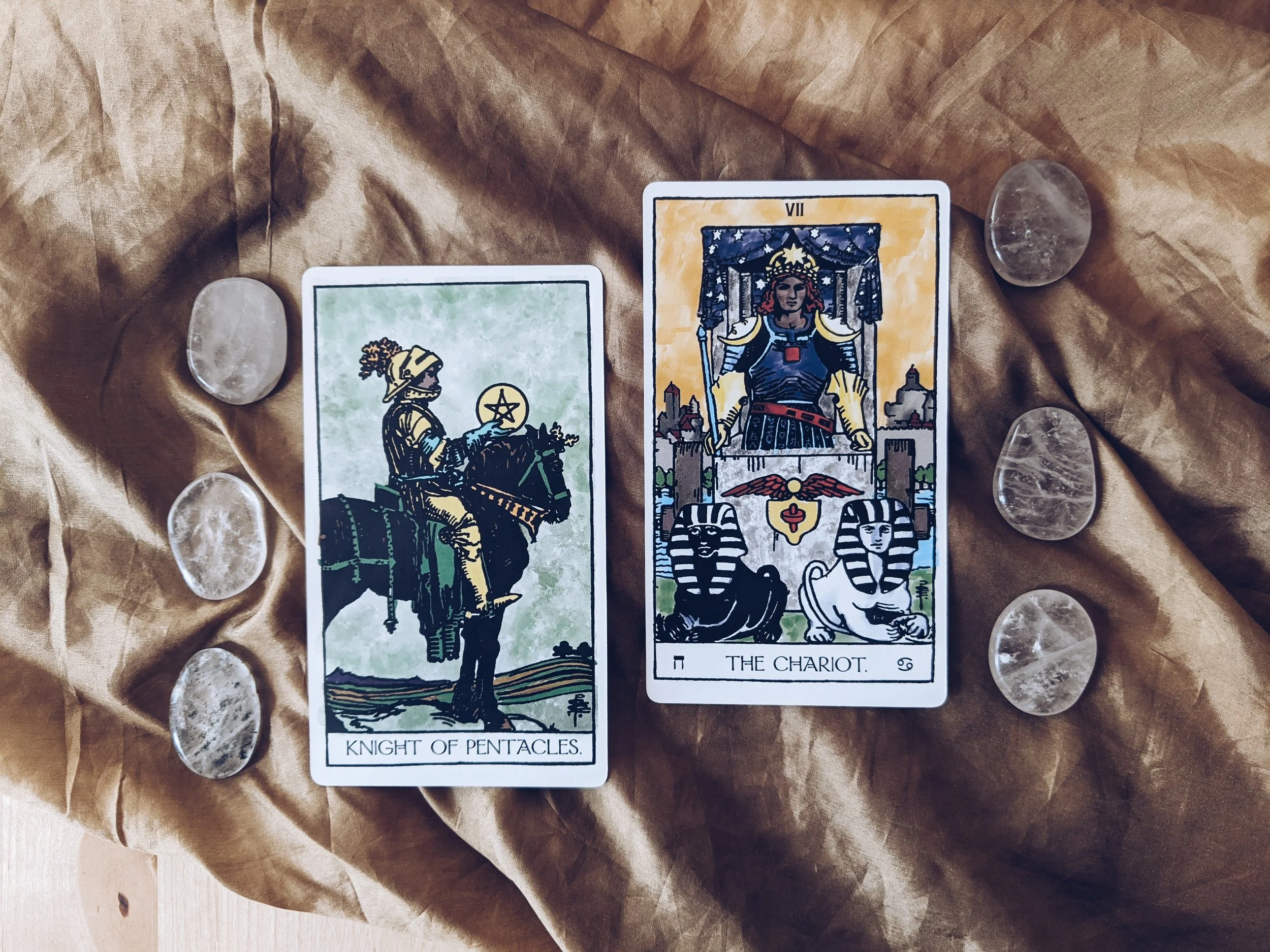
  • VII. The Chariot: Knight of Pentacles

  • VIII. Strength: Page of Pentacles

  • IX. The Hermit: Queen of Pentacles

  • X. Wheel of Fortune: See Note Above

  • XI. Justice: King of Swords

  • XII. The Hanged Man: Knight of Cups

  • XIII. Death: Page of Wands

  • XIV. Temperance: Queen of Cups

  • XV. The Devil: King of Pentacles

  • XVI. The Tower: Knight of Wands

  • XVII. The Star: See Note Above

  • XVIII. The Moon: See Note Above

  • XIX. The Sun: See Note Above

  • XX. Judgement: Knight of Swords

  • XXI. The World: Queen of Swords

life patterns tarot

Finding the Pattern Tarot Spread

If you are trying to better understand how the pattern of a Major Arcana card is playing out in your personal relationships and development of your own identity in these relationships, the following spread is meant to help.

Begin by choosing the Major Arcana card whose energy you want to explore, setting that at the top of your spread. Next, separate out the Court cards from your deck - you'll be pulling only from the Court cards for this spread.

Card 1. How I am Manifesting the Pattern

This card represents how you currently understand and are manifesting the energy of the pattern of the Major Arcana card you are exploring. For our example, let's say you are exploring the energetic patterns of the Hierophant in your life and you pull the King of Cups to represent you. The King of Cups shows that you are deeply engaged in the work of examining the hierarchical structures, restrictions, and allegiance to authority in your life, that this is a front and center focus for you. If you are seeking more clarity, you can pull two more cards from the Minor Arcana to represent how you can ease the strain of this pattern in your life (i.e. the Hierophant energy can be very serious, here are some ways to lighten up) as well as support your explorations (i.e. talk about what you're exploring with friends instead of trying to untangle it all on your own).

Card 2. The Person Helping My Understanding of the Pattern

This card, as the position title suggests, helps you identify a person in your life who is beneficially assisting your ability to explore and understand the energy of the Major Arcana card you are working with. Everything from personal and familial relationships, social and work relationships, as well as para-social relationships can show up here. For our example let's say that you pull the Queen of Pentacles who represents the energy of your high school English teacher who encouraged all of their students to read banned books, helping you to understand how the energy of the Hierophant often seeks to restrict the flow of information. 

Card 3. The Person Hindering My Understanding of the Pattern

This card helps you to identify a person in your life who is challenging your ability to understand the energy of the Major Arcana card you're exploring. For our example, you might pull the Knight of Swords, who represents an online video essayist on popular culture who you used to love for their what you thought was incisive commentary, but are coming to realize are shallow in their opinions and driven more by gossip than insight. 

Card 4. The Person to Connect With

This card represents someone who may or may not be currently connected with in your life (whether they are someone you haven't connected with recently, to someone you haven't met yet) that you would benefit from knowing as you explore the energy of the Major Arcana card you've chosen. Let's say you pull the Queen of Wands - this card might represent someone who brings a fiery, creative energy to your explorations of the often cold and reserved Hierophant, helping you find playfulness and bravery on your journey.

⭐️

Explore the rest of my tarot Court series with a look at the Pages and the Knights (including an overview of the Court structure and non-hierarchical alternatives to the royalty theme) followed by the Queens and Kings. If you’re looking for more tarot spreads, I have a whole collection to inspire your practice, too. For those ready for deepening your knowledge of how herbalism intersects with tarot, come this way.

Whether or not you work with tarot, I hope that this post has inspired you to take a look at the big patterns showing up in little ways (especially in your relationships) in your life. May you be freed from those relationships that seek to keep you stuck and small. May you be drawn towards the people and places where you feel seen, where you are able to connect through collaboration and compassion. May we find each other again and again through our healing work.

This post was made possible through patron support.
❤︎ Thanks, friends. ❤︎

᠅

Tarot Decks Shown

The Neutral Vibes Tarot
The Weiser Tarot
The Natural Ink Tarot

 
magick mail newsletter

We respect your privacy.

Thank you for signing up for Magick Mail! Once you have confirmed your subscription to the list you will gain access to our member's only apothecary.

1 Likes
categories / tarot + divination
tags / tarot, tarot spread, tarot apothecary, major arcana, the tarot court, tarot cards, how to read tarot cards, tarot healing practice, healing tarot, healing with tarot

Opening Up To Ourselves: Agrimony Plant Profile

November 07, 2023  /  Alexis J. Cunningfolk

It can be hard to ask for help when we need it, especially when we use chronic cheerfulness as a way to hide our own suffering in stressful situations. Most of us know (or maybe are) a person who keeps saying “I’m fine! Everything’s great!” when they have every reason to not be ok. Agrimony (Agrimonia eupatoria) is the plant ally that they’ll probably never reach for by themselves (“Really, I’m fine!”) but the sort of plant friend they need and deserve.

Agrimony is a plant that has been in the traditional western materia medica for thousands of years, helping to alleviate many forms of suffering, which is why I’m excited to be exploring this plant more in-depth with all of you.

And maybe, for those of you who have stumbled across this post, after a long day of Agrimony smiling (learn what an “Agrimony smile” is below), you may feel called to get the loving care and connection you deserve.

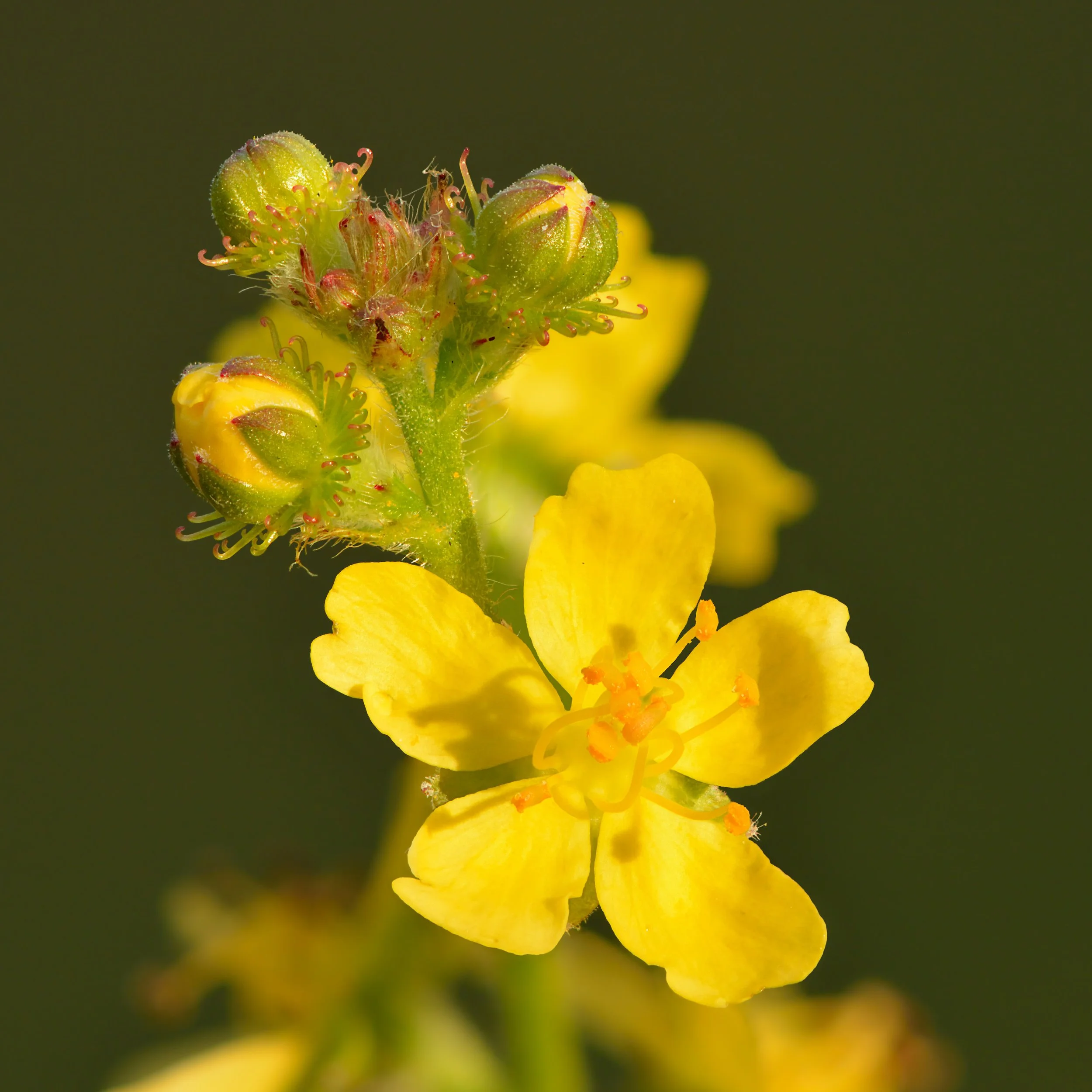
image source

Agrimony
(Agrimonia eupatoria)

Common + Folk Names : Common Agrimony, burr marigold, liverwort, church steeples, cocklebur, garclive, philantropos, sticklewort, stickwort, red-tail, goosechite, fairy's wand, aaron's rod, grooveburr

Element : Air, Water

Zodiac Signs : Cancer (Remedy Herb), Virgo (Guardian Herb)

Planets : Moon, Mercury, Venus

Moon Phase : New Moon

Tarot Cards :  The Hermit, Justice, The Tower (learn more about the connections between the tarot and herbs)

Parts used : Aerial parts

Habitat : Native to Eurasia. 

Growing conditions : Wildflower conditions. Sunny, sandy hillsides, and poor soil.

Collection : Harvest when flowering through summer.

Flavor : Bitter

Temperature : Dry

Moisture : Cool

Tissue State : Tense/Constriction, Heat/Excitation

Constituents : Polysaccharides, tannins, triterpene acids, glycosidal bitters, agrimonin, furanocoumarins, volatile oils, flavonoids, coumarins, vitamin B, vitamin K, iron, silicon, phenolic acids.

Actions : Analgesic, anti-inflammatory, antiparasitic, antiviral, astringent, digestive, diuretic, emmenagogue, febrifuge, hemostatic, hepatic, vulnerary.

Main Uses : I first met Agrimony through my flower essence studies - it is one of Dr. Edward Bach's 38 original remedies. The essence was described to me as being best for folks who tend to "grin and bear it" or to smile through their suffering. The origin of their smile and its purpose can be manifold for a person. Sometimes folks, especially those socialized as and/or perceived to be women, experience undue expectations to perform cheerfulness for everyone who interacts with them. Sometimes the smile is meant to deflect the curiosity of others, so that the suffering or disharmony beneath the surface goes undetected. The smile might be a shield against confrontation or a way to prove your strength and good-naturedness or to generally appease another person. The smile can be a shield used so often in unsafe situations where a more powerful party must be placated, especially in early childhood, that it becomes a permanent fixture of a person's interaction with nearly everyone in their life.  Learning to spot a smile like this in the consultation room can be a useful skill in helping to figure out what questions to ask to draw a person out and begin to get them help they deserve  but might be afraid to outright ask for not only within an herbal care context but broader health services.

Later on in my practice when I learned about the medicinal gifts that Agrimony offers, I was reminded of the resonance that is often found between the flower essence energetics and the herbal properties of a plant. As an herb, Agrimony helps to alleviate the (often invisible) suffering hidden behind the "Agrimony smile" including peptic ulcers and indigestion. Indications for Agrimony include indigestion that is aggravated by stress and tension caused by "swallowing" your feelings to keep the peace, poor absorption of nutrients, and not enough secretion of digestive bile from the liver and gall-bladder. Greek herbalist Galen classified Agrimony as hot and dry in the first degree making it a useful herb for thinning out build-up in organ systems and re-opening clogged passages.¹ Agrimony has been used since antiquity for ulcers as well as all types of liver and gallbladder diseases and herbalists today still use Agrimony for conditions such as gallstones, cirrhosis of the liver, jaundice, and portal hypertension. Other uses for Agrimony as a drying and opening herb include clearing the respiratory system of excess mucus as well as opening the airways to alleviate the symptoms of asthma. 

Through a traditional western energetic lens, those who would benefit from Agrimony are often experiencing an excess of Earth manifesting as build-up and tension in the body because there is so much Air (self-expression, mental health support, decisiveness) and Water (feeling and emotional need) that needs a structure or container to find a home in that they are not experiencing in their life and relationships. These emotional experiences of Agrimony folk and their use of the "Agrimony smile" to cope are not the cause of their suffering, but are often a result of a life that has been defined by lack - lack of resources to good food and clean water, shelter and quality education, and/or a lack in their personal relationships. It is important to be wary of any belief you hold about how someone may have "deserved" or "manifested" their disease because of circumstances beyond their control and we should honor their stories while making sure they access the support they need to thrive. Agrimony types are already taking on so much all while struggling to maintain a sense of agency - be mindful of how you might be contributing to the pressure of having to suppress their discomfort in order to appease you or anyone else on their healing team. Here, too, is a gift of Agrimony to the practitioner - helping us to sit with our own discomfort and biases and come out the other side more compassionate and curious.

The other primary use for Agrimony, from the ancient world to the modern one, is as a vulnerary (i.e. an herb for wound care). Agrimony is an excellent plant ally, both externally and internally, for wounds of all kinds including bruises, strains, cuts, swellings, and general joint pain. You can use the herb as an astringent compress and as a tea when healing a wound, as well as an ingredient in drawing and blood stopping powders. Agrimony has antiviral and antioxidant qualities, adding to its gifts as a healer of wounds. The herb can also be used in the case of infection as well as clearing out heat present in conditions like fever and inflammatory conditions (from inflamed joints to inflamed gut). As an astringent plant with an affinity for the fluids of the body, Agrimony can be a useful ally in cases of menorrhagia, lessening heavy periods as well as providing mild pain relief - look for signs of excess heat during menstruation. Agrimony can be used in mouthwashes and gargles for mouth ulcers, sore throats, laryngitis, and inflammation of the gums. Use in footbaths to relieve soreness.

image via @wyxina

Magickal Uses : Agrimony has an long association with sleep magick and herbalist Maude Grieve shares an old English rhyme speaking to Agrimony's ability to bring about a restful and undisturbed sleep:

If it be leyd under mann's heed,
He shal sleepyn as he were deed;
He shal never drede ne wakyn
Till fro under his heed it be takyn.²

Include Agrimony in charms against nightmares as well as in blends to bring about trance states. An herb regarded as a panacea by ancient Greek and Roman herbalists, Agrimony can be included in all forms of healing magick to enhance the outcome of the spell. Scott Cunningham notes that Agrimony is an excellent protective herb, one that can be used to return unwanted energy to the sender, as well as banishing negative energy (as well as goblins, apparently).³ Use to help you find community of a healing nature.

The Agrimony Personality : The smile of Agrimony folk hides so much - their fear of conflict, their fear of rejection, of being denied their humanity. Agrimony folk can suffer from a build up of emotions that leads to emotional clogging, stagnation, and an inner tension that feels unbearable. This pattern of hiding their pain while appeasing the emotional needs of others (whether or not their is an expectation of appeasement by the other person), is a defense mechanism that has kept Agrimony folk feeling safe enough in their life, but the price of that "safe enough" feeling has been a high one to pay. While Agrimony folks have been so busy projecting an appearance of cheerful enthusiasm and peace with their situation, this often leads them to believing their own performance, making it that much more challenging for them to admit that they are in any sort of pain.

Vulnerability is terrifying to many Agrimony folk and the honest expression of how they are feeling to people who deserve to hear their story is one of the most challenging experiences Agrimony folk can go through and they have often already been through a lot. Agrimony folk can be adept at hiding their pain because they have overdeveloped skills for "grinning and bearing it" and invest incredible amounts of energy into passing as being more than ok. Sometimes they use tools such as drugs and alcohol, deceitfulness, toxic masculinity, committed superficiality or spiritual bypassing to maintain appearances, but it cannot hold. With bravery, vulnerability, and therapeutic support, working with Agrimony can help these folks to open up emotionally so that they can experience the inner peace they are trying so hard to convince other people they have. Connecting with their inner peace helps Agrimony folks to clear out fear and welcome in the type of transformative relationships with themselves and others they've been seeking for so long.

Contraindications : Avoid in pregnancy and breastfeeding. 

Drug interactions : Caution with anticoagulant medication, insulin, and hypoglycemic medication. Discontinue seven days before surgery.

Dosage : Standard dosage.

᠅

Do you know someone who has an Agrimony smile? Are you that person? I find the emotional indicators for plants so interesting. I hope you had fun learning more about Agrimony and the ways it helps us to tend to our emotional wellbeing alongside our physical healing needs. If you’re looking for more plant profiles, come this way, and you can find a printable copy of the Agrimony profile in The Plant Ally Library.

Agrimony works well with other plants like Milky Oat (Avena sativa) and Skullcap (Scutellaria lateriflora), so if you feel a resonance with what you’ve read so far be sure to check out those plant allies, too.

May your journey of healing lead you back into ever-deepening connection with your community.

This post was made possible through patron support.
❤︎ Thanks, friends. ❤︎

📚

Footnotes

1. Graeme Tobyn, Alison Dunham, Margaret Whitelegg, The Western Herbal Tradition: 2000 Years of Medicinal Plant Knowledge (Edinburgh: Churchill Livingstone Elsevier, 2011), 47.

2. Maude Grieve, A Modern Herbal: Volume I (New York: Dover Publications, 1971), 13.

3. Scott Cunningham, Cunningham's Encyclopedia of Magical Herbs (St. Paul, MN: Llewellyn, 2001), 27.


We respect your privacy.

Thank you for signing up for Magick Mail! Once you have confirmed your subscription to the list you will gain access to our member's only apothecary.

2 Likes
categories / plant allies
tags / agrimony, agrimonia eupatoria, plant allies, agrimony flower essence
Newer  /  Older

© 2010 - 2025 Worts & Cunning Apothecary | All Rights Reserved | Disclaimer | Land Acknowledgement
. live your magick .