• Home
  • About
  • Offerings
    • My Book
    • Magick Mail (It's Free!)
    • The Lunar Apothecary
    • The Tarot Apothecary
    • The Plant Ally Library
    • Solace: Herbs for Sensitive People
    • Begin With the Breath
    • The Green Bottle Method
    • Gatherings
    • Patreon
  • Blog
    • most recent
    • plant allies
    • astroherbology
    • moon studies
    • recipes + tutorials
    • magickal arts
    • tarot + divination
    • sliding scale
    • archive
    • search
  • Contact
  • Search
  • More
    • FAQ
    • Support the Work
    • Calls to Action + Resources
    • Bookshop
  • Home
  • About
  • Offerings
    • My Book
    • Magick Mail (It's Free!)
    • The Lunar Apothecary
    • The Tarot Apothecary
    • The Plant Ally Library
    • Solace: Herbs for Sensitive People
    • Begin With the Breath
    • The Green Bottle Method
    • Gatherings
    • Patreon
  • Blog
    • most recent
    • plant allies
    • astroherbology
    • moon studies
    • recipes + tutorials
    • magickal arts
    • tarot + divination
    • sliding scale
    • archive
    • search
  • Contact
  • Search
  • More
    • FAQ
    • Support the Work
    • Calls to Action + Resources
    • Bookshop

Worts & Cunning Apothecary | Intersectional Herbalism + Magickal Arts

Elemental Imbalance & Disease in Traditional Western Herbalism

September 29, 2021  /  Alexis J. Cunningfolk

In part two of my series on the elemental energetics of traditional western herbalism, we’re looking at elemental imbalance and how it helps us to understand disease and discomfort. If you haven’t read part one yet, where I look at what the elements of traditional western herbalism are and their correspondences, I recommend that you do that first to help set you up for the explorations ahead.

A foundation of good health within traditional western herbalism is maintained through the harmony of the four elements within and around a person. In other words, living in ways (including sleeping, eating, moving, thinking, spiritual practice, and relating to others) and in spaces that balance the four elements within us. Being born with tendencies towards one or more elements (i.e. our inherent constitution), there are often things which we'll need to practice throughout our life to support our health. If we tend to have busy thoughts and are prone to anxiousness (a quality of excess Air), mindfulness practice might be a lifelong remedy that we use (which brings in grounding Earth energy).

Just as every person has elemental dispositions (i.e. the temperaments as discussed in part one), so too do diseases have elemental signatures. Fevers, for example, are an imbalance (and strength) of Fire, usually combined with too much Air (intermittent fever) or Earth (prolonged “bonebreak” fever). Too much cold (Earth and/or Water) might lead to issues with digestion and constipation where too much dryness (Air and/or Fire) can often manifest as skin issues. An excess of damp (Water) can show up as edema or a wet, unproductive cough. I'll highlight different elemental imbalances and the diseases and symptoms they may produce in the elemental profiles later on, but hopefully you're beginning to get an idea of how to think about diseases from an elemental perspective.

Keep reading about elemental imbalance or jump to the rest of the series:

  • The Four Elements of Traditional Western Herbalism

  • Finding Balance: Traditional Western Herbalism Energetics in Practice

🜄 🜁 🜃 🜂

What I find useful about considering the elemental imbalance of disease is that it can help us think about the body as a living, holy space that needs to be cared for as a whole, as opposed to being overly focused on what is "broken" about a person. It is also a continuous process of recentering the healing process and the person in need of support as being of the land and seeking remedies of the land in turn (whether those remedies are simple herbal teas grown on your windowsill or complex, plant and organic material derived medicines administered by your pharmacist).

Of course, there is a lot more than considering the elemental balance or imbalance when it comes to assessing disease within traditional western herbalism. As you move further into your studies you’ll begin to encounter specific traditions within traditional western herbalism. Do you work with the astroherbalism of Culpeper? The regimens of traditional Greek medicine? The healing procedures of Unani medicine? Or the plant and spiritual guidance of Hildegard of Bingen? The medicinal traditions of the Eclectics? Those are just a few ideas, but that is beyond the scope of this post and I recommend exploring further if you're feeling inspired. 

The Elemental Correspondences of Herbs

Herbs can be categorized strictly using the systems of ancient correspondence used by the Greeks (where the heat, coldness, moisture and dryness of herbs was measured to different degrees), but these days the elemental energies of herbs are determined in a number of ways from ancient tradition to magickal correspondences and, importantly, direct experience. So it's not uncommon to see one herb assigned an elemental correspondence in different ways by different herbalists. The primary point of learning about the elemental system in traditional western herbalism is not to figure out the "right" correspondence (because that will always be subjective to some degree) but to have another way to directly connect with plants beyond a strict biomedical approach which ignores the spiritual aspect of herbalism and/or dangerously commodifying plants into cure-alls.

Knowing Ginger (Zingiber officinale) as an herb of Fire, for example, I have an instant sensory response - I can feel the heat in my body and I know that it assists with circulation which helps me better understand how Ginger would be of use when there is too much coldness in the body brought on by an illness and depletion of energy.

As you go along and apply elemental energetics to your study and practice of herbalism, you'll also know that there is a lot of subtlety with the elements. All plants, people, and diseases are a combination of elemental energies and it's only through observation that we begin to pick up on those subtleties and begin to discern what herb would work best in what situation. I know from tradition and experience that Angelica (Angelica archangelica) is an herb of Fire, but for me it also carries with it a subtle Water energy because of the way that it moves through the body, soothing the nervous system, breaking up stagnation, and gently stimulating the imagination. 

Below I’ve created elemental profiles for each of the four elements. In addition to the aspects of the four elements we've already discussed, I've also included the Six Tissue States that each Element corresponds to depending on if there is excess or lack of an Element leading to imbalance. I've also included a summary of how we create elemental balance through working with each of the elements, magickal actions, remedy type suggestions, as well as a general overview of what each Element represents in a person's life beyond physical health.

You'll also find listed herbal actions (i.e. terms for ways an herb acts in the body and its most common properties) for each of the four elements, but I want to emphasize that these are not hard and fast correspondences, nor does any one type of herbal action defined by a single Element. The herbal actions and the four elements you see below are derived from the recorded traditional western herbalism, such as those codified during the 17th century by herbalists like Nicholas Culpeper, oral tradition and exchange, as well as my own direct experience with plants.

Discussing herbal actions is where the system of four element theory and modern herbal actions can seen to be in conflict if four element theory is taken at literally (i.e. all Air herbs are hot and heating in nature such), whereas an herb like Lemon Balm (Melissa officinalis) carries a number of Air qualities and is generally seen as cooling in nature. This is where we must remember that four element theory is a) describing not just actual temperatures but non-temperature based energies and b) our energetic system in traditional western herbalism has continued to grow and change over the centuries. Lemon Balm is generally considered cooling and is excellent for alleviating tension (many cooling herbs are) and tradition handed down from Paracelsus honors Lemon Balm as a life restoring herb - something which aligns it strongly with the element of Air. Flexibility of thought and understanding is needed when exploring herbal energetics so that we understand that there are multiple layers of meaning to seemingly simple terms like "Hot" or "Cold."

The Elemental Profiles

background image via @billy_huy

background image via @billy_huy

Air

Primary Quality: Hot + Moist
Secondary Qualities: Light, thin, subtle, adaptable, porous, moves energy upwards
Humor: Blood
Temperament: Sanguine
Season: Spring
Direction: East
Signs: Gemini, Libra, Aquarius
Excess: Tension/Constriction Tissue State.
Lack: Damp/Relaxation Tissue State and/or Damp/Stagnation Tissue State

Herbal Actions: Aromatics, balances temperature, stimulants, nervous system tonics, circulatory tonics, vasodilators, astringents that support focus, opens and expands, protective against air-born viruses and bacteria.

Magickal Actions: Inspiration, communication, uncrossing, hex-breaking, blessing new beginnings and endeavors, transitions, study aid, divination (all forms but especially wind, cloud, and smoke divination), bringing out change.

Remedies: Hydrosols, room and body sprays, incense, smoking blends, essential oils.

Excess: Flighty, nervous, anxious, lack of coordination, irritable, prone to mood swings, tense, fanatical or obsessive thoughts, the nervous system is overworked and feels frayed, sharp-worded, easily overwhelmed and over-reliant on others for help, remaining superficial in interactions. Excess Tension/Constriction tissue state.

Lack: Brain fog, unfocused, difficulty breathing, poor circulation, understimulated, lack of vision, uninspired, stagnant but restless, poor memory, insufficient memory, ineffective cellular metabolism, lack of tone, easily overwhelmed by feeling under-resourced, difficulty with executive functioning. Too much Damp/Relaxation and Damp/Stagnation tissue state.

Elemental Balance: When in balance, Air strengthens our intellectual, logical, and communication capacities. The element of Air also helps us to be grounded in consensus reality while exploring beyond its boundaries without losing ourselves. Working with Water, Air is able to become more mutable, a bit more solid, and able to experience empathy better. Fire and Air make a very energizing pair which can help to move us out of emotional and physical stagnation, but typically needs to be used in small, short-term doses. Earth and Air bring about a sensation of seated flying - the visionary qualities of Air are able to be rooted and grounded with the gifts of Earth. 

Air Herbs: Air herbs are often one or some combination of the following - aromatic and/or slender in appearance, warming to neutral in temperature, tightening, astringent to neutral in flavor. Examples of Air herbs include Vervain (Verbana spp.), Lavender (Lavandula spp.), Catnip (Nepeta cataria), Dandelion (Taraxacum officinale), Elder (Sambucus nigra), Peppermint (Mentha piperita), Skullcap (Scutellaria lateriflora). 

In our life and remedies Air represents the ability to think deep and connect with what we are inspired by. Inspiration is what guides us to know more about ourselves and the world. Through Air we meet our inner scholar, engaging with the abstractions of the universe, and dwelling at the boundary between our inner depths and the world around us. Air is the part of ourselves that is most visible to the world around us and so it is a place that we also learn about how we express ourselves in alignment with our values.

background image via @yucar

background image via @yucar

Water

Primary Quality: Cold + Moist
Secondary Qualities: Moderate heaviness, soft, slippery, smooth, easily adapts shape of energy, receptive 
Humor: Phlegm
Temperament: Phlegmatic
Season: Winter (traditional) or Autumn (modern)
Direction: North (traditional) or West (modern)
Signs: Cancer, Scorpio, Pisces
Excess: Damp/Relaxation, Cold/Depression, and/or Damp/Stagnation Tissue State
Lack: Dry/Atrophy, Hot/Excitation, and/or Tension/Constriction Tissue States

Herbal Actions: Nervines, demulcents, adaptogens, analgesics, diuretics, anti-inflammatories, anti-spasmodics, cardiotonics, galactagogues, sedatives, vasodilators, emmenagogues, febrifuges, herbs that soften and open up, and cooling herbs.

Magickal Actions: Psychic development, sacred bathing and cleansing rites, rituals of transition, ancestral connections, emotional release, water based divination such as scrying, menstruation magick, Moon magick.

Remedies: Infusions and water based extractions of all kinds including teas, herbal baths, flower essences, hydrosols, glycerites, and spiritual waters (such as Moon or Florida Water).

Excess: Lack of willpower, easily overwhelmed, oversaturated emotionally, poor digestion due to weak digestive fire and to much damp in the system, lack of tone, water retention, tends to be cold, easily influenced by others, difficulty setting healthy boundaries, tendency to addictive habits and thought cycles, chronically self-sacrificing. Too much Damp/Relaxation or Damp/Stagnation tissue states.

Lack: Lack of empathy, underdeveloped emotional intelligence in regards to themselves or others, unyielding and inflexible, unable to adapt or change plans, aloof and disconnected from the needs of others, dismissive of the feelings of others, belief in invulnerability and avoidance of display of vulnerability. Excess Dry/Atrophy and/or Tension/Constriction tissue states.

Elemental Balance: When in balance, Water strengthens our emotional intelligence, reflective abilities, and capacity to empathize. With Water we expand our perception and are able to feel and resonate with the complexity of life. Working with Air, Water is able to dry up excess damp, think a bit more critically, and begin to communicate effectively in the world. With Fire, Water warms up and aids in metabolic function as well as strengthens willpower and self-confidence. With Earth, Water begins to take form, toning water-logged body systems, and helping rooting dreams and desires into real-world action and manifestation.

Water Herbs: Water herbs are often one or some combination of the following - water-rich and/or oily, sea and water growing plants, cooling to neutral in temperature, softening, gentle, sweet and/or neutral in flavor. Examples of Water herbs include Chickweed (Stellaria media), Cleavers (Galium aparine), Lemon Balm (Melissa officinalis), Mugwort (Artemisia spp.), Milky Oat (Avena sativa), Aloe (Aloe barbadensis), Passionflower (Passiflora incarnata), Willow (Salix alba), Yerba Mansa (Anemopsis californica).

In our life and our remedies Water represents the ability to feel deeply and connect to our dreams and other beings. We are able to evolve as a species through the empathy we develop with Water. Through Water we meet our inner mystic, distilling wisdom from simple and complex experiences, and learn how to dissolve the boundaries which keeps us separate. Water is the part of ourselves that can be most hidden from the world, because it represents how we feel and what we know to be true. So with Water we learn how to bring these stories to the surface or dive deep with them as needed.

background image via @tengyart

background image via @tengyart

Fire

Primary Quality: Hot + Dry
Secondary Qualities: Absolute lightness, bright, very rare, transforms and transmutes energy into other qualities
Humor: Yellow Bile
Temperament: Choleric
Season: Summer
Direction: South (Northern Hemisphere) or North (Southern Hemisphere)
Signs: Aries, Leo, Sagittarius
Excess: Heat/Excitation and Tension/Constriction Tissue States
Lack: Cold/Depression, Damp/Relaxation, and/or Damp/Stagnation Tissue States

Herbal Actions: Stimulants, diaphoretics, anti-depressants, rubefacients, carminatives, cholagogues, cardiostimulants, herbs that stimulate digestion, herbs that help us reconnect to the spark of life and our willpower.

Magickal Actions: Candle lighting spells, fire and smoke magick and divination, fire-based cleansing rites (such as jumping the fire, burning sacred herbs), carrying prayers and spells via smoke, energizing all forms of spellwork, sex magick.

Remedies: Incense, herbal bundles for fumigation, herbal oils and rubs, liniments, alcohol extracts.

Excess: Prone to anger, short-tempered, restless and impatient, accusatory and quick to blame others, bullying and cruel, egotistical, overbearing, intolerant of differences, lack of empathy, self-centered, prone to burnout, overheats easily which can cause intense or chronic fevers, dry skin, poor digestion from lack of moisture, brittle hair, and chronic inflammation. Excess Heat/Excitation and Tension/Constriction tissue states.

Lack: Lack of willpower, prone to depression and pessimism, difficulty connecting with joy, creative lack and blocks, conservative mindset and lack of creative thinking when it comes to other ways of doing things or imagining possibilities, rarely excited, possessing an imagination deficit, lack of heat can cause poor digestion, circulation, and inability to fight off illness and infection. Excess Cold/Depression, Damp/Relaxation, and/or Damp/Stagnation tissue states.

Elemental Balance: When in balance, Fire strengthens our creative capacity, our love of life, and our inherent vitality. With Fire we realize ourselves as participants in shaping the world we live in and yet to come. Working with Air, Fire is fed and brings life and enthusiasm to all situations. With Water, FIre is tempered and taught empathy so that it can warm and not burn out or become destructive. With Earth, Fire is held and focused bringing heat and light where necessary and helping shape raw material into invaluable tools and skills.

Fire Herbs: Fire herbs are often one or some combination of the following - warming and dry, warm to hot in temperature, irritating and stimulating, strong or spicy in flavor. Examples of Fire herbs include Basil (Ocimum spp.), Ginger (Zingiber officinalis), Blessed Thistle (Cnicus bendictus), Motherwort (Leonurus cardiaca), Nettles (Urtica dioica), Rose (Rosa spp.), St. Joan’s Wort (Hypericum perforatum).

In our life and remedies Fire represents our spark of life and how we engage with the creative energies of life. Without Fire there would be no life, no joy, and no open-hearted hope. Through Fire we meet our inner optimist and change-maker, learning how to find possibility and bravery in the most dire of situations. Fire is our source of energy and shapes the way that we pass on wisdom and knowledge to those around us, including the generation to come.

image via @sebastian_unrau

image via @sebastian_unrau

Earth

Primary Quality: Cold + Dry
Secondary Qualities: Heavy, firm, stable, dense, sustained and enduring energy that centers and moves downwards
Humor: Black Bile
Temperament: Melancholic
Season: Autumn (traditional) or Winter (modern)
Direction: West (traditional) or North (Northern Hemisphere) or South (Southern Hemisphere)
Signs: Taurus, Virgo, Capricorn
Excess: Cold/Depression, Damp/Relaxation, and/or Damp/Stagnation Tissue States
Lack: Dry/Atrophy (think poor soil quality) and/or Hot/Excitation Tissue State

Herbal Actions: Alteratives, carminatives, expectorants, bitters, anti-parasitics, anti-catarrhals, hepatics, nervines, food staple plants like Oats (Avena sativa), tonic herbs that can be taken over a long period of time.

Magickal Actions: Rituals of transformation, death rites, stone and rock magick, rituals acts of burying, garden magick, dismantling systemic oppression, strengthening community, body magick, and rituals of self-discipline.

Remedies: All forms of cooking with herbs, powders, herbal salt rubs, compresses, salves, decoctions, herbal pills, suppositories, herbal sachets and plants worn on the body.

Excess: Too much Earth can lead to stagnation in issues of health and in life in general, stubbornness, cynicism, workaholism, overreliance on systems of hierarchy, being loyal to an idea, cause or person beyond reasonableness, dictatorial behavior, decrease of mobility physical, emotional, and mental, self-indulgent, over-valuing the acquisition of material objects or "perfecting" the body as a sign of self-worth. Excess Cold/Depression, Damp/Relaxation, and/or Damp/Stagnation tissue states.

Lack: Difficulty being present in the body (everything from being spacey to dissociation and beyond), inability to manifest dreams into reality, demonstrate follow-through in projects, under-developed survival skills, a dislike or disinterest of "nature", lack of stamina and vitality, unreliable, over-promises and under-delivers, prone to posturing in place of actual self-reflection, stuck in one part of life and not growing and developing as a person. Excess Dry/Atrophy and/or Hot/Excitation tissue states.

Elemental Balance: When in balance Earth helps us to be embodied in all aspects of our life. With Earth we see ourselves as part of the world and in a deep interconnectedness with all other beings. Working with Air, the steady and slow nature of Earth can find a bit of speed and mutability, warming up what can be a cold element. With Water, Earth can become a rich and fecund place of growth, helping to bring empathy to embodiment. With Fire, Earth is warmed up, becoming a greenhouse where the spirit and body can thrive throughout the year and all kinds of experiences.

Earth Herbs: Earth herbs are often one or some combination of the following - nutrient dense and/or oily, cold to neutral in temperature, toning, strong, earthy, and/or bitter in flavor. Blessed Thistle (Cnicus bendictus), Chickweed (Stellaria media), Dandelion (Taraxacum officinale), Elder (Sambucus nigra), Elecampane (Inula helenium), Hawthorn (Crataegus monogyna), Mullein (Verbascum thapsus), Rose (Rosa spp.).

In our life and remedies Earth represents our ability to manifest, ground and center, and to be embodied in the physical world. Without Earth there would be no growth, no sensations of life, and a lack of shared experience. Through Earth we meet our animal self which has never forgotten that we were born of wild places and that from Earth we emerged and to Earth we shall return. Earth is our source of physicality and the way we experience all our sensation in the world, gleaning wisdom from a very real and felt journey through life, death, and rebirth.

🌿

In the next part of our series we’ll be exploring the four elements theory in practice including simple remediation techniques. If you’re head is buzzing with all this information and paths of study to follow, may I suggest a cup of Skullcap (Scutellaria lateriflora) tea?

A practical exercise you might do to help you integrate some of this knowledge about elemental energetics is to think about a recent health issue you had and begin to describe it from an elemental perspective? A cough that was damp and persistent? That sounds like too much Earth and Water. A rash that’s red and dry? Lots of Fire and Air happening there. It’s one simple way to begin to think about yourself and the world from an elemental perspective.

Until next time, friends!

Signature Summer 2019.png

This post was made possible through patron support.
❤︎ Thanks, friends. ❤︎


We respect your privacy.

Thank you for signing up for Magick Mail! Once you have confirmed your subscription to the list you will gain access to our member's only apothecary.

1 Likes
categories / recipes + tutorials, path of the herbalist
tags / traditional western herbalism, traditional western herbalism energetics, herbal energetics, western herbalism, the elemental energetics series, four elements theory, elemental imbalance, western herbal energetics, energetics of western herbs, theory and application of traditional western herbalism, humoral theory

Using Tarot In Your Healing Practice

September 05, 2021  /  Alexis J. Cunningfolk

tarot healing practice.png

When I started reading tarot I had the good fortune to be gifted a book that centered the cards as not only a tool of divination but one of transformation. The tarot was a living temple that one could visit, populated by interesting people, creatures, Old Ones, and landscapes that reflected our own inner psyche. Another of my early tarot books was on shadow work with tarot which I worked through as an earnest teenage witch who didn't quite know what they were doing. That early enthusiasm for self-inquiry and healing work has supported me these decades later and led me to turn again and again to my cards when seeking clarity around healing work. 

For me, the tarot is a multidisciplinary magickal tool - it is art, a collection of rebellious and traditional ideas, a practice of self-realization, a path of divination, a book of healing, and so much more.

With that in mind, I wanted to share with you some of my favorite ways of bringing tarot into your healing practice, whether for your own healing work or as a practitioner working with clients. 

The Gentle Tarot by Mari in the Sky

The Gentle Tarot by Mari in the Sky

Create a Healing Tarot Altar

Tarot can easily become a vision board so why not create an altar incorporating cards related to your healing desires? For me, The Star is one of the most beautiful and healing cards in the deck and often finds its way onto my altar. It represents rest and restoration which is something I struggle to commit to in my healing practice. But any card in the deck can represent healing for you including goals you might have, allies you want to remember to recognize or call-in, and healing practices you want to incorporate into your practice. Finding cards for your healing altar can be as simple as flipping through your deck and pulling out whatever cards call to you, that you feel hope and possibility with. Add some other items if you like (a bowl of water, a candle or two, a healing stone or plant friend) and you've set up a sweet little space for healing work. If you work with clients this can be a really special thing to do with them while in session or ahead of time before they arrive in the space. If you're looking for more inspiration I've written about each of the healing qualities of each of the tarot suits.

Tarot by Caro - Caro Clarke

Tarot by Caro - Caro Clarke

Find Your Shadow Card

I've written a whole post about tarot and shadow work including how to find your shadow card, but essentially it's a wonderfully visual and visceral way to understand a healing challenge you might be faced with at the moment. For example, if you're working with a client who is experiencing anxiety but is having difficulty pinpointing why or one of the places it might be stemming from, helping them choose a shadow card can help to start a discussion by talking about what they see in the card and the feelings it brings up in them. I do this in my own personal practice when I'm feeling overwhelmed by what seems like an endless expanse of things to be anxious about during these times of churn and change, to help me find an anchoring point to reconnect with my own inner compass and figure out what needs meeting with first. Learn more about how to find your shadow card.

The Future Ancestors Tarot by Alexa Villanueva

The Future Ancestors Tarot by Alexa Villanueva

Cast a Healing Spread

I have a couple of different tarot spreads that I turn to for healing insights including the Healer's Celtic Cross for general readings, this one for working on old stuff including ancestral inheritance and generational trauma, and this one for helping point towards hope in the midst of a challenging situation. But I more often than not pull very simple three card spreads for healing guidance such as:

  • Mind/Body/Spirit: A good general spread to check in with different parts of ourselves. You can pull additional cards for any of these points, expanding the reading if you need more clarity.

  • Finding the Love: Struggling with health (mental, physical, emotional, spiritual, and so on) can be draining and demoralizing. When I'm seeking hope I like to pull a card that represents the situation I'm in, another card for what I'm feeling challenged by, and a third that represents where the love is at. I don't think illness is here to teach us a lesson, but we have opportunities to learn through whatever we're going through, and one of the skills we can develop is to learn to spot the love in any situation. It might be recognizing who showed up to support you when you needed them or the ferocious way you chose to believe in your worth no matter what in a challenging situation or the simple pleasures that are helping you keep grounded and centered. Love fuels hope and hope fuels healing which is why this three card spread can be so useful.

  • Embrace/Release/Return: One card for something you should be doing more of (embrace), something you should let go of (release), and a reminder of where you hope to go (return). 

🌿

So those are my simple suggestions for bringing tarot into your healing practice. What are the ways you use tarot in your healing work? I work a lot with the tarot and plant allies, so if you're interested in the healing intersections of tarot and herbalism, check out The Tarot Apothecary.

However you cast your cards, I hope that you're able to find the answers you're looking for and that your healing needs are met again and again.

Signature Summer 2019.png

This post was made possible through patron support.
❤︎ Thanks, friends. ❤︎

Notes

The two books I refer to at the beginning of this post are Teach Yourself Tarot by Naomi Ozaniec and Tarot Shadow Work: Using the Dark Symbols to Heal by Christine Jette.

 
MagickMailAd 2019 hag.png

We respect your privacy.

Thank you for signing up for Magick Mail! Once you have confirmed your subscription to the list you will gain access to our member's only apothecary.

1 Likes
categories / tarot + divination
tags / tarot, the gentle tarot, the future ancestors tarot, tarot by caro, tarot spread, tarot healing practice, tarot apothecary

Honoring Sensitivity: Chamomile Plant Profile

August 30, 2021  /  Alexis J. Cunningfolk

chamomile plant profile.png

I work with a lot of highly sensitive people, neurodivergent folks, and empaths in my practice and a few years back I wrote about herbs and essences to support those of us who live with extra sensitivity (and then created a course). The gentle yet effective ways of plant medicine can be a welcome path of healing for many sensitive folks working with their sensitivities instead of overwhelming them. Over the years there have been a number of herbs that I have returned to again and again to support sensitive folks and one of those plant allies is Chamomile (Matricaria recutita).

Chamomile is a beautiful herb to work with for young folks and old folks and all in-between as it supports our ability to grow into our sensitivity in ways that may not have been possible when we were younger.

If you are someone who experiences extra sensitivity in the world or work with folks who sensitive, you might be interested in my upcoming course on healing practices for highly sensitive people and empaths being published later this year - sign-up for Magick Mail to be kept in the loop.

And now let’s meet Chamomile…

image via @michaelheld

image via @michaelheld

Chamomile
(Matricaria recutita)

Common + Folk Names : Mayweed, ground apple, manzanilla, German chamomile, wild chamomile, blue chamomile
Tarot Cards: The Moon, The Sun, 6 of Cups
Element : Water
Zodiac Signs : Water Signs, Leo
Planets : Venus, Moon, Sun
Moon Phase : Full Moon
Parts used : Flower
Habitat : Native to Eurasia.
Growing conditions : Sun to partial shade and makes a good and fragrant ground cover.
Collection : Collect flowers in spring.
Flavor : Sweet, bitter
Temperature : Neutral
Moisture : Moist
Tissue State : Tense/Constriction, Hot/Excitation

Constituents : Calcium, magnesium, iodine, phosphorous, potassium, vitamin B2, choline, essential oils, flavonoids, levomenol, sesquiterpene lactone, coumarins, salicylates, plant acids,

Actions : Analgesic, anodyne, antibacterial, antifungal, anti-inflammatory, antihistamine, antioxidant, antiseptic, antispasmodic, aromatic, carminative, diaphoretic, digestive, emetic (in large doses), febrifuge, nervine, sedative, stomachic, tonic, vulnerary.

Main Uses : Chamomile has an affinity for the stomach and as such is an herb for emotional upsets that manifest in the stomach and digestive tract. Think about the person (maybe you!) who gets a nervous or upset stomach during emotionally challenging times - Chamomile is a fantastic ally. The herb is bitter and sweet which helps us to produce fluids such as bile for digestion, but also helps us to digest our emotions properly. 

Chamomile is one of my favorite herbs for all varieties of childhood complaints from upset stomach, nervousness, cold and 'flu, and invoking calm. It's a classic remedy for the colic-y child and it is a great herb for the sensitive child whose emotional disturbances and overstimulation is felt by them through their stomachs as they often complain of an upset stomach when their environment (internal and external) feels unsteady. But truthfully this describes many sensitive adults, especially those who did not have stable home and parenting environments when younger. Chamomile helps to settle an upset stomach and any accompanying digestive issues, while helping to move energy throughout the body so it doesn't just stagnate in one spot.

After helping to settle an upset stomach, Chamomile continues to work its magic, helping to support children and adults who have great emotional sensitivity to move through their feelings and the world around them. For adults, Chamomile can be especially useful in connecting with our inner child and re-parenting them if necessary. Many of us are carrying around emotional baggage from our young and formative years that can keep us floundering or stagnating in our present life. Chamomile can help us to process these difficult emotions, by gently reconnecting us with who we were before so that we can move on to who we are becoming.

Chamomile has a great ability to cool overheated conditions including excess heat and inflammation, pain, and the emotional turmoil such conditions can create including anger and irritability. One of the indications for Chamomile is oversensitivity to pain which can let us know that the nervous system is on the verge of burnout or already there. The herb is deeply relaxing, helping to alleviate tension and create a sense of calm in the body. Use for cases of anxiety, low self-esteem, and an overall belief that one cannot be properly cared for (look for signs of masking disappointment and low self-esteem with anger). Sometimes when our sensitivity is rejected as a child or we grow up in an environment that is not safe for us to be sensitive in, a shield of anger and toughness can grow over wounded places which traps heat and energy. Chamomile's cooling qualities are useful here and if you're identifying with a lot of what I've been writing about Chamomile so far, be sure to read the "Chamomile Personality" section, too.

Chamomile is a bit of a panacea meaning that it is beneficial to most common conditions that you'll come across in your family or practice including headaches (especially caused by conditions of excess heat), insomnia, heartburn, ulcers, fever, restlessness, sciatica, and so on. Another sign for sensitive folks that Chamomile might be a good ally for you is the need for touch, being held and cared for, but in very particular way as most touch feels too overstimulating or irritating and/or feeling like there is never enough reassurance (physical or otherwise) even as folks are actively reassuring you.

The herb is helpful for premenstrual tension as well as relieving cramps during menstruation. If menstruation is a time of excess sensitivity (especially when there are signs of excess anger and irritability), Chamomile can be a great ally to work with. The herb is also useful for allergies and hay fever and inflamed respiratory systems. Take as a tea daily through allergy season. Use during fire season in the same way to help protect the body from the excess heat and pollutants in the air. 

Use for all sorts of external treatments of the skin including for inflammation and burns, hives, eczema, psoriasis, insect bites, dermatitis, sunburn, acne, and wounds in general. Use in sitz baths for hemorrhoids and in baths for both children and adults to create calm in the body. The salve is great for diaper rash and a mild tea can be used for teething. Use in massage oils for pain conditions including sciatica and inflamed joints. The hydrosol or simple tea infusion makes a great toner for skin prone to redness and acne. Gargle for sore throats and infections, as well as gum and tooth pain. Use as eyewash for conjunctivitis. 

image via @yoyoqua

image via @yoyoqua

Magickal Uses : Use in money spells as the golden flowers resemble gold coins. Add to luck and success spells and any ritual honoring or invoking the energy of the Sun. A beautiful addition to the altar during Midsummer and Yule. The herb is a sweet addition to sleep charms as well as children's charm bundles. Place the Moon card and the Sun card from the tarot on your altar (or an image of the Sun and the Moon) and a bowl of Chamomile with your name written on a piece of paper tucked inside to help you find balance between your inner (Moon) and outer (Sun) worlds.

The Chamomile Personality : Anger can be a tool of signalling that they are in distress because it is a loud and self-protective way of letting others know something is up, but for Chamomile folks it is often overused. For one reason or another (childhood neglect, unhealed trauma) anger has become an overdeveloped muscle and Chamomile helps these folks to become open to and develop other skills of self-expression, especially when they are feeling hurt and insecure. Anger can be a tool to help protect us in acute situations, but when it becomes a chronic condition there is a need for extra mental health support. There is often some emotional trauma unhealed from childhood for Chamomile folks and Chamomile is one of the best plant allies to work with when navigating challenging experiences of our youth. The herb helps Chamomile folk to re-parent themselves and have space to be youthful and appropriately protective and loving towards their own inner child. From this place of tending to the roots of their soul, Chamomile helps folks to feel safe in knowing that they can express themselves beyond anger and be heard and held and wanted and loved always.

Contraindications : Ragweed allergies and some folks experience contact dermatitis with the fresh plant. Otherwise generally considered safe.

Drug interactions : Avoid with anticoagulant medications. 

Dosage : Standard dosage.

🌿

I hope you enjoyed the sweet wisdom of Chamomile. If you felt resonance with the descriptions above but don’t know much about what it means to be sensitive, you might check out my new course on herbs and essences for highly sensitive people.

If you are a person living with extra sensitivity in this world, I hope that you are receiving lots of care and support so that you are able to experience your sensitivity as the gift that it is.

Signature Summer 2019.png

This post was made possible through patron support.
❤︎ Thanks, friends. ❤︎
 
MagickMailAd 2019 hag.png

We respect your privacy.

Thank you for signing up for Magick Mail! Once you have confirmed your subscription to the list you will gain access to our member's only apothecary.

5 Likes
categories / plant allies
tags / chamomile, matricaria recutita, magickal herbalism, herbs for highly sensitive people, highly sensitive people, empaths, neurodivergent, neurodivergent herbalism, chamomile plant profile

The Four Elements of Traditional Western Herbalism

August 09, 2021  /  Alexis J. Cunningfolk

four elements part 1.png

The energetics of traditional western herbalism are fascinating to study and useful to know when it comes to working with the people we serve as herbalists. In my practice, traditional western herbalism energetics help to shape my work with plants and people.

Studying energetics, and especially the four elements, we can begin to synthesize the vast and varied traditions and cultures of traditional western herbalism from its astrological roots, its magickal foundations, and its modern breakthroughs. The language of energetics also offers us another way to speak of the experiences we have as people, serving to connect us back to our bodies, our thoughts, and our feelings so that we understand ourselves and our world better.

In this series I'll be focusing on one part of traditional western herbalism energetics: the four elements. We'll look at where the four elements intersect with humoral theory, the zodiac, and how we might begin to apply four element theory to our practice. My hope is that this will be a useful and clarifying introduction to the four elements of traditional western herbalism and that you'll feel inspired to bring some aspect of this theory into your own practice. Engaging with the four sacred elements helps to connect our practice as herbalists more deeply to the sacred and deeply interconnected aspects of our work - and that is healing in and of itself.

Keep reading the first post below or jump to the rest of the series:

  • Elemental Imbalance & Disease in Traditional Western Herbalism

  • Finding Balance: Traditional Western Herbalism Energetics in Practice

image sources: @a2eorigins, @joshuanewton, @zoltantasi, @saadchdrhy

image sources: @a2eorigins, @joshuanewton, @zoltantasi, @saadchdrhy

Traditional Western Herbalism Energetics

The four elements are part of the energetic system of traditional western herbalism which also includes concepts like the three spirits, the six tissue states, and other esoteric and astrological principles. The phrase "herbal energetics" gets used in a number of ways, including as an interchangeable term for herbal actions (i.e. astringent, digestive, emollient, etc.). In this course and my work in general, I use the term energetics to describe the ways that herbs are defined primarily through an elemental based system codified by ancient Egyptian, Greek, and Arabic scholars (i.e. the foundational cultural traditions of traditional western herbalism that made their way through Europe and eventually the United States). It's important to note that there are many variations of how the four elements are defined and applied in practice within traditional western herbalism - and even the ancient Greeks laid significant foundations of the elemental practice within traditional western herbalism that you see today contradicted themselves and each other when defining the elements.

In addition to ancient Greek and Arabic tradition, the works of Galen and Culpeper, my elemental practice is influenced by my training in the United States and the Physiomedical tradition. My magickal training and practice as a modern Pagan and Witch also shapes my understanding of the energetics of the four elements as the four elements are not only foundational in my healing practice, but my spiritual practice (which are inextricably intertwined). Ancestral and indigenous tradition as well as direct experience shape my understanding of the elements, too. It is important when studying any modality, but especially a culturally diverse and living tradition that is traditional western herbalism, that we seek out what works for us, engage with but not become hindered by what challenges us, and ultimately choose the path most relevant and inspiring to our work as herbalists and the land, people, and creatures we serve.

As always, I am trying to share with you what I have found useful and inspire you to improvise and adjust as needed.  

Understanding herbal energetics is essential for understanding traditional western herbalism, astroherbalism, and the broader scope of medical astrology and lunar-centered healing work. What follows is a description of the four elements, starting with some of their ancient traditional western herbalism origins. Not all of these concepts will feel relevant to your own practice or maybe even of much interest, but I do think it is good to have passing familiarity with these concepts as they show up again and again in older texts on traditional western herbalism and medical astrology. Even though I don't use the language of the four humors in my practice, for example, understanding them has helped me better grasp the roots of healing philosophies of traditional western herbalism and informs my understanding of the six tissue states which I do use in my practice. 

In other words, we'll be strolling through older concepts that describe the fundamental roots of traditional western herbalism practice, get to know the four elements from an ancient and modern perspective, and then conclude our tutorial with a look at ways we can become elementally-centered in our own life and practices.

Defining the Four Elements

Let's start with defining the four elements. In the Greek tradition (which was most likely influenced by older Egyptian practice) the four elements are categorized by the primary qualities as follows:

  • Hot

  • Dry

  • Moist (alternatively called Wet or Damp)

  • Cold

The four elements were further defined by secondary qualities moving from heavy to light as follows:

  • Earth: heavy, firm, stable, dense, sustained and enduring energy that centers and moves downwards

  • Water: moderate heaviness, soft, slippery, smooth, easily adapts to different shapes and spaces, receptive

  • Air: light, thin, subtle, adaptable, porous, moves energy upwards

  • Fire: absolute lightness, bright, very rare, transforms and transmutes energy into other qualities

There are also two interpretations, one more traditional and one more modern, for where Water and Earth correspond with the seasons and stages of life. A traditional correspondence that aligns with the humoral system places Water in the North, corresponding with winter and old age, with Earth in the West corresponding to autumn and middle age. Modern interpretation, that makes more sense to Pagan practitioners, for example, places Earth in the North with winter and old age and Water in the West with autumn and middle age.

Both systems of correspondence work and I suggest working with either or both correspondences depending on what makes the most sense for your practice. There is no one official form of traditional western herbalism and even the ancient traditions that we draw upon as modern practitioners, disagreed and contraindicated themselves.

traditional western herbalism energetics

To understand the Qualities and how they show up in modern western herbalism we have to do a bit of "yes, and" thinking. Yes, Hot is descriptive of temperature in some ways and it is far more than that. Within traditional western herbalism the vital spirits which give life to the body (also known as pneuma and similar in nature to prana or chi) was understood as warm and radiating life-giving breath. So Hot is describing the heat of life as opposed to the coldness of death. The element of Air, seen as delivering the breath of life throughout the body, is viewed as Hot in nature because life requires heat. In modern western herbalism we would describe many Air herbs as circulatory tonics helping to deliver nutrients, warmth, as well as strengthen the heart (one of the seats of pneuma in the body), carrying on the ancient tradition of viewing Air as an element of Heat.

Next, the four humors describe the processes of synthesization of the elements in the body and are a way of describing chemical reactions of the body (i.e. metabolic function). Developed during the Greek period of Hippocractic medicine, the Four Humors are:

  • Blood

  • Phlegm

  • Yellow Bile

  • Black Bile

The humors were seen as the human scale equivalent of the four elements found in nature. The Blood Humor, for example, corresponds to the element of Air which is Hot and Moist, plentiful in a healthy body, seen to be produced by the liver, and supportive of circulation and distribution of nutrients. In modern terms we would see the Blood Humor as, in part, a key component in the function of cellular metabolism in the body. As we'll see in a moment, even if the concept and language of humors is not widely used by herbalists trained in the western tradition (at least here in the United States), the way we talk about Air and its energetics in herbalism is still influenced by humoral theory. If you're wanting to learn more about humoral theory I recommend Graeme Tobyn's excellent book Culpeper's Medicine (full details in the resources below).

Finally, we have the concept of temperaments which is the way that the elements manifest in the body and personality of a person. In other words, the temperaments described a person's inherent constitution. Everybody is a mix of temperaments, though typically one or two temperaments are more prominent. Again, for more on the temperaments, I highly recommend reading Culpeper's Medicine by Graeme Tobyn. The four temperaments are:

  • Sanguine (Air-predominant Temperament)

  • Phlegmatic (Water-predominant Temperament)

  • Melancholic (Earth-predominant Temperament)

  • Choleric (Fire-predominant Temperament)

The four elements are also linked to the four seasons of the year because the body is a reflection of the world around it and the world a reflection of the body. The four seasons and elements are:

  • Spring: Air

  • Summer: Fire

  • Autumn: Earth (traditional) or Water (modern)

  • Winter: Water (traditional) or Earth (modern)

Finally, the four elements were applied to the zodiac with each of the twelve signs seen as embodying one of the elements. The elements of each sign of the zodiac are as follows:

  • Air: Gemini, Libra, Aquarius

  • Water: Cancer, Scorpio, Pisces

  • Fire: Aries, Leo, Sagittarius

  • Earth: Taurus, Virgo, Capricorn

Now for a slight deviation into a bit more astrology but something which is very useful when understanding the nuance of the four elements. Each of these three signs within the four elements embody different aspects of the elemental quality. Within astrology there are three Qualities (also known at Modes as in "modes of energy") known as Cardinal, Fixed, and Mutable.

Cardinal signs (Aries, Cancer, Libra, Capricorn) mark the beginning of a new season (Aries marks the start of Spring, Cancer the start of Summer and so on) and their energy is initiating. So Aries embodies the swift and initiating energy of Fire, like a sudden spark of flame or intense rise in heat like in a fever. Fixed signs (Taurus, Leo, Scorpio, Aquarius) mark the middle of a season and their energy is slower and steadier (think of the phrase "fixed in their ways"). The energy of Leo embodies the steady and sustaining energy of Fire, like a long summer days or an oven fire. Mutable signs (Gemini, Virgo, Sagittarius, Pisces) mark the end of a season, when energy is starting to change direction and are very adaptable in nature. Sagittarius embodies the unexpected and adaptable nature of fire, at one moment lighting the tip of a small candle and the next burning through a forest. 

So, as you can see, the quality of the element adds nuance to how it appears in a person, a plant or a condition. Looking at the qualities when it comes to healing work, cardinal energy can manifest in short-acting, acute conditions that quickly arrive but just as quickly pass. Fixed energy can manifest in chronic, inherited, ancestral, and difficult to treat conditions. Mutable energy can manifest as illness that lingers, brings about weakness, and is prone to recurrence.

traditional western herbalism energetics

What emerges from all of the element-based correspondences is a way of seeing the world and ourselves within it. The elements of our inherent constitution interact with the elements of disease (which the ancients would consider an excess or lack of one or more of the humors), the elements of plants, the elements of the seasons, and the elements of the planets and stars. For our ancient traditional western herbalism ancestors, wellness was obtained through elemental balance and attention to the ebb and flow of elemental lack and excess throughout the year and the entirety of one's life. Later on I'll give examples of how we apply this four elements based model to healing care.

The Elemental Temple, Garden, and Seasons

Since storytelling and metaphor is an ancient way of sharing knowledge and we are trying to study ancient wisdom for modern times, here are a few simple ways to imagine the four elements. The first two metaphorical meanderings are borrowed from my lunar rituals and healing series.

Imagine creating a temple out of clay. We need warm and damp (Air) material to initially build the walls of the temple. The heat begins to "cook" the clay that will eventually harden, but it is still early in the process where moisture is present, allowing for the malleability needed to form foundations and walls. Next increased heat and the arrival of dryness (Fire) transforms damp clay and dirt into increasingly sturdy and permanent boundary walls of our space. The walls are still fragile, not yet cool and completely sturdy, but they begin to give shape to our desire of what we hope to bring into our sacred space. After the heating and drying energies of Fire, cooling along with continued dryness (Earth) is required to enable the walls to completely harden - now the temple space is ready to be lived and loved and held in. Cool and damp energies (Water) are necessary for redesigning and reworking a temple space after it has been lived in for a while, bringing back the cool damp of malleability to reshape a space. 

For my garden-minded folks trying to create the best batch of compost, the right balance of heat and moisture (Air) are essential to beginning the process of breaking down plant and food material into rich and nutritive soil. Next is the height of heat with the right amount of dryness (Fire) to burn off excess damp. Cooling and drying (Earth) happens next and the compost is ready to be used in the garden. Finally, cool and damp (Water) compost that has been watered and seeded is ready to support the growing cycle in the garden.

Finally, we can think of the elements in terms of the four seasons. The element of Air brings exuberant, outward-moving energy of new life through heat and just the right amount of damp to warm up the land and waters after winter. In summer we are in the height of heat and dryness where the element of Fire reigns and the energy moves upwards. Autumn brings much welcome coolness and moisture, often with rains and the start of the decomposition of plant life that started to die back at the end of summer and through fall. Autumn energy is diffusive, helping the energy of summer settle back down towards the earth. Cold and dry energies of Earth are found throughout winter as energies slow and turn inwards.

None of Us Perfect, All of Us Whole

Having worked with the four sacred elements since the beginning of my studies starting with their magickal application and then their medicinal one, I've come to appreciate one of the lessons reflected back at us when working with this particular system. Each of us are born whole and holy with certain elemental dispositions. Some of us are more fiery and quick to act, others of us are slower, steadier and more considered in our actions. Some of us have an ocean's worth of capacity to feel, others an endless line of energy for philosophizing and storytelling. Each of us have all four elements within us, but we are not born perfect and completely realized. We come to know ourselves and our world by seeking out what we need to support our self-awakening and the greater consciousness of our communities. Within the framework of traditional western herbalism we do that, in part, by finding ways to support the elemental energy we have in abundance and seeking out ways to enrich parts of our elemental self that need extra support. 

Your abundance of water nurtures the spaces within me which need to be filled up with Water's wisdom. My earthiness supports the longevity of your airy visions. We feed and hold and support eachother by allowing ourselves to come into balance through engagement with the earth, its people, places, and creatures. We are meant to find one another and heal together. We are meant to come into balance - and fall out of balance - within beloved community. 

The Earth of me loves the Earth of you
The Air of me loves the Air of you
The Fire of me loves the Fire of you
The Water of me loves the Water of you
All is whole
whole and holy

🌿

I hope you enjoyed part one of our exploration of the four elements of traditional western herbalism. In part two, I explore what happens when elements are out of balance in the body and how that helps us understand disease. The ancestral philosophies which have formed traditional western herbalism are fascinating and I think that the four elements offer a lot of room for innovation and inspiration. Be sure to check out the additional resources below if you’re looking to dive in deeper.

If you are curious about exploring the seasonal nature of the four elements, my witchcraft and weeds series does just that - check out the posts for:

  • Spring

  • Summer

  • Autumn

  • Winter

Sign-up for Magick Mail to get notified when part two comes out and we look at elemental imbalances. Until next time, be well!

This post was made possible through patron support.
❤︎ Thanks, friends. ❤︎
📚

Additional Reading

For a more in-depth list of Traditional Western Herbalism books, come this way.

Culpeper's Medicine: A Practice of Western Holistic Medicine by Graeme Tobyn

The Humoral Herbal: A Practical Guide to the Western Energetic System of Health, Lifestyle and Herbs by Stephen Taylor

Traditional Western Herbalism: As Above So Below by Elisabeth Brooke

Traditions in Western Herbal Medicine: The Development of Theory in North America by Peter Mackenzie-Cook, DBTh, FETC

The Sensory Herbal Handbook by The Seed SistAs

The Practice of Traditional Western Herbalism by Matthew Wood

Greekmedicine.net

The Astroherbology Series

 
MagickMailAd 2019 hag.png

We respect your privacy.

Thank you for signing up for Magick Mail! Once you have confirmed your subscription to the list you will gain access to our member's only apothecary.

2 Likes
categories / recipes + tutorials, path of the herbalist
tags / traditional western herbalism, four elements theory, humoral theory, temperaments, culpeper, astroherbalism, astroherbology, traditional western herbalism energetics, the elemental energetics series

Rooting: Dark of the Moon Ritual and Healing Practices

July 08, 2021  /  Alexis J. Cunningfolk

dark moon ritual

On the land I live with, it is a time of seeking shade and cool places. The height of summer buzz is only gently starting to wane as the nights begin to flow further into the hours while daylight starts to ebb. The great swell of energy leading to Midsummer is only just starting to dissipate and I find myself slowing down as I find restful places to be still with my thoughts, my feelings, my dreamings of the land of my body and the land around me. During these unprecedented periods of heat during our current climate emergency, I have struggled to be restful, worrying that I should be in constant movement, but it is in the pause that we are able to refocus, breathe more deeply, and reconnect to what needs to be done to protect life and the land. And so the Dark Moon beckons, calling us to the shade before we spend any more time in the heat of the day.

The Dark of the Moon is an interesting time, not one observed as broadly as say the Full Moon or New Moon, but a period of time during the lunar cycle that I cherish in my own personal practice. (1) The Dark Moon is a period of profound rest before a new lunar cycle begins. If the New Moon is re-emerging onto a stage, the Dark of the Moon is when we are behind the curtains, waiting backstage, grounding and centering before we re-emerge back into the world. Without this period of rest we are unable to sustain the work and energy of the rest of the lunar cycle - though the importance of rest in magickal work and healing can often be overlooked or made difficult to access by capitalist-driven overcultures that pervade both institutional and personal spaces. There is a reason why, in this time of climate emergency, when we are confronting global patterns of consumption, waste, and destruction, that the call for rest as restorative justice has been growing. We need to rest for rest's sake, not to rest in order to become more productive to work, but to rest as a path of self-realization and community resilience. That is the magick of the Dark Moon.

For those who move through the world as womxn or somewhere on the spectrum of femme identity, however that manifests for you, there is a transgressive and radical magick to working with the Dark Moon. In patriarchal cultures, a womxn’s worth is tied up to her fertility and the Dark of the Moon is a time of un-fertileness, the barren field, the Hag who is unconcerned with what society says of Her, allowing her to move freely throughout all of the worlds. It is a time of breaking the hex of the male gaze (which hurts all of us, no matter our gender) and conjuring the collapse of oppressive systems of power. It is beautiful and wild and if this magick calls to you,

Just before the New Moon takes to the sky and far from the fecundity of the Full Moon, the Dark Moon marks the time of greatest dark during the lunar cycle. It is a time to be slow and still, joyfully unproductive, fertile to nothing else but our own needs, and to tend to the boundaries and edges of our wild spirit that help to shape who we are. Descending and returning, shedding and stillness, remembering and forgetting are all key energies of the Dark Moon.

Herbal Traditions

There is not an official correspondence within Traditional Western Herbalism to the Dark Moon. If we were to think of the Moon phase as a cycle of building a sacred structure, the Dark of the Moon is the temple completed, but empty of movement, waiting to be filled up with the sounds of life that people bring, but content and whole unto itself to be still and quiet at this moment. It is the point of the process of creating sacred space that we realize that the spaces we inhabit in are living and breathing and exist beyond us and our needs and our process of coming to respect that. For my garden-minded friends, the Dark Moon is the period between the end of one compost cycle and the beginning of the next.

As I've shared throughout this series, lunar work is deeply personal and I encourage you to trust your intuition and spiritual callings when creating when it comes to working with the Moon and interpreting Her cycles. For me, the Dark of the Moon is a time between work, as lengthy or brief as that may be, where I pause from doing and rest into being. It is both one of my favorite parts of the lunar cycles and one of the most challenging ones as I continue to undo patterns of overwork in my own life. If you believe you do not have time to rest it is a sure sign that you need to rest more. And I recognize that rest is more accessible to some, which is why it is so important for all of us to create cultures which recognize the sanctity of fallow periods as much as fertile ones.

In my own practice I very rarely make herbal remedies at this time and I try not to schedule classes, consultations, or other outer world work. For remedy-makers I think it is really important to have regular time off from making remedies and I invite you to explore what that might look like in your own practice, whether it becomes a Dark of the Moon practice or another lunar phase practice, during your Lunar Return, or perhaps tied to physical cycles like menses (another traditional time to pause from medicine-making). I don't have any specific plant parts that I work with during the Dark Moon. Personally, it's a time of Crone and Hag Goddesses, so I am more likely to reach for plant allies that I associate with elder, haggish, fiercely independent energy.

Examples of Dark of the Moon Herbs: Elder (Sambucus nigra), Mullein (Verbascum thapsus), Hawthorn (Crataegus monogyna), Mugwort (Artemisia vulgaris), Rose (Rosa spp.).

Mugwort (Artemisia vulgaris, spp.)

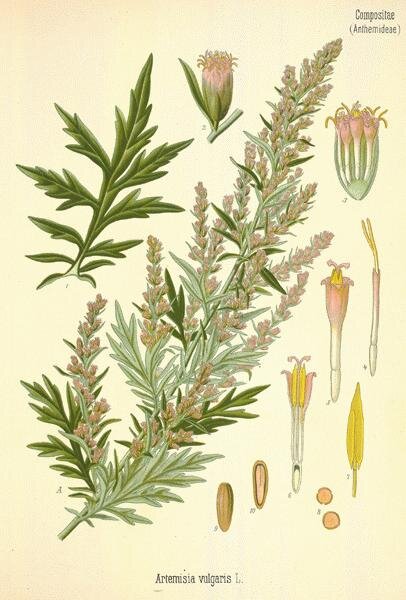
To be perfectly honest, Mugwort is the lunar herb in traditional western herbalism so it can be easily called upon during any Moon ritual. I'm writing about it here, at the Dark of the Moon, because Mugwort is referred to as the "oldest of herbs" within Old English herbal and spiritual tradition and the Dark Moon is a time of Hags. (2) Mugwort is an herb that has a strong effect on me so I am very intentional when I choose to use it and the period of the Dark Moon is one of my favorite times to engage with their magick. 

Mugwort's latin binomial clues us into some of its healing qualities. Artemis is a Goddess of all womxnfolk and their magick, with a particular resonance with womb-bearing womxn and the cycles of menstruation, pregnancy, and menopause.  Mugwort is a warming and opening herb, helping to warm up the uterus and clear out stagnant blood. Take just before your menstrual cycle to release tension, ease cramping, and soothe back pain. After a birth, Mugwort helps cease postpartum bleeding and hemorrhage.

As a fiercely protective herb, the Artemisian qualities of Mugwort help guide us back to the sanctity of our sexuality as fully our own, defined by our own parameters, and expressed however we please within the holy boundaries of consent. Along these same lines, Mugwort has a special affinity for womxn who have experienced trauma, especially of a sexual nature, where they feel isolated from their spiritual power, have difficulty feeling their emotions, and feel frozen in their anger and despair. The herb helps us to step back into our power.

As a warming Moon herb, Mugwort is especially good at moving emotions that have stagnated or frozen up in the body. Mixed with the anger and frustration of past or current traumas, indications that Mugwort can be useful include intermittent fever resulting in both hot and cold conditions in the body. Mugwort increases circulation and warmth throughout the body, clearing out stagnation. It wakes up a sluggish digestive tract and stimulates the secretion of digestive fluids making it a valuable ingredient in bitters blends. If the sleep is disturbed with vivid and disruptive dreams, Mugwort is a night ally, bringing deep sleep and growing a dreamer’s ability to be lucid. 

One of the ways that Mugwort works its magick is by opening us up to our own psychic gifts and ability. In small regular doses (i.e. 1 drop daily) or by using the flower essence on a regular basis, Mugwort can help to establish an appropriate protective barrier around our psychic senses to help us avoid psychic overwhelm and burnout. The herb can help us articulate our psychic and emotional experiences to ourselves and others in a way that helps us feel connected to our self and our community.

image via @tishine

image via @tishine

Altars + Rituals

Cover your altar, your body, with a veil. Be hidden away from the world, known only to yourself. Let yourself be completely naked to the eye of your spirit, to your love, to your own deep way of being that can only be you.

A Simple Dark of the Moon Ritual

To honor the roots of your power

The following ritual helps you to reset as the lunar cycle comes to an end and before it begins again, reconnecting you to what it is that keeps you rooted in your power so that you can more deeply rest your whole self. This ritual can be performed at any time of day or night, but I recommend performing it just before a period of rest (including bedtime) and relaxation.

The charm that you'll be speaking during this ritual starts with "I root my power in…" Examples of how you might complete this sentence might be:

I root my power in the wisdom of my ancestors.
I root my power in the courage of self-love. 
I root my power in the hope of the land.

You can choose a few statements before starting the ritual or be guided by what arises during the ritual. In my own tradition, I would recommend three, six or nine statements, but work with the numerical system that is most meaningful to you and your cultural and/or spiritual traditions. 

To begin, remove all of your jewelry and sacred adornments that you wear daily, including scents like perfumes. As you do this, begin to soften your breath until you are breathing in a way that is filling and easeful, guided by your own rhythm. Place all your sacred adornments in a bowl (or bag or on a cloth) that you can comfortably hold in your lap and lift above your head. If you can, sit cross-legged with the bowl centered in your lap, but choose the position that is most comfortable for you with the bowl low in your body or placed on the ground or table in front of you. 

Take a deep breath in and out.

On the next in-breath, lift the bowl above your head, the objects in this bowl symbolizing how you present yourself to the world, the crown you wear for all to see. Speak the first of your charms (I root my power in the way of…), as you lower the bowl before you, maybe circling it softly, moving it through your energy centers before resting again on your lap (if the items are on an altar before you or not easily lifted, you can lift just your arms and hands instead).

Continuing to breath deeply, look at the items in your bowl, perhaps picking them up one-by-one and asking yourself if they align energetically with the charm you just spoke. Perhaps everything is in alignment, but if something feels like it doesn't quite match up energetically, remove it from your bowl and set it aside. The item might need to be cleansed and/or recharged, just need a break for a lunar cycle or longer. In some cases an item is ready to move on and be gifted or disposed of in a sacred manner.

Repeat the process with all of your daily adornments until your bowl is full of items that help reflect your inner values and principles with your outer appearance.

Take a deep breath in and hold the bowl above your head. Breathe out and lower the bowl to your heart. Breathe in. Breathe out and lower the bowl to your lap. Breathe in, reveling in the alignment of your energy.

Once the ritual is done, take a few more deep and centering breaths before retiring to rest. I often like to take a moment at the end of any magick, but especially when I am grounding and centering to be grateful for the people, places, things, and experiences which have affirmed who I am and helped me to rest, whole and complete.

A Simple Dark of the Moon Tarot Spread

To help you find the path of rest

Card 1 · Restless

This card highlights what is hindering your ability to rest deeply.

Card 2 · Restful

This card shows you what tools or practices can help you to rest fully.

Card 3 · Story

The overall message of the Dark Moon in your life. If you are familiar with your birth chart and how to find the transiting Moon in your chart this card can help you to understand the message of the Dark Moon in the context of where it lands in your chart.

moon emoji.png

I hope you enjoyed this fifth and final post in my series exploring simple ritual practices of the lunar phases (and thanks to my patrons who requested this series!). You can find the posts for the other phases here:

  • Waxing Quarter Moon

  • Full Moon

  • New Moon

  • Waning Quarter Moon

If you’re looking for more lunar magick, start by finding the Moon in your birth chart. I also teach a full course centered on lunar herbalism and astrology to help you discover your unique gifts as a healer called The Lunar Apothecary.

Wherever the Moon finds you I hope you find yourself and the kind spirits who inhabit the dark places of the night, holding up a mirror to your brilliance as you reflect the back the brilliance of the stars to them.

Signature Summer 2019.png

This post was made possible through patron support.
❤︎ Thanks, friends. ❤︎

Notes

(1) The New Moon and the Dark of the Moon are sometimes used interchangeably, but in my practice they are two distinct, though closely situated, periods of time and space. I was taught that the Dark Moon is when there is no Moon visible in the sky for a day or two before the New Moon when a crescent becomes visible. The Dark Moon corresponds to the Balsamic Moon in astrology. Honoring the Dark Moon is a tradition passed down through Goddess spirituality and feminist circles that places emphasis on honoring not only the bright energy of the Full Moon but the beautiful dark depths of the Dark Moon (of course, the honoring the Dark Moon is not exclusive to those spaces and traditions, but that is where I learned it).

(2) I highly recommend reading the full Nine Herbs Charm in both modern English and in the original Old English. Read the Old English out loud to get a feel for the deeply trancey rhythm and pace of the spell (though you can listen to it in modern English here).

 
MagickMailAd 2019 hag.png

We respect your privacy.

Thank you for signing up for Magick Mail! Once you have confirmed your subscription to the list you will gain access to our member's only apothecary.

4 Likes
categories / astroherbology, magickal arts, tarot + divination
tags / lunar rituals, moon wisdom, moon, dark moon, dark of the moon, haw, hawthorn, elder, mullein, rose, mugwort, moon phase rituals, moon phase magick, moon phases, herbs of the moon phases
Newer  /  Older

© 2010 - 2025 Worts & Cunning Apothecary | All Rights Reserved | Disclaimer | Land Acknowledgement
. live your magick .