• Home
  • About
  • Offerings
    • My Book
    • Magick Mail (It's Free!)
    • The Lunar Apothecary
    • The Tarot Apothecary
    • The Plant Ally Library
    • Solace: Herbs for Sensitive People
    • Begin With the Breath
    • The Green Bottle Method
    • Gatherings
    • Patreon
  • Blog
    • most recent
    • plant allies
    • astroherbology
    • moon studies
    • recipes + tutorials
    • magickal arts
    • tarot + divination
    • sliding scale
    • archive
    • search
  • Contact
  • Search
  • More
    • FAQ
    • Support the Work
    • Calls to Action + Resources
    • Bookshop
  • Home
  • About
  • Offerings
    • My Book
    • Magick Mail (It's Free!)
    • The Lunar Apothecary
    • The Tarot Apothecary
    • The Plant Ally Library
    • Solace: Herbs for Sensitive People
    • Begin With the Breath
    • The Green Bottle Method
    • Gatherings
    • Patreon
  • Blog
    • most recent
    • plant allies
    • astroherbology
    • moon studies
    • recipes + tutorials
    • magickal arts
    • tarot + divination
    • sliding scale
    • archive
    • search
  • Contact
  • Search
  • More
    • FAQ
    • Support the Work
    • Calls to Action + Resources
    • Bookshop

Worts & Cunning Apothecary | Intersectional Herbalism + Magickal Arts

Crone Wisdom : The Full Moon in Sagittarius
May 18, 2016  /  Alexis J. Cunningfolk

The following is an extract from my bi-monthly newsletter, The Moonlight, that all of my Lunar Apothecary students receive. Each month we explore a Moon sign and phase, as well as associated herbs, and different aspects of herbal medicine, magick, and practice in addition to the material of the yearlong ecourse. If you're thinking "heck yeah, I want more of that!" you're invited to join the Lunar Apothecary.

The first of TWO Full Moons in Sagittarius happen at the end of the week. The next Full Moon in Sagittarius is in June so we have a lot of fiery lunar energy happening over the next two cycles. When the Moon enters into the sign of Sagittarius adventures are on the horizon and with two Sagittarius Full Moons back-to-back energies are getting stirred up and wanderlust, whether of the physical, emotional or spiritual variety, comes into bloom.

While it is traditional to associate the elder energies of the Crone or Old Wise One with the Dark of the Moon, the Full Moon in Sagittarius has a Sage quality to it - both when speaking of age and of the herb (Salvia spp.). Sagittarius is associated with the Ninth House of the birth chart which is the House of adventures and travel, but also of philosophy and the perspective gained from a life that is lived. In other words, the Ninth House does a lot to shape who we will become in our elder years. Since the Full Moon is a time of maturation and Sagittarius the sign of wisdom gained from experience and age, I always feel a distinctly Crone energy during this time. Sometimes the Crone is a gentle grandmother welcoming us in for a warm hug and other times the Crone is a fearsome visage of all that unsettles us. And hey, if we pay attention to our fairy tales, sometimes the kind grandmother and the fearsome one are the same.
 

Black Sage (Salvia mellifera) by author

Black Sage (Salvia mellifera) by author


Sagittarius is also a mutable fire sign which means it embodies a fire that is flexible, adaptable, and changing. So while Leo is a intense fixed fire sign of solar heat and Aries is the sudden cardinal fire of a lightening bolt, the fire of Sagittarius is the heat of our blood running through our veins and the moving flame of a poi spinner's light. Mutable signs teach us adaptability and as a mutable sign Sagittarius teaches us that wisdom does not come from sitting in one place and following the rules - wisdom is gained by being uncomfortable, in charge, following the wind, coming undone, and any other myriad ways we experience life. In short, it is the wisdom gained by growing up. 

image by gabriel santiago

image by gabriel santiago

What wisdom have you gained through age, clever one?

Sage (Salvia spp.) is in many ways a mutable herb with a strong fiery element. As a sun-loving plant often found in dry and desert settings, Sage shows its ability to adapt to harsher environments than many of its herbal companions. Indications for the herb include similar signs to the environment that the plant enjoys growing in - look for dryness and heat with signs of sometimes accompanied by signs of mental burnout. Sage is quite resinous which is one of the reason that it is so excellent as an expectorant in cases of chest and head colds where there is excess mucus. Overall, Sage helps to regulate the fluids of the body, especially in cases of stagnant conditions (such as poor circulation) or excess secretions (such as too much sweat from hot flashes or wanting to dry up breast milk for weaning), but because the herb has mutable qualities it can help where there is lack of fluids and secretion as we'll see in a moment. The herb also helps with the oils of the body, improving the digestion of oils and fats (in part, because of its bitter taste which stimulates digestion and the production of bile). As a restorative for the mind, Sage helps to clear out mental fog by improving circulation to the brain and oiling the tracks of memory. It is an herb of Jupiter and it seems in its Crone wisdom to temper the excesses of Jupiter in order to let the benefits of Jupiterian energies shine through (i.e. longevity and the wisdom that comes with age). 


A Note on Sage + Smudging

In North America, White Sage (Salvia apiana) has become an increasingly popular herb to use for smudging or cleansing by smoke. The herb has historical and modern-day use amongst American Indian groups primarily located along the southern Pacific Coast, but since becoming popular in New Age and Pagan communities, White Sage has been overharvested to the point of endangerment and, clever ones, there is nothing sacred about wiping a plant out so that it can sit about collecting dust on the shelves of shops. 

So what to do? First, if you're able, grow your own White Sage as it can help in small ways to turn the tide of its endangerment. Second, you only need one leaf at a time to effectively engage White Sage's clearing properties - no more mega bundles! Third, but maybe most importantly, find other plants to smudge with. There are plenty including Juniper (Juniperus spp.), Mugwort (Artemisia spp.), and Lavender (Lavandula officinalis) to just name a few. Have fun getting to know your local and ancestral smudging plants and give White Sage the space and support it needs to regenerate in the wild. 


White Sage (Salvia apiana) by author

White Sage (Salvia apiana) by author

When using Sage in your practice, know that the herb has different qualities when prepared either hot or cold as a tea. The cold tea restricts while the hot tea stimulates. In other words, the cold tea is good to curb excess sweating (such as menopausal night sweats) whereas the hot tea brings out the aromatic qualities of Sage and stimulates secretions. One of my favorite ways to prepare Sage as medicine for cold and 'flu season is to make a simple Sage honey by infusing the leaves in local, raw honey for a cycle of the Moon. You can strain the leaves out, but I typically leave them in, eating them as I go along. Add a teaspoon to water for an instant cup of cold care and sore throat soothing tea with antimicrobial qualities. 

The flower essence of Sage is sweet and simple: it helps us to connect with our wisdom. Through working with Sage we gain perspective which is a crucial component for growing our wisdom. Use the essence during times of transition (such as a school graduation) to help integrate all that has been learned for the path ahead. I also enjoy using the essence when someone feels clouded or confused about their self-worth - Sage helps us to connect with our own unique wisdom even if we didn't know it was there in the first place.

Ready to practice herbal medicine and magick? Be sure to sign-up for my free and fully enchanted Magick Mail to gain access to exclusive content including my Sage Wisdom Tea and Crone's Blessing ritual!
Sage Wisdom Tea.png
Crone Blessing Ritual.png

If you enjoyed that little preview from the Lunar Apothecary I know you'll love the rest of the course.

My students get even more astroherbology-inspired content including profiles on Guardian and Remedy herbs for the sign of Sagittarius, rituals and recipes for all Moon phases in the sign of the Archer, and a full astroherbology profile on Sagittarius' Guardian Planet of Jupiter. Sign up today!

Happy Full Moon Magicking, clever ones!


We respect your privacy and will not share your information with anyone no matter how wise they say they are.

Thank you for signing up for Magick Mail! The digital owls have been dispatched. Once you have confirmed your subscription to you will gain access to our super secret member's only area!

1 Likes
categories / plant allies, astroherbology
tags / sage, white sage, salvia officinalis, salvia apiana, salvia melliferia, black sage, crone, full moon, sagittarius, full moon in sagittarius

The Triangulation Tarot Spread

May 12, 2016  /  Alexis J. Cunningfolk

When I read tarot cards, whether in-person or for my awesome Tarot Stella or Solstice Star clients, I often feel like I am not so much interpreting the cards as I am eavesdropping on their conversation between one another. For me, the tarot deck is a living book of wisdom that is constantly moving and shifting parts, telling new stories, and uncovering old paths. Some cards are more talkative than others, but when they are cast in a spread they begin to talk amongst themselves about the question presented to them. 

"The pain of this heartbreak is real and cannot be ignored any longer, no matter how many times we are told to 'get over it,'" says the Three of Swords.

"I know," nods the Eight of Swords, "it has led to us to being trapped by our own thoughts and ensorcelled by our feelings. Everything feels darkened now, hopeless and unsteady."

"But the fire of love is not gone," the Three of Wands gestures to a vast landscape of possibility. "It has simply moved. Elsewhere and unseen at the moment, but not truly lost."

In my class on card casting and creating custom spreads, we talk about the importance of the question. The question helps to set up the space for the conversation that the cards can have. Sometimes when we get confusing cards in our spread that seem to make little sense given our question, it's not that the cards are wrong or our ability to interpret them is lacking (though, sometimes the cards are cleverer than us and it is important to continue to cultivate a student's mind throughout your work with divination), but that the question did not allow for the answer to come through. 

There is also the actual structure of the spread to consider when seeking information and insight. If you imagine, for example, each card in your spread to be a chair at the dinner table, what cards do you want to be close enough to each other so that they are able to talk without yelling from one end of the table to the other? In other words, what are the conversations you wish you could be having in order to gain further insight and how can you bring this to play in your spread.

It was in the spirit of experimentation and trying to recreate the complexity of conversations between multiple parties (whether the inquiry is along the lines of a she said / they said question or a question from our conscious mind to our subconscious mind or having a chat with our future self), I came up with the idea of a spread of moving pieces or The Triangulation Spread. While I very much enjoy simple spreads, there is plenty of space in my practice for stretching my divinatory muscles with a more complex piece of casting that I'm about to describe with the Triangulation Spread. Yet, what is fun about the spread is that it can be as simple or complex as you like and you can decide that as you go along as opposed to ahead of time giving the reader greater flexibility in gleaning knowledge from the cards.

The basic structure of the Triangulation Spread is three triangles of three cards each, with each triangle representing one segment or aspect of the inquiry. For the following sample reading, the querent is seeking insight into how to turn their interests - which are many and varied - into a career. The question is:

How can I focus my creative passion into a sustainable career?

All cards shown in this post are from the World Spirit Tarot.

All cards shown in this post are from the World Spirit Tarot.

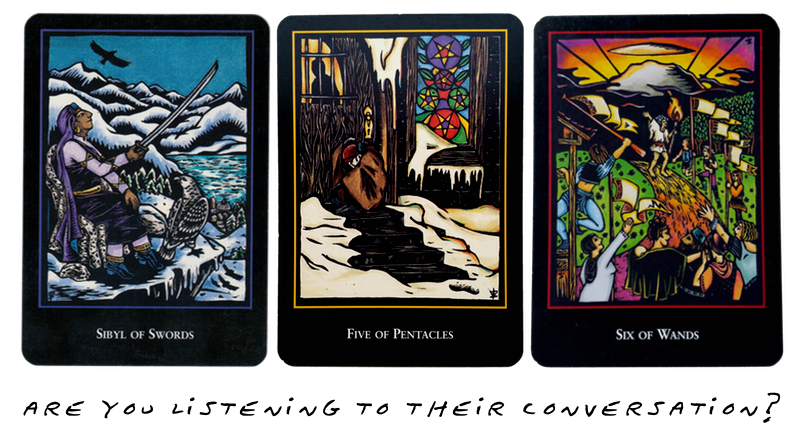
Since our querent has many passions, the first triangle is one of self with a focus on the querent's strengths in order to help them figure out what passions may be best turned into a career path. The first triangle is the foundation stone of the spread - these cards will not move but will still interact with the other cards pulled which will be explained as we go along. For their triangle of self, the querent pulled the the Sibyl (or Queen) of Swords, the Two of Wands, and the Ten of Wands (inverted).  I've given some brief interpretations as a full interpretation of this spread would be a long post indeed! The Sibyl of Swords crowns the triangle and speaks to the querent's underlying theme of storytelling in all that they do as well as a maturity to their craft . The Two of Wands both represents the querent's ability to help others find hope and possibility through telling their stories and re-membering (literally, putting back together) who they are as well the possibilities ahead of the querent in regards to turning their passion into a career. The inverted Ten of Wands recognizes the querent's overwhelm at having so many interests, which has left them feeling stuck and burdened, but since it is inverted the energy is diluted and there is a recognition that the querent is focusing their creative fire (as represented by the wands) as opposed to being completely overrun by it. The Ten of Wands is a reminder for the querent to continue to understand their own story and to own it as part of their work of discovering the path ahead of them.

The next three cards make up the triangle of chrysalis which gives specific insight to help the querent begin to transform their passion into a career. The three cards of the triangle of chrysalis are the Seven of Pentacles, the Five of Pentacles, and the Hanged Man which overlay the last three cards of the triangle of self.  First, we look at the conversations happening between the Sibyl of Swords and the Seven of Pentacles (it's time to actually harvest what you've grown with all of the hard work you've already put in - you're not starting from ground zero even if it feels like it at the moment), the Two of Wands and the Five of Pentacles (it is difficult to help others find possibility and hope if the querent has a limited vision of possibilities about their own success and feel that they are in a permanent state of scarcity), and the Ten of Wands and the Hanged Man (the Hanged Man recommends that the querent transforms the feeling of stagnant stuckness to focused stillness in order to understand that they have all the tools they need for the task ahead even though it requires them to sacrifice self-limiting beliefs and practices).

Once the initial conversations have been listened to, move the cards clockwise the next position. So the Hanged Man sits with the Sibyl of Swords, the Seven of Pentacles states talking with the Two of Wands, and the Five of Pentacles strikes up a conversation with the Ten of Wands. Further insights can be gleaned now with the same cards in different positions. The Five of Pentacles, for example, reveals that part of the overwhelm experienced through the Ten of Wands is trying to figure out what passion will be most profitable which feels limiting and confusing to the querent. The cards are moved one final time to complete the circuit and have their third conversation, and then they are moved back to their original position before the final three cards of the last triangle is cast. 

The third triangle is one of action, recommending next steps for the querent to take on to create a sustainable career from their storytelling passion. The three cards pulled were the Seer (or Page) of Pentacles, the Three of Wands, and the Six of Wands. The Seer of Pentacles, especially in this deck, has a powerful air energy moving through it (see the creatures flying out of the tree above the head of the sitting person) and speaks to the Sibyl of Swords' ability to help guide folks through their reflective journey to finding their own stories and becoming grounded in their truth. The Seer of Pentacles serves as an affirmation that the path of the storyteller will not only be a prosperous and sustainable one for the querent (since Pentacles are a suit of security, abundance, and long-term planning), but the card also illustrates the type of work environment that the querent can create in order to be successful. The Seer of Pentacles is also speaking with the Seven of Pentacles and, in fact, represents the harvest illustrated in the Seven of Pentacles. The Three of Wands is a great continuation of the conversation started by the Two of Wands and continued with the Five of Pentacles - it shows what the cultivation of hope and the exploration of the querent's money and success story can do when it comes to expanding their prospects. The Six of Wands shows the transformation of the figure in the Ten of Wands into the Hanged Man and finally returning home again to community that wants and needs their skills and insights. The Six of Wands reminds the querent that they have a vast support network that they need to tap into when it comes to promoting themselves and developing their business. Again, as with the triangle of chrysalis, these last three cards move around the spread conversing with new cards, gleaning more insight into steps to take for the path ahead. You can move the cards in the triangle of chrysalis again, too, if you like. Imagine the conversation that could be had between the Sibyl of Swords, the Five of Pentacles, and the Six of Wands about clearing out a scarcity complex as part of the work of bringing together community.

What I like about the moving parts of the Triangulation Spread is the fact that it reflects the complexity of the shifting parts of our lives. Moving the cards around can be helpful when a querent feels stuck in one place and has no clue how they're supposed to get to a hopeful card that has shown up later in the spread. The act of physically moving these cards together (which is a play on traditional spellwork in which components of the spell are moved closer and closer together to attract a certain outcome) can be such a simple act but still provide a surprising amount of revelation. As you can imagine, there are many ways to ask questions and shift cards within the context of a Triangulation Spread - I hope you have fun experimenting and share your experiences in the comments below or by using the hashtag #TriangulationSpread in your various feeds (I'm on instagram most often if you're looking to chat). Need more tarot in your life? Come this way!

Have fun triangulating!

All cards shown in this post are from the World Spirit Tarot.

1 Likes
categories / tarot + divination
tags / tarot, divination, oracle, world spirit tarot, how to read tarot cards, herbal tarot, tarot apothecary

Stank Face and the Power of Emotional Bitters

April 27, 2016  /  Alexis J. Cunningfolk

You know stank face.

The look you pull when you don’t like something or someone. The face you make when you’re feeling irritated and aggravated. Or your expression when someone is dancing on your last nerve.

We've all been there and maybe you've already made a stank face or two today. That's why I'm sharing with you my recipe for emotional bitters to detox the stank and reconnect with compassion for yourself and others.

Stank Face is an excellent elixir for those who work in cubicles, those who work with angsty teenagers or are angsty teenagers, people who purposely read blogs or consume media that they know will irritate the heck out of them, community organizers, those folks who have ever found themselves snarling, and anyone with a face.

So what clears up a bad case of stank?

Lavender (Lavandula officinalis): Lavender says chill out, everything will be ok. Here have an emotional massage and a love cookie.

Rose (Rosa damascena): Rose reminds you that you are a prism of love. An irritated, tired, but ultimately awesome and able to shift your mood for the better prism of bad-ass love.

Vine Flower Essence: Vine says bend and sway. Learning the skill of emotional flexibility and connectivity is the gift of Vine.

Holly Flower Essence: Holly tells us to let it go. Really, emotions like jealousy, rage, envy, and hatred don't serve us in the long run. Holly reminds us to love.

Rhodochrosite Gem Essence: Rhodochrosite tells us to gaze within. Our irritation and frustration with the "other" and those things that we perceive to be happening around us or to us can act as a mirror to underlying emotional wounds and unmet needs that we carry. Rhodochrosite helps us to use challenging emotions as a mirror to gain greater clarity into previous experiences that still affect us today and how we might move that energy in more useful and beneficial ways. Then again, sometimes we just need a hug. Rhodochrosite can give us a good supportive squeeze.

StankFace ad.png

Stank Face has a taste that is sweet with an edge of bitter to detox tension, irritation, and eye-rolling. Stank Face requires a tincture and glycerite be made which you can learn about on our Plant Ally Project: 30 Day Challenge page. Alternatively, you can always purchase the following extract and glycerite from your local herb resource and simply mix them together.

Begin by making your own Lavender (Lavandula officinalis) alcohol extract (if you are alcohol-free you can make a Lavender glycerite instead).  You will also need to create a Rose (Rosa damascena) glycerite. Find directions on how to create a simple folk extraction on our  Plant Ally Project: 30 Day Challenge page.

Once your extracts have brewed, combine them as such:

  • 3 parts Lavender (Lavandula officinalis) alcohol extract
  • 1/2 part Rose (Rosa damascena) glycerite

Then add the following essences:

  • 5 drops Rhodochrosite Gem Essence
    • Alternatively, you can use the easier to find Rose Quartz essence OR Rose Flower Essence if you cannot find or make your own Rhodochrosite Gem Essence.
  • 1 drop Vine Flower Essence
  • 1 drop Holly Flower Essence

Stank Face is already naturally sweet with the Rose glycerite, but you can add some local raw honey or maple syrup to your blend if you want it a little sweeter. I typically add 1/2 - 1 teaspoon of sweetness to every 1 ounce of brew.

Keep in a cool, dark place - it'll probably be to the left of where you keep your snarky thoughts. Your elixir will last the longest if stored in the refrigerator. The remedy is best enjoyed within 2 years, but will last for many more years if stored properly.

Recommended Uses

  • Take 1 - 3 drops as needed, either directly under the tongue or in a glass of water, juice, tea, or other liquid beverage.
  • Add drops to your water bottle.
  • Use before bed, meditation, working out, or anytime to release tension.
  • Rub into pulse points.
  • Add a few drops to a bath.
  • Add to a spray bottle and use as a room spray. Do not spray others with it out of irritation. Spray yourself first, friend.
  • Add a few drops to spell bundles and ritual amulets to charge them with extra potency!

Enjoy the stank-free days ahead and let me know your experiences with the recipe, including ways you adapted it to your unique needs, in the comments below!

4 Likes
categories / recipes + tutorials
tags / stank face, bitters, herbal bitters, lavender, rose, vine, holly, rhodochrosite

To Know : The Practice of Engaged Herbalism

April 18, 2016  /  Alexis J. Cunningfolk

I'm intrigued by practice. I like exploring the what and the why and the how of those things we find ourselves invested in. In fact, the first book I wrote was a workbook exploring devotional practice and it is a topic that I think about on the daily as I perform my regular rituals of magick and devotion. As part of my practice as an herbalist, I often reflect on why I do what I do and how I do it, not only as part of my continuing education as a wellness practitioner, but in order to make adjustments to my practice as I grow in my ability to serve others and their healing. Such reflection is part of my practice of engaged herbalism, which is an herbalism that is strongly rooted in the development of relationships between plants, peoples, and creatures. Practicing an engaged herbalism allows me to maintain and grow my ability to engage and re-engage those I am working with on their healing journey and to always be re-connecting with the wisdom of our plant kindred.

As a teacher of herbalism and magick, I have come to find that the concept of engagement, if understood early on, can prevent student overwhelm which can lead to a stagnation or abandonment of their studies. For the more experienced practitioner, engaged herbalism can help to prevent burnout and compassion fatigue.

Let’s start with understanding what engaged herbalism is not before exploring why it can be so useful.

Engaged herbalism is not:

  • An herbalism of quick cures and magic pills. 
  • An herbalism that sees plants as inert and spiritless.
  • An herbalism that treats the body as a compartmentalized machine in need of repair.
  • An herbalism that is infallible and always right.
  • An herbalism that is divorced from social and environmental justice.

In fact, engaged herbalism is:

  • An herbalism of the long view and the journey of wellness.
  • An herbalism that sees plants as wise, complex, and generous of spirit.
  • An herbalism that interacts with the body as a profound and intricate physical vessel of consciousness and experience.
  • An herbalism that is curious, ready to try again, and always open to learn more.
  • An herbalism that is firmly rooted in social and environmental justice.
Rosmarinus officinalis by author.

Rosmarinus officinalis by author.

Engaged herbalism embodies the following big vision tenets:

Relationships change.

Your relationship with plants, those you serve, and your own sweet self will change continuously throughout your practice as an herbalist. Through engaging with all of these relationships, we’re better able to keep up with the shifts and swings of our sacred (and sometimes challenging, let’s be honest) interconnectedness. The idea of what herbalism is and who you are as an herbalist will change. Your relationship with individual plants will change. How you make medicine, formulate, and ingest your brews will change. Create space for change from the get-go and you’ll have a built-in system for dealing with some of the more difficult challenges that come your way through your practice.

If you know that your relationship with herbalism, plants, and people will always be in a state of change you give yourself a whole heck of a lot more room to grow. You won’t always feel like the total beginner. Latin binomials will not always be a mysterious realm of antiquity. Those bitter tasting herbs you couldn’t stand at first may well become a familiar and craved taste (yeah, bitters!). You’ll recognize that you and who you are relating to is changing and you are continuing to grow into yourself. Most importantly, when we allow ourselves room for change we recognize that we have all the time we need for change. You have all the time you need to learn how to engage with plants in a way that sings to your soul and enlivens the communities you serve.

Inclusivity matters.

Inclusivity, the idea that there is room for everyone at the table, is foundational in my practice. The art of inclusivity is two-fold - one must learn to be inclusive to others in a way that is love and justice-centered and one must also learn to be inclusive to oneself in the same way. While the conversation of how to create an inclusive practice is for another blog post, I will say that there is a deep need for better inclusivity skills in the Traditional Western Herbalism (TWH) community of North America. There needs to be more voices of color, queer perspectives, multi-abled, class diverse, gender variant and many other sounds and songs invited to the table within TWH gatherings and conferences (though I do recognize and celebrate the smaller festivals doing just that such as the California Women of Color Herbal Symposium - heck yeah!). 

At it’s core inclusivity is learning to engage yourself and the world around you with compassionate curiosity. Inclusivity is also about learning to recognize when you are imposing your beliefs, your stories, and ways of beings on others. The last bit is especially important to learn when working with others in a practitioner-client relationship as it can be easy for our own stories and experiences to block the view of the needs and stories of another.

Rosmarinus officinalis by author

Rosmarinus officinalis by author

At the same time, inclusivity must be practiced on a inward and personal level where we engage and excavate those stories, beliefs, and systems of power imposed on us. When I was taking my first couple of herb classes, for example, I nearly abandoned the idea of becoming an herbalist when I was introduced to the weight-and-volume method of creating extracts because it involved a bit of math. Sounds ridiculous, right? But I had been told a story for years and years by teachers that some kids - like me - aren’t smart enough for math (what an awful inclusivity fail). So, having not examined the story of being a numberless mongrel in my life yet, I thought that if herbalism involved math I therefore must not be qualified to be an herbalist. I had uninvited myself to the table and it took a few years to invite that little kid who got overwhelmed by numbers back home. Fortunately, my fear of calculations did not put me off from practicing as an herbalist (and I developed a few techniques for the number intimidated to calculate their tinctures as a result) and I make sure in my classes to keep an eye out for these moments when students might feel like they have hit an impasse of intimidation. It is my responsibility to create a classroom and consulting space that I am not only able to notice when intimidation or overwhelm is occurring but that folks feel empowered enough to speak up and ask for help, a break, or a moment of “don’t worry we all get confused by this stuff sometimes” affirmation.

Inclusivity matters because we learn to listen to that which has remained hidden - whether this is something within us that we have hidden from ourselves or something that we do not see in others because we (often from a place of privilege) get in our own way. If you are someone who is confused by or perhaps balks at the idea of inclusivity as foundational to herbalism, consider this: as herbalists, many of us value and treasure wild weeds that are often disdained, rooted out, and poisoned by the general non-plantfolk public. Yet, we have been invited by these tenacious plant kindred to learn of their healing gifts and, in turn, we have included them in our hearts, sharing their wisdom with others. By working that inclusivity muscle we have engaged our herbalism and come out the better for it. (Sidenote: I’m currently reading Invasive Plant Medicine by Timothy Scott and it’s great! The book explores topics of inclusivity and migration within the context of plant medicine as well as a practical materia medica for these often undervalued plants.) Engaged herbalism leads to better inclusivity which creates more opportunities for healing - everyone gets their fill of nourishing plant wisdom when we know how to get to the table.

Rosmarinus officinalis by author

Rosmarinus officinalis by author

Make sure to turn inspiration into insight.

Now here is where a lot of students (and long-term practitioners!) get stuck. It can be so very easy to be head-over-heals in love and inspired by the romance of herbalism. A deeper relationship with the earth, the fragrance of grinding herbs with a mortar and pestle, the ancestral connections, and the sense of rebellion that comes with taking charge of your wellness. Jars are bought, herbs are collected, we consider changing our names to something more earthy like Seedwizard, we buy the best harvesting knife, oh and one of those woven baskets for drying herbs! The inspiration to practice herbalism can be intoxicating, but without a foundation to grow on, the energy is quickly spent as the reality of the practice of herbalism settles in. Yes, there is the romance and the heady scent of an herb garden, but there is also moldy herbal oils, stubborn health imbalances that no tincture seems to help, terrible tasting teas, and the frustration of feeling like one knows some things but not enough things about herbs and how to use them to be really effective. I have been there myself, clever ones, wondering where the spark of inspiration has gone in my herbal practice.

What I have discovered is that inspiration is a spark that craves the wax and wick of insight to keep burning.  Inspiration starts the journey and reinvigorates the path from time to time, but if we do not give inspiration a place to take root it can fly off leaving us feeling like we’ve failed somehow. To keep inspiration, I have found that you have to learn how to allow it to grow into insight. We may have been inspired to use herbal medicine to reconnect to our wellness, but insight is when we suddenly realize that we get the same chest cold at the same time every year which started when our mother passed away and that perhaps there is some underlying grief we need to explore. Insight is a sign of growth and that we are engaged in our practice. Through insight we pay attention to why we are inspired and what our inspiration brings. Insight is realizing that we can and should always be learning more about ourselves and the world, giving ourselves the freedom to do just that. Ultimately, the inspiration to get well leads us to the insight of how to do it.

How do you practice your herbalism?

Is it engaged? Ecstatic? Enchanted? Funky? Revolutionary? Under-the-cover-of-darkness? Let me know in the comments below how you describe your herbal practice.

One more thing… I wanted to point out that the first part of the title of this post To Know is a reference to the Witch's Pyramid, also known as the Four Pillars of the Magus or the Powers of the Sphinx. The other three traditional pillars are To Dare, To Will, and To Keep Silent. Modern additions to the pyramid have been made adding a fifth point such as To Weave or To Desire. The Witch’s Pyramid is an important part of my magickal practice and I’ll be incorporating it’s philosophy into forthcoming posts about life as a practicing herbalist. For those wanting to go more in-depth, I explore the Witch’s Pyramid and it’s relationship to creating ritual in a podcast series in the Lunar Apothecary - I invite you to check it out.

Wherever your herbal studies may take you, I hope you always find yourself returning home to the knowledge of you - expansive, microscopic, complex, and wondrous you.


We respect your privacy and will not share your information with anyone no matter how engaging they are.

Thank you for signing up for Magick Mail! Once you have confirmed your subscription to you will gain access to our super secret member's only area!

0 Likes
categories / path of the herbalist
tags / to know, rosemary, herbalism, herbology, four pillars of the magus, plant medicine

Shine Bright! Golden Herbal Powder Recipe

March 23, 2016  /  Alexis J. Cunningfolk

My Golden Herbal Powder will have you shining bright! 

Dispel the clouds of fatigue, the fog of exhaustion, and the overcast humdrum of dull living! Live with shine, I say, and strengthen your adrenals with our sunny tonic. Golden Powder Blend is a wonderful daily remedy for those wanting to help rebuild adrenal strength and is beneficial for those with hypothyroid conditions. 

So, what makes Golden shine so bright?

Maca (Lepidium meyenii) 

Maca is the strong foundation of our adrenal tonic, addressing issues of adrenal exhaustion, chronic fatigue, and having a balancing affect for those with hypothyroid conditions. Maca is also a good reproductive tonic, as it has aphrodisiac affects and improves the quality of sperm. As an adaptogen, Maca helps us adapt to stress.

Pine Pollen (Pinus massoniana)

Pine Pollen is a golden sunbeam of nutrition! Full of vitamins and minerals, Pine Pollen contains 20 amino acids, including the 8 essential amino acids and minerals such as Calcium, Iron and Zinc. Pine Pollen helps to regulate metabolism, increase energy and dispel brain fog. A friend to the prostate, Pine Pollen is a wonderful wellness ally in preventing prostate disease.

Mesquite (Prosopis pallida) 

A wonderful, sweet and low-glycemic food, Mesquite is a good source of fiber and easily digestible protein.

To make your own Golden Herbal Powder mix together the following powdered herbs:

  • 2 parts Mesquite (Prosopis pallida) 
  • 1 part Maca (Lepidium meyenii) 
  • 1/4 part Pine Pollen (Pinus massoniana)

Recommended dosage is 1/2 - 1 teaspoon up to three times daily. You can mix Golden into water, juice, smoothie or your food of choice.  Enjoy!


We respect your privacy and will never share your information with anyone no matter how brightly they're shining.

Thank you for signing up for Magick Mail! Once you confirm your subscription you'll receive access to our super secret member's only area! Neat!

1 Likes
categories / recipes + tutorials
tags / maca, pine pollen, pine, mesquite, herbal powder, adrenals
Newer  /  Older

© 2010 - 2025 Worts & Cunning Apothecary | All Rights Reserved | Disclaimer | Land Acknowledgement
. live your magick .