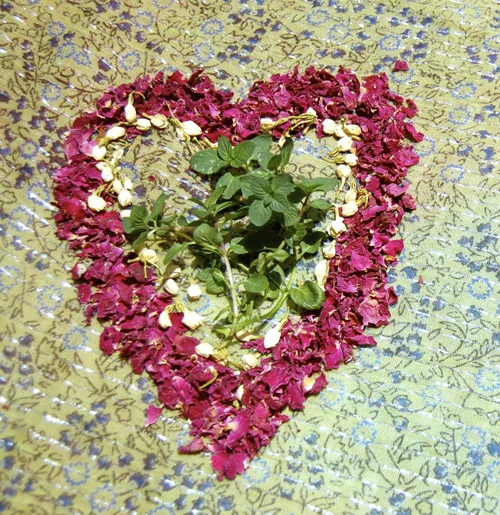
She Pours Again: Full Moon in Aquarius


It happens.
We try our darndest to keep it centered, but then there is the knock at the door.
The Blah-beast has come with its one-monster show of stressful cacophony, the dullest brew of boredom, and the persistent fear that we might never get back on track.
"NO! Not the Blah-beast!" We cry out.
And, then we have a thought.
"Blah-beast, could you hold on just one moment? We wanted to position ourselves in a much more effective repose of despair and put on the kettle so its sharp wailing will add to your monstrous sense of foreboding!" We shout from behind the door.
"Blah, whatever, it doesn't matter, I'll be wiggling my toes in your head very soon," The Blah-beast grumbles.
Gross. We think, but don't dare say. "Thank you, great Blah! We'll be but a moment!"
Quickly, quickly, what to do? Gather together herbs for the heart, herbs for passion, and herbs to disassemble the structure of stress attempting to build a small suburb along our spine. Jars full of herbs are pulled down from the shelves, the magick wooden bowl is brought out for the mixing, and with a wild-eyed charm (Will it work? It must! It will!), a tea pot is given four spoonfuls of a new herbal tea.
There is a shout in the kitchen for the kettle is hot! There is a grumble at the door of a Blah-beast anxious to come in!
Pour the dancing water in the pot, let it brew, keep it hot. Pour a cup and drink it up!
The Blah-beast has been tricked! It roars and beats its paw upon the door - but it has been overtaken with an overwhelming sensation to bust a move, drop it like its hot, and groove its suddenly happy heart off into the sunset.
Phew. We made it, our Blah Buster Brew to keep the Blah-beast bustin' a move to their own happy dance and not our own personal groove.
click image to enlarge
Blend together the following herbs:
Boil up fresh water and add 1 heaping teaspoon of tea per every cup of water to your teapot. Brew for at least 15 - 20 minutes, but the longer the better! Pour into your favorite tea cup and get ready to set some boundaries with the Blah Beast + break out into your own sweet groove! Enjoy!




I just spent the past weekend in the beautiful wilds of Oregon dancing the days and nights away with magickal creatures of all varieties at the amazing Faerieworlds art and music festival! I came back to my seaside city feeling inspired and with some extra dirt and glitter packed in my bags (and, to be honest, tangled in my hair and between my toes). As some of us celebrate the week of the First Harvest in the Northern Hemisphere and late winter / early spring fire festivals in the Southern Hemisphere, I'm filling up on summer's glow as the promise of fall is just around the corner.
One of the ways I like to celebrate the early mornings and long, lazy nights of summer is with pots of chai. Chai is simply the word for tea in a number of cultures, though many of us are familiar with the Masala chai of South Asian fame. I love to make chai blends based on local flora, culturally-entwined spices, and my own take on whatever tea drinking culture I may find myself in. Some of my chai blends are created with longing-in-the-heart, as I dream of places I look forward to visiting. Sweden has captured my imagination in recent years and so I created a Swedish chai in exploratory tea anticipation of future journeys. The recipe is below along with some insight into the spices and herbs included in the blend. Enjoy!

Books have been written espousing the greatness of healing spices and what many consider dusty kitchen condiments are actually earthy jewels of wellness delight. Spices are healing foods that are easy to add to any meal and act as a fragrant passage for medicine to find its way through our mind, body, and spirit.
Cardamom (Elettaria cardamomum) is an excellent spice for indigestion and calming upset stomachs. Like many spices, Cardamom also has aphrodisiac qualities.
Clove (Syzygium aromaticum), like many spices, aids with indigestion, but also has anti-inflammatory, anti-oxidant, and anesthetic qualities.
Cinnamon (Cinnamomum spp.) is a delicious blood sugar balancer and is also heart-healing, promoting healthy circulation, reducing hypertension, and possessing anti-clotting properties.
You can learn more about Elder, the Tree of Medicine + fiery Ginger in previous posts!


One of the most common emails I get (besides “Who are you and where do you come up with the names behind your products?! Zombie bait, what?!”) are ones that ask me about my path of becoming an herbologist and how to start working with herbs. I wrote about 10 ways to start your herbal studies, but I wanted to focus more in-depth on a subject central to the craft of the herbologist – cultivating our relationship with the plant medicine.
As I suggested in the previous post about herbal studies, I recommend starting with one herb. You do not have to work exclusively with only one herb, but choose to work with one herb consistently for an entire year. You should, though, spend at least some time working only with that herb in order to understand its full complexity. You may choose to work with an herb that you already feel a resonance with or something that you spot growing down the street from you. You may dream of an herb, study a plant that has a long history of significant use within your culture or choose an herb that may have a beneficial impact on a particular health imbalance. The importance of working with one herb regularly for an extended length of time is manifold:
In my own practice, both personal and professional, I work with a handful of herbs at a time, and while I enjoy a complex tea blend or a raw cacao concoction with multiple herbs dancing in wild harmony, when I am learning about a plant or dealing with a chronic health imbalance, I generally stick to one or two herbs. We are in the midst of an herb revival within North America, as well as many other parts of the western world, and that means that there is an abundance of information and access to a wide array of plant medicine. I tend to think that we will learn more about ourselves and the plant medicine we are interacting with if we treat our practice with the rhythm of a slow, regular tea time conversation as opposed to a social media aggregate of endless stream of herbs shuffling through our lives at a rapid pace.[1]

It is pleasurable and useful to recognize the affects of individual plant medicines on our mind, body, and spirit. Working with one or two herbs at a time allows for greater clarity and distinction between the subtleties of difference between herbs with similar healing qualities. Moving steadily in our relationship with plant medicines, we begin to build our knowledge of the energetic signatures of herbs along with their physical qualities. These energetic signatures combined with their physical qualities is one reason why one herb will be so successful for Person A, but seem to have little affect for Person B in a similar situation. Valerian (Valeriana officinalis), Skullcap (Scutellaria lateriflora), and Tulsi (Ocimum sanctum) are all remedies for migraines, for example, but each have unique energy signatures that affect our physical, emotional, and mental systems differently.
As you begin working with a chosen plant medicine (whether you chose them or they chose you), I offer the following considerations for your journey together, based on the idea of recognition, engagement, and kinship.
Each of us will engage our herbal practice with different insights, experiences, and personal skills that shape every aspect of our lives and relationships. As an herbologist, with my experiences as a Pagan, queer, feminist, multi-racial, tea-loving womyn living in the United States with the myriad of privileges I have and lack access to, my relationships with my plant allies is rooted in these experiences - a foundation of legacy and futuredreaming. The process of working with plant medicines is about learning the ways that I may help facilitate healing between plant and people and creature, but also is about my own personal journey and how I relate to the world within and around me.
I hope that your own journey with the plants of our ocean planet is sweet, challenging, ecstatic, luminous, and balancing, and that you grow in your own wild and greening healing energy.
Be well, clever friends!

[1] Can we take a moment to imagine the Twitter account or Tumblr of some of our favorite plant medicines? Hawthorn will always be posting the latest heart-warming video about puppies, while Cacao keeps posting an endless stream of abstract party photos involving a lot of nudity, and Elder’s stream would be sorta spooky, badass, and intriguing.


6/16/12 Addendum
Damn.
Since originally posting this blog it seems like America has become only more violent. But that would be disingenuous because, especially for communities like Black folk, Indigenous folk, Queer + Trans folk, Womyn folk, and the multitude of intersections of these identities, America has long been a relentlessly violent place. We're only just starting as a larger culture to acknowledge that it may be so.
But we haven't decided to reject and uproot the violence within our systems of power that allow for the incredible acts of everyday violence that goes unchecked and unchallenged. We haven't rejected but instead have continued to breed a culture of mass shootings to the point that we have grown numb as a people.

It makes sense to be angry and exhausted and worn-down and afraid and confused and grieving. It makes sense to be anxious and depressed and heart-broken. There is no magic pill to relieve us of the pain. As a community herbalist invested in the welfare of the web of folks I care for, I can offer to share with you what has been shared with me by our plant kindred who have an ability to remain kind to our confused species even when we don't seem to make any damn sense at all. These are not herbs that are meant to make you "tougher" or more "resilient" to the violence - they are meant to help us let the trauma pass through us so that we may know it but not let it rot our bones and spirits. These herbs offer to hold space, hold hearts, and give us the gentleness we all deserve.
While the following is only a short list of suggestions, see my ongoing list of grief-related resources and writings.
Hiya, everyone,
Given the recent events in Boston, I was reminded that I have wanted to start a community conversation about herbs in times of tragedy. In my own practice I work with lots of folks who are recovering from various levels of violence and trauma in their background, so I have certain herbs (including flower and gem essences) that I find myself reaching for often. In general, I reach for adaptogens (such as Tulsi Ocimum sanctum) and nervines (like Oats Avena sativa) for dealing with the impact of trauma. I think Bach's Rescue Remedy is an excellent in-the-moment aid and I usually keep a small bottle on me. The remedies I use range depending on the circumstances as well as when I use them, but Rose (Rosa spp.), Motherwort (Leonurus cardiaca), Elder Berry and Flower (Sambucus nigra), Black Cohosh (Cimicifuga racemosa) have all been useful. For those who hearts are hurting right now, consider inviting in Hawthorn (Crataegus monogyna) in as a tea, tincture, glycerite or powder.
For herbalists, street medics, birthworkers, social workers, and others who find themselves working on the edges, I always recommend knowing what plants are your allies - the ones who have your heart when things get really tough - and to develop a sacred relationship with them before the hard times come.
What other herbs have folks used? I look forward to learning about other folk's herb allies and the way we support our communities when they are in pain.
Be well, be tender, and reach out to those around you.