
Creating a Personal Curriculum: Herbalism Edition
Have you heard about personal curriculums?
For those who are not yet familiar with the idea, a personal curriculum is meant to be an antidote to the current content overconsumption but information-deprived era of online social spaces by committing to slow, deep, and inquisitive learning practices. To say that I - a 900 year old moss hag and keeper of this ever-growing archive of community resources - love this movement is a dramatic understatement. A community response that encourages curiosity and the joy of learning to counter advertising-driven "social" spaces online and the concurrent dismantling of offline third spaces? Yes!
I try to encourage this sort of curiosity that inspires people to create their own interest-based curriculums throughout my writing (whether in my courses or my book). In fact, when I was first planning out Worts & Cunning Apothecary and what I wanted it to become I wrote down "curiosity" as one of my core values. I believe so strongly that curiosity rooted in compassion is a vital skill to cultivate as an herbalist. Curiosity helps us to notice when we need to learn more, have the grace to admit such a thing, and then to have the initiative to pursue understanding. Curiosity is a central ingredient in the spell of collective liberation.
So with all that in mind, I'd thought I'd share some ideas for personal curriculum courses of study as an herbalist - imagine these as classes you might choose from a course catalogue if Worts & Cunning Apothecary was a university (called Mugwort Commons, of course), complete with academic terms based around the equinoxes and solstices. Choose one or more courses that you're excited about studying for the time frame that works best for you whether that be a lunar cycle, from the solstice to the equinox or even a full turn of the wheel.
And, yes, I've created fake course catalog style signifiers for each course like HERB101 and ANC201 because I'm imagining whole school departments in this pretend university of ours. The current departments at the university (with plans for expansion) are:
Herbology (HERB)
Apothecary Arts (APOTH)
Ancestral Studies (ANC)
Literature & Media Studies (LMS)
Critical Social Thought (CST)
Herstory, History, & Theystory (HER)
Community Practice (COM)
Department of Rest (REST)
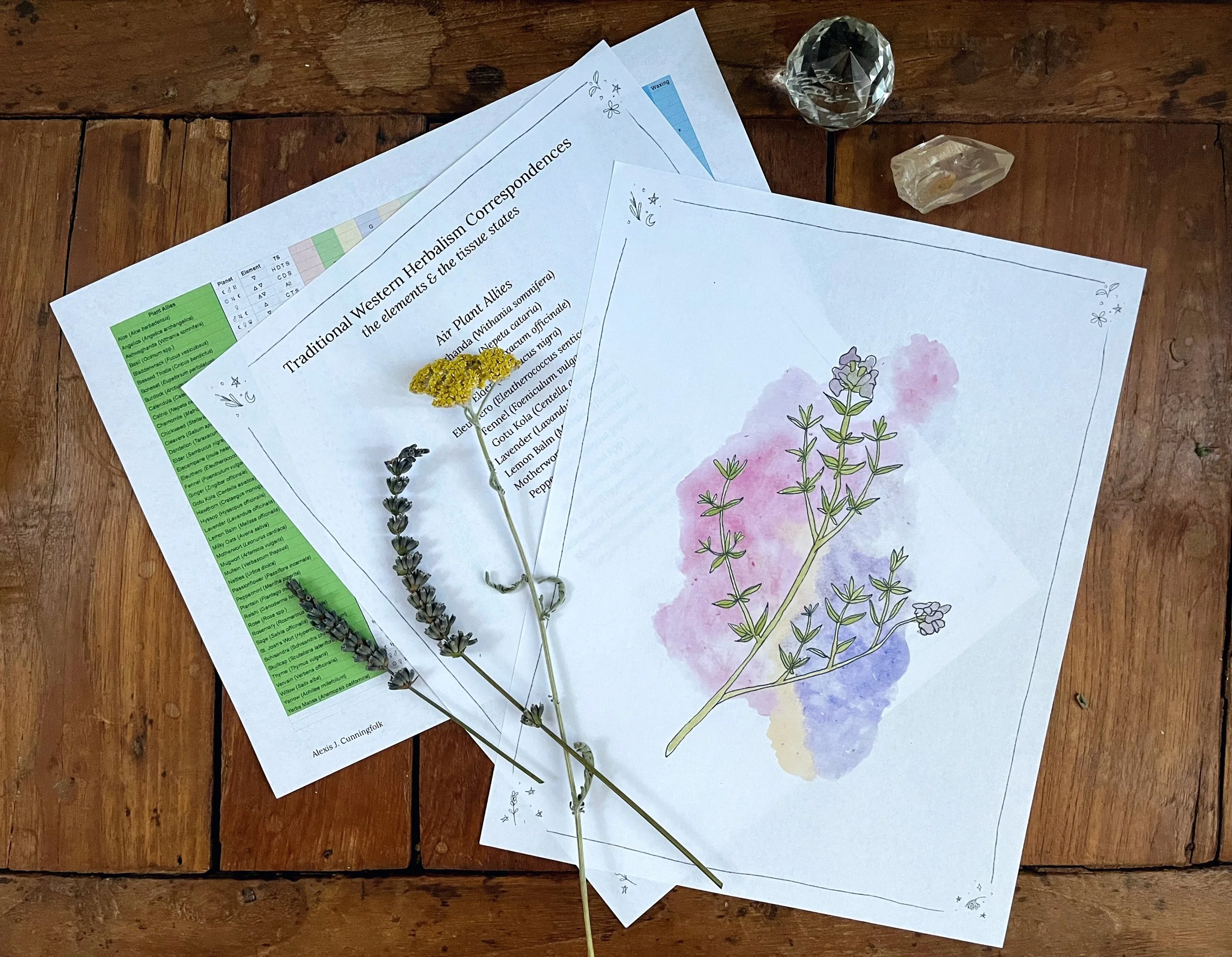
Pages shown from The Plant Ally Library
Mugwort Commons: Solstice Term Courses
🌿 Foundations: A Plant Ally Study (HERB101)
A great course to take if you're not sure where to start and want more structure to your studies. A plant ally study can consist of completing my (increasingly ancient) Plant Ally Project or simply choosing one herb to study and work with for the term. Begin with What Is A Plant Ally? as your first lesson.
🌿 Foundations: Materia Medica Study (HERB102)
Choose one materia medica or herbal book to read through and take notes on, including what you felt about the author's approach (both in philosophy and organization) as well as further areas of study inspired by your reading. Practical applications of recipes or other practices from the materia medica are encouraged, as well as beginning to create your own materia medica. Adaption: You can easily adapt this class to any book on healing arts or broader discussion on health and wellbeing.
🌿 Apothecary Arts: Create An Indispensable Herb List (APOTH201)
Create your own list of indispensable herbs through studying the herbs you choose and creating your own plant profiles to reference. Additional credits can be earned by creating and/or writing down recipes for each of your indispensable herbs. For magickally minded folks, an altar with all of your indispensable herbs present or represented can be created and added to throughout the term.
🌿 Apothecary Arts: Create An Equinox Apothecary (APOTH202)
Depending on whether you're in the northern or southern hemisphere, choose to create season specific remedies for your autumn apothecary or spring apothecary.
🌿 Herbal Names, Herbal Stories: From Common Names to Herbal Novels (LMS201)
A media and literature course exploring the ways that herbal knowledge is shared through myth, folklore, modern stories, and all varieties of media (including podcasts, movies, and television shows). Students can choose to learn about the folklore of a plant ally you are studying (such as the meaning behind the common name of Alchemilla vulgaris and the myths of healing surrounding the plant). Additionally, students can seek out and access media featuring herbal practice and herbalists to inspire their own practice and learn about the original folklore that inspired such portrayals.
🌿 The Herb Bundle: Starting on the Ancestral Path (ANC201)
Connecting to ancestral practices through your herbal practice is powerful and this course focuses on exploring the traditions of people and place in your ancestral line. This class focuses on regional studies (so finding a book on herbs the regions that your ancestors lived), cultural studies, and incorporating ancestral herbs into your current practice.
🌿 The Crossroads of Practice: Intersections of Culture, Identity, and Power (CST301)
For those wanting to understand systems of power, privilege, identity, and oppression within our current medical models and why people seek "alternative" paths like herbal medicine. The course focuses on exploring the social dynamics of power and privilege so that students can strengthen their intersectional perspective on healing and ability to competently and compassionately serve those that seek their services. Examples of areas of study include: the impact of race and class in accessing and receiving competent medical care, the impact of generational trauma on descendents, exploring one's privileges and oppressions, and creating inclusivity in herbal clinics, gatherings, and classroom spaces.
🌿 A Time & A Place: Era or Event-Specific Herbal Practice (HERS301)
For students interested in the history of herbalism and how herbs were used in certain periods of time. Examples of areas of study include: herbalism and the influenza epidemic of 1918, the rise of Thomsonian herbalism, herbal practice in the ancient world (with a focus on a specific region and period of time), herbalism in the era of Nicholas Culpeper, and so on.
🌿 Community Studies: In the World Practice (COM102)
This course focuses on bringing your herbal practice into the world including activities like starting an herbal garden or spreading seed bombs, creating or attending a plant walk or visiting a plant filled place, starting an herbalism focused little library, creating or joining an herbal study group, making and donating remedies to herbal calls to action, and more. The focus is to be on creating community ties, meeting up with people, and engaging with community.
🌿 Moss Beds & Crescent Lounges: A Seasonal Rest Seminar (REST101)
A course dedicated to finding ways to rest and slow down this season, prioritizing screen-free activities and extra credit if rest occurs outdoors. Students gently observe the seasons as wellsprings of inspiration for their rest practices. Connecting with Sacred Ones of dreams, rest, and healing sleep is encouraged, as well as working with plant allies that help relax the body. Completely optional post-seminar activities might include creating digital or physical resources for clients or community members on rest-centered practices of healing and plant allies.
🫖 🌿 📖
If you enjoy this post and not just herbal-focused but magickal-focus personal curricula, come join my sweet patreon community where this series lives. Not only will you be supporting my ability to continue to create free and low-cost resources on herbalism and magickal practice, but you get to hang out with other curious and folk while getting access to hundreds of patreon-exclusive posts.
For those of you looking for more seasonal guides to your herbal studies, you might like the create your own apothecary series or having a browse around my plant allies archive. You can also check out my herbal resources list for more ways to study herbalism through the abundance of free resources and gatherings out there.
Wherever your studies take you, I hope that they lead you to a greater sense of connection with the world within and around you, inspired by what you discover there.

This post was made possible through patron support.
❤︎ Thanks, friends. ❤︎
