
Finding Ease: Meadowsweet Plant Profile
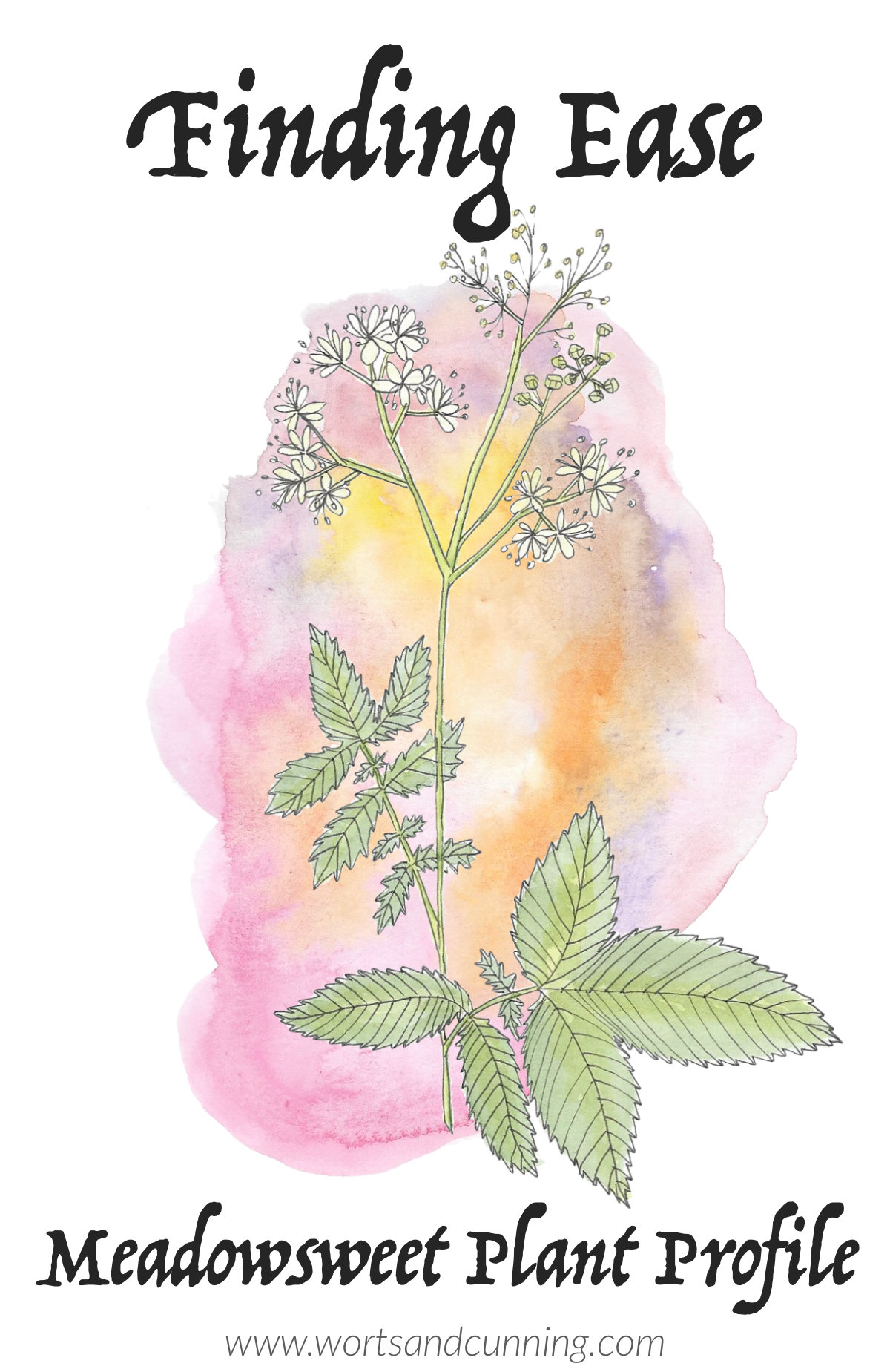
Writing about a plant like Meadowsweet (Filipendula ulmaria) which has long recorded use and even further evidence of use in prehistory, can feel like walking into a very full gathering of herbalists and Druids, midwives and cunningfolk, alchemists and physicians, all noisily sharing their stories at once. You begin to imagine all the places Meadowsweet has been - offered as part of the burial goods of beloved member of a tribal community; showing up in a bridal bouquet or burned in a midsummer bonfire; hastily harvested by the eldest daughter to brew a pain-relieving tea for an injured brother; or gathered by staff of a noble household for strewing about the bedchamber. Meadowsweet demonstrates just how ubiquitous a plant can be in our lives, showing up for both the profoundly mundane and intimately mystical.
It's rather amazing how herbal knowledge has been preserved through the ages - this wasn't a guarantee and while there has been loss, there has been a stronger persistence that working with plants is not only useful but meaningful. While I might not be adding a significant amount of knowledge about Meadowsweet to our collective library of plant stories, I do hope that these plant profiles help you experience a sense of familiarity and kinship with all of these plant allies who have journeyed with us through the generations. I hope you'll share your stories of our green kin freely, too, so that the knowledge of herbalism continues to flow like a river and all can drink deep of its wisdom.
So, let's meet Meadowsweet together and and learn all about their healing gifts…
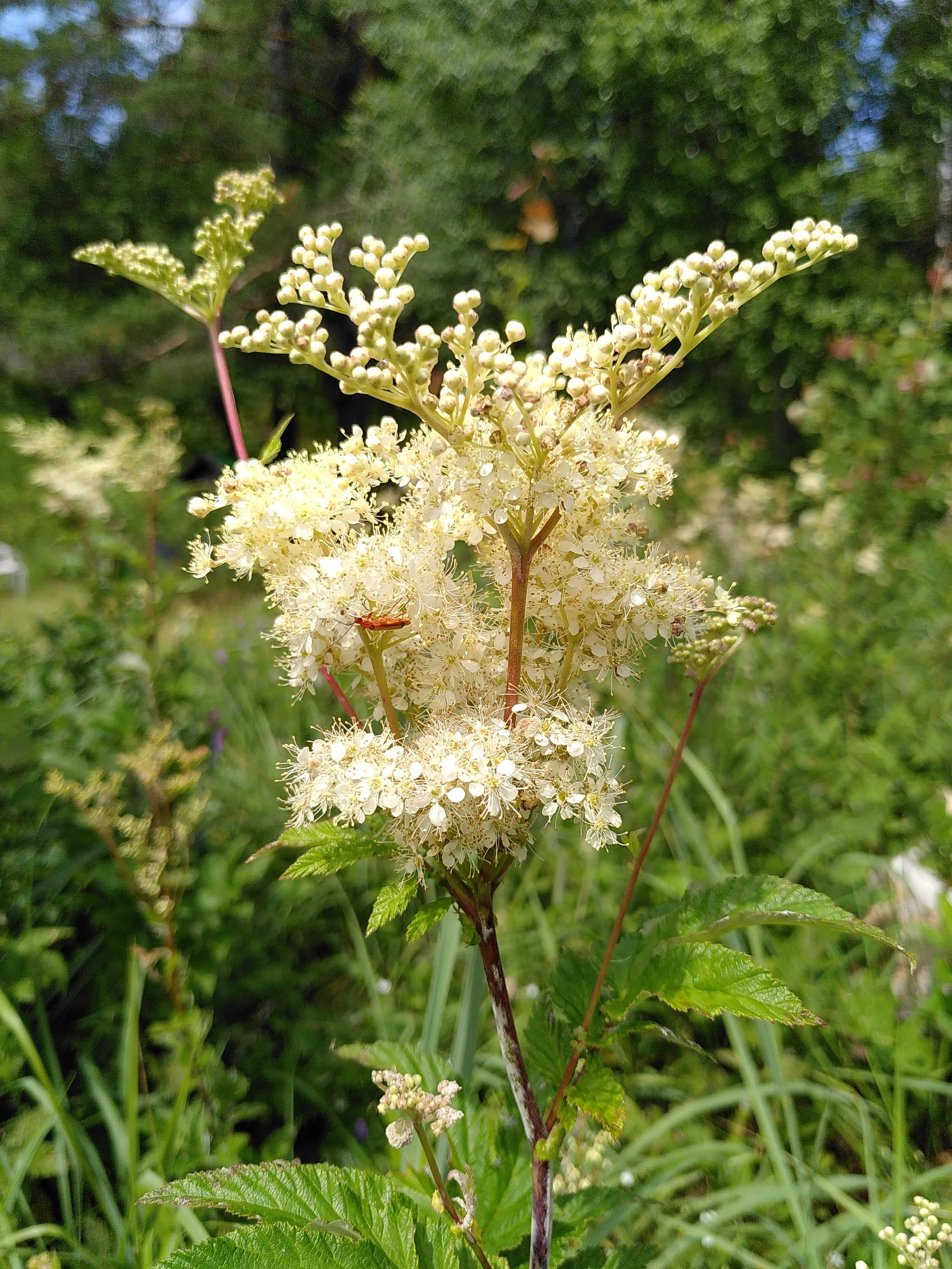
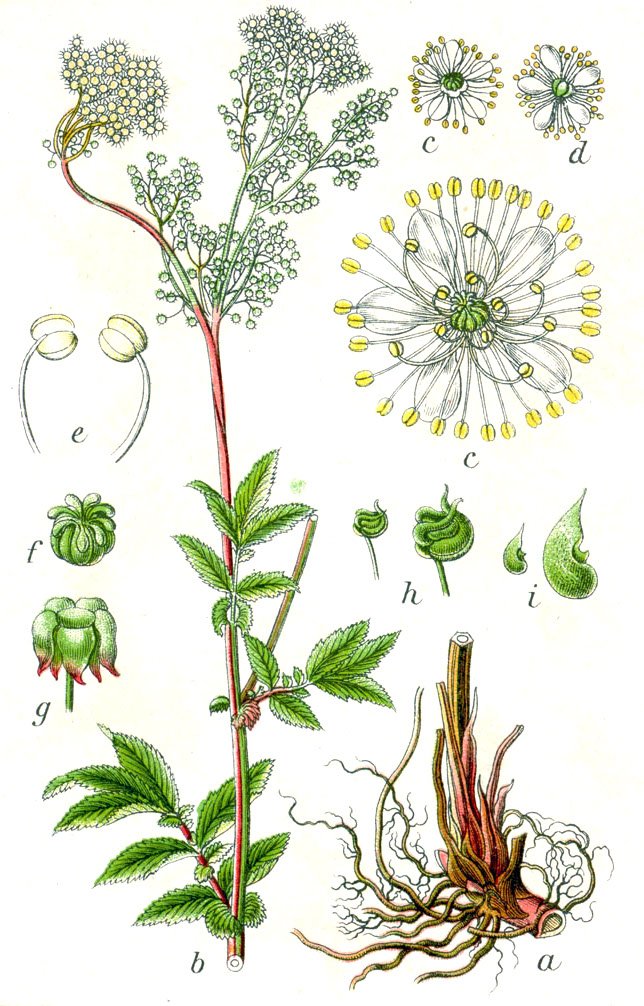
Marterum, CC0, via Wikimedia Commons
Meadowsweet
(Filipendula ulmaria)
Common + Folk Names : Mead wort, bridewort, dolloff, goat's beard, lady of the meadow, meadsweet, pride of the meadow, queen of the meadow, steeplebush, trumpet weed, gravelwort, little hay, spirea, crios cú chullain
Element : Air, Water
Zodiac Signs : Carries the energy of Sagittarius and Libra. A remedy for Virgo, Scorpio, and Capricorn.
Planets : Primarily Jupiter and Venus, with Mercury and Saturn to a lesser degree
Moon Phase : Full Moon
Tarot Cards : The Lovers, Temperance (learn more about the connections between the tarot and herbs)
Parts used : Aboveground plant
Habitat : Native to Europe and Asia.
Growing Conditions : Loamy, moist soil and part shade to full sun. Herbalist Angela Paine suggests that the ideal place to grow Meadowsweet is in "a boggy patch in your garden where water tends not to drain away."¹
Collection : When the flowers are in full bloom, typically from Midsummer to the end of July.
Flavor : Bitter, astringent, slightly sweet
Temperature : Cool
Moisture : Dry
Tissue State : Heat/Excitation, Damp/Relaxation
Constituents : Vitamin C, calcium, iron, silica, sulfur, essential oils, salicylic acid, spireine, gaultherine, spiraeoside, flavonoids, vanillin, coumarin, glycoside, mucilage, magnesium, tannin
Actions : Analgesic, anodyne, antacid, antilithic, antibacterial, antiemetic, anti-inflammatory, antiulcer, antirheumatic, antispasmodic, aromatic, astringent, cholagogue, diaphoretic, diuretic, febrifuge, sedative, stomachic, urinary antiseptic, immunostimulating, antimicrobial, connective tissue healer
Main Uses : Queen of the grasslands, heathlands, and the edges of riverbanks, lovely Meadowsweet is a member of the Rosaceae family alongside fellow toning and anti-inflammatory herbs like Rose (Rosa spp.), Raspberry Leaf (Rubus idaeus), Agrimony (Agrimonia eupatoria), and Lady's Mantle (Achemilla vulgaris). Meadowsweet has deep roots in the Welsh and broader Celtic healing traditions - including use as a healing herb by the legendary Physicians of Myddfai. In the humoral tradition (which form a significant part of the foundation for the more modern six tissue states), Meadowsweet embodies the energies of the sanguine humor, also known as the humor of air and blood. With its "home" in the liver, the sanguine humor not only helps with digestive warmth, but was a pre-modern way of describing the circulatory system. While there are plenty of practices to be left in the past the qualities of an herb with long recorded use within traditional western herbalism like Meadowsweet is even better understood when we have a basic understanding of the ancient energetic systems that our herbal ancestors drew upon. In addition to developing an appreciation for how certain medical concepts came to be in the western herbal and medical traditions, it's also a way to spot and weed out ideas about bodies that are best composted and returned to earth rather than carried forward any longer.²
As modern herbalists, we continue to use Meadowsweet as a digestive tonic and as a circulatory tonic especially in the case of fever. Signs that Meadowsweet might be particularly useful for a cold or fever is indigestion - which you'll sometimes see referred to as "dyspepsia" in older texts which roughly means "ill-humor" - and an accompanying headache arising from stagnant energy. Consider combining with Boneset (Eupatorium perfoliatum) for extra pain-relieving support.
In fact, it was the study of Meadowsweet's pain-alleviating salicylic compounds that led to the development of aspirin.³ Yet another plant to thank for the gifts of modern medicine! If you find aspirin to be too upsetting for your stomach or need to avoid blood thinners, Meadowsweet might be a useful alternative as it has the added benefits of phenolic compounds which protect against irritation that can be caused by salicylic acid. In the case of ulcers, herbalist Elisabeth Brooke notes that Meadowsweet "increases the rate at which the lining of the stomach is renewed and so helps any ulcer to heal faster than usual."⁴
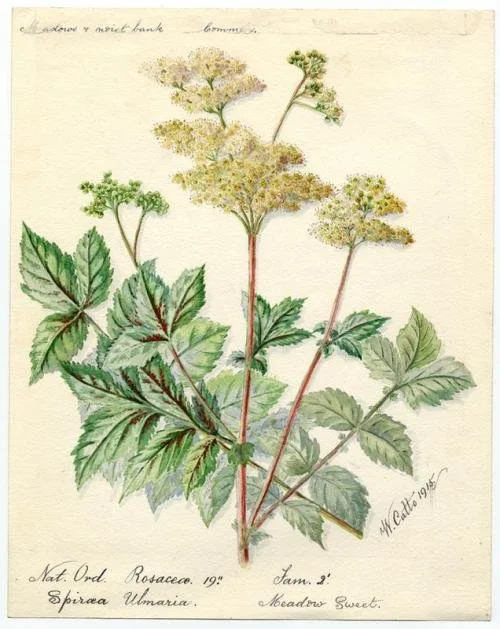
William Catto, Public domain, via Wikimedia Commons
Meadowsweet is also considered a cleansing herb not in a harsh, purgative manner, but in the way that it helps to thin and flush out build-up throughout the filtration systems of the body. Use for urinary tract inflammation and infections. The herb is also helpful in cases of rheumatoid arthritis, osteoarthritis, and gout, alleviating pain and helping to resolve the build-up of uric acid and oxalic acid - use both internally and topically for relief. In addition to breaking down uric and oxalic acid, Meadowsweet can help to break down deposits that can lead to kidney stones and gallstones. Returning again for a moment to the humoral tradition, humoral herbalist Stephen Taylor's description of the Meadowsweet for rheumatism illustrates some of the ways our ancient herbal ancestors conceived of the four elements as diagnostic tools:
"Rheum in Greek means flow, so the joints or rheumatics are strongly associated with the water element. When they are hot and inflamed, a cooling, eliminating herb associated with water, such as meadowsweet, is very helpful…"⁵
These days elemental language is both somatically useful as well as being a way of making medical concepts more accessible. For some clients they'll resonate with a description of "applying anti-inflammatory herbs to help lubricate joints to improve mobility" while others might be able to comprehend and feel what is being said clearer with a statement like "we want to bring cooling herbs to this hot and stiff knee so that you can move more freely and feel like you're getting back into your flow." Both are useful approaches and usually a combination of medical and somatic or elemental language will allow for the greatest understanding between practitioner and client.
Meadowsweet is a general digestive tonic, helpful for many cases of indigestion, but it can be particularly helpful in cases when indigestion and accompanying symptoms of nausea are worse in the morning. The digestive fires need help "waking up" in the morning and Meadowsweet can help to stoke the flames (consider combining with Zingiber officinale). Sea captain turned herbalist and naturopathic doctor specializing in digestive disorders, Captain Frank Roberts wrote highly of Meadowsweet, naming it as "a true normalizer of a badly functioning stomach."⁶ Herbalist Maude Grieve further affirms the herb as a "corrector of the stomach."⁷ Meadowsweet is also an excellent remedy for indigestion caused by an overly acidic stomach (look for signs of acid reflux, nausea, and heartburn) and useful in the case of peptic and gastric ulcers (consider combining with Althea officinalis, Hydrastis canadensis, and/or Curcuma longa). Additionally, the herb is a diarrhea remedy that is considered safe for all ages and helps in general with inflammatory bowel disease, enteritis, gas, and general digestive discomfort. For children (and, let's be honest, adults) with diarrhea and feeling too cranky to relax and recover from a cold, consider combining with Chamomile (Matricaria chamomilla).
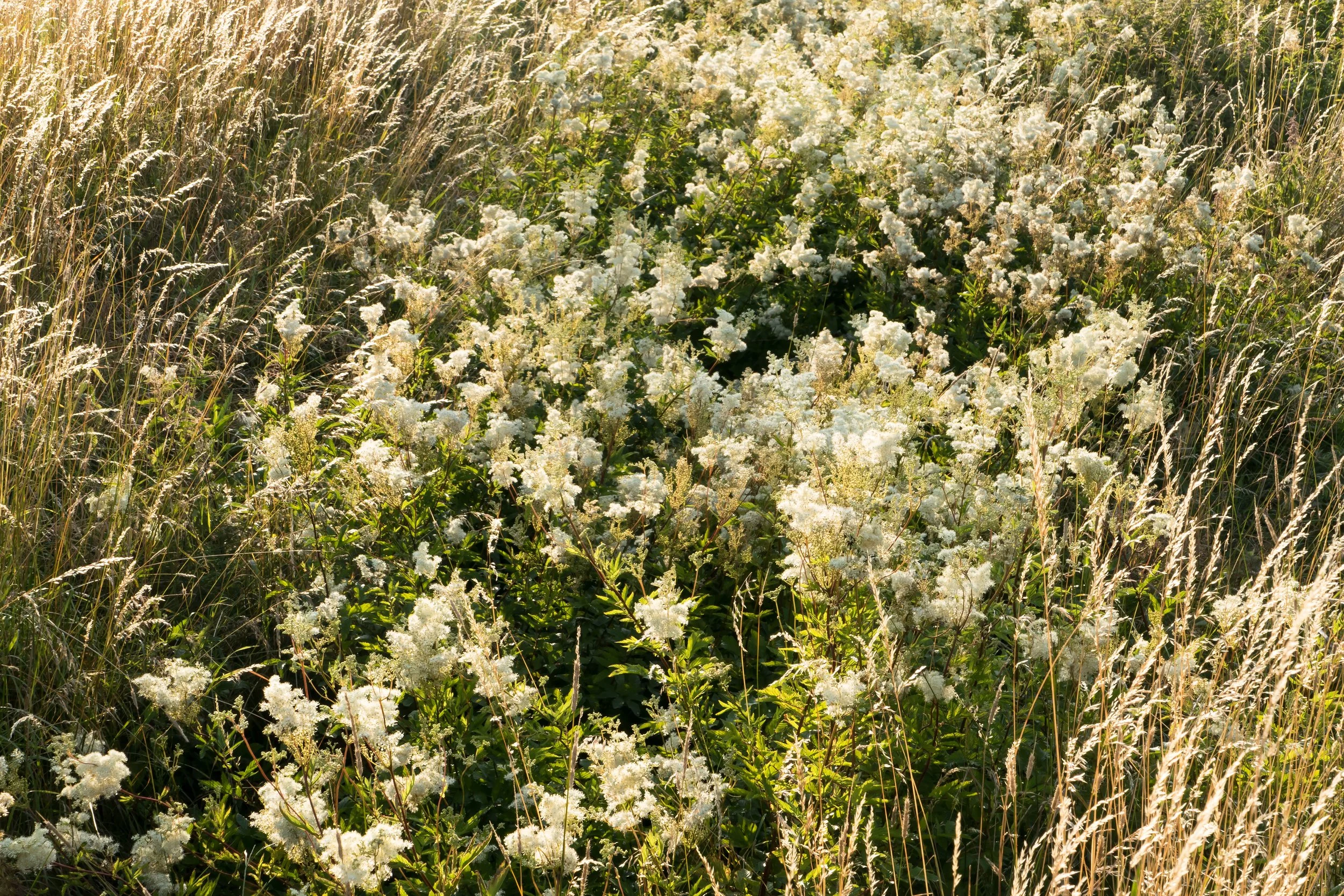
W.carter, CC0, via Wikimedia Commons
Meadowsweet was also considered a "spring fever" herb by our western herbal ancestors, which referred to both the illnesses that could occur with the change of seasons, but also to the increase of allergens in the air, leading to conditions like hay fever.⁸ Again, we visit with the words of Taylor who summarizes Meadowsweet's gifts well when it comes to moving energy:
"It is a relaxing, anti-inflammatory, and astringent herb, reducing excess phlegm and swelling of mucous membranes. All the passages of the body - urinary, digestive, and respiratory - are helped by meadowsweet, which through expelling heat, cools, calms, and reduces hot wet swellings and excess phlegm."⁹
Traditionally, Meadowsweet has been used for "all the diseases of the lungs" aiding with alleviating congestion and breathing issues (though caution with asthma - see contraindications below).¹⁰ Again, this speaks to Meadowsweet's ability to clear out stagnant conditions like excess phlegm and bring warmth and energy to tired out body systems.
There have been some limited but interesting studies regarding Meadowsweet's anti-tumor and anti-cancer qualities. Antioxidant-rich Meadowsweet has shown to prevent cells from damage as well as prevent tumorous and cancerous cells from reproducing in vitro.¹¹ Though, to be perfectly clear, we have incredible modern approaches to treating cancer that continue to get better and better, and while herbs should definitely be considered an preventative and adjunct therapy they are not a replacement for cancer care. If you have a family history of tumors - cancer or otherwise - consider adding herbs like Meadowsweet and Lady's Mantle (Alchemilla vulgaris) into your regular herbal rotation as part of a broader anti-tumor preventative practice.
Use for headaches either alone or combining with your favorite nervines to create a calming remedy such as with Skullcap (Scutellaria lateriflora) to quell anxiety and a noisy mind or with Milky Oat (Avena sativa) to bring a sense of ease and gentleness. Taylor recommends combining with St. Joan's Wort (Hypericum perforatum) "when difficult emotions, such as grief and anger, have exhausted the vital spirit and saddened the heart."¹² Brooke points out that Meadowsweet can be a helpful plant ally for highly sensitive people, helping them to "feel they can cope better with their lives; it strengthens and soothes."¹³ Working with Meadowsweet as a flower essence and through meditation can help us remove hurdles around communication that lead to irritation and frustration. In the case of herbalists and healing practitioners, Meadowsweet is a plant ally that can help us learn how to meet our clients where they are at - not where we expect them to be - and point us in the direction of expanding our vocabulary of connection.
Meadowsweet is a wonderful compress for bumps, bruises, bites and stings, eczema, inflamed and irritated skin (including heat rash), and arthritic pain as well as for inflamed eyes and conjunctivitis. Use as a gargle or mouthwash for bleeding gums (either as a tea or a dropperful of tincture mixed with water), mouth ulcers, and sore gums. The herb is also a traditional topical treatment as a vaginal douche for low-grade (CIN 1) cervical dysplasia - this is only suggested while continuing to work with both your herbalist and your healthcare provider for ongoing monitoring. Meadowsweet is also useful for vaginal inflammation and infection. Brooke mentions the use of the flowers by Romany folk around Somerset, England as a beauty tonic for clearing the complexion by steeping the flower heads in water "mixed with a little dew from the teasel plant."¹⁴
Traditionally, Meadowsweet was used as a strewing herb for homes, which not only added a pleasant aroma, but could help deter unwanted pests and act as a mild disinfectant. It's also a traditional ingredient in mead-making (the "Meadow" in Meadowsweet is likely a reference to mead-making rather than the meadows it commonly grows in). Meadowsweet has been found in the pre- and proto-Druidic Bronze Age burial mounds in Wales, Scotland, and beyond speaking to its sacred status to ancient peoples and the many generations of herbalists who have turned to the plant as ally.
Magickal Uses : A traditional ingredient in love spells. The herb also has a Midsummer divination tradition:
"If gathered at Midsummer, Meadowsweet will give you information regarding thieves; if you have been robbed, place meadowsweet on water. If it sinks, the thief is a man. If it floats, a woman."¹⁵
Meadowsweet, alongside Water Mint (Mentha aquatica) and Vervain (Verbena spp.), is said to be one of the three most sacred herbs to the Druids. I'm not sure the origin of the "three sacred herbs of the druids" and whether it is based on historical or modern myth, but it is certainly widespread and meaningful in our present age, which is a beautiful thing. As far as I can tell, many herbals mentioning these three herbs as "the most sacred to the Druids" are referencing Maude Grieve's description of Meadowsweet in her widely read and influential book, A Modern Herbal, first published in 1931.¹⁶
The herb was so calming it was said to calm the legendary Celtic hero Cú Chullain's terrifying fits of rage, even given the name "the belt of Cú Chullain".¹⁷ Meadowsweet is also associated with Blodduewedd who was made of the herb alongside Broom (Cytisus scoparius) and Oak (Quercus spp.).¹⁸ The herb was said to be the favorite strewing plant of Queen Elizabeth I and given her connections with the shenanigans of John Dee and Edward Kelley, perhaps add a bit to the altar at your next royal seance, angelic rave or announcement of your newly adopted neopronouns.¹⁹
The herb was included in graves within Wales, Scotland, and beyond, and may serve as an herb of burial rites and connections with the ancestors. The herb is an excellent choice for connecting with the Welsh healing tradition of the Physicians of Myddfai as the Welsh burial mound where Meadowsweet was found lies above Llyn y Fan Fach, the lake associated with the famed healers.²⁰ Druids Phillip and Stephanie Carr-Gomm recommend Meadowsweet not only as a funerary herb for assisting with safe passage between the worlds, but as an herb for coming-of-age ceremonies and initiations.²¹
Brooke associates Meadowsweet with the festival of Lammas / Lughnasadh, suggesting that the sabbat altar be decorated with the flowers and garland crowns be worn. She mentions that "Meadowsweet has a heady, narcotic perfume which helps the participants to leave their physical forms behind and contact the essence of the Great Mother and feel at one with her. Meadowsweet tea can be drunk to heighten the effect of the celebration and to provide an atmosphere of merriment."²²
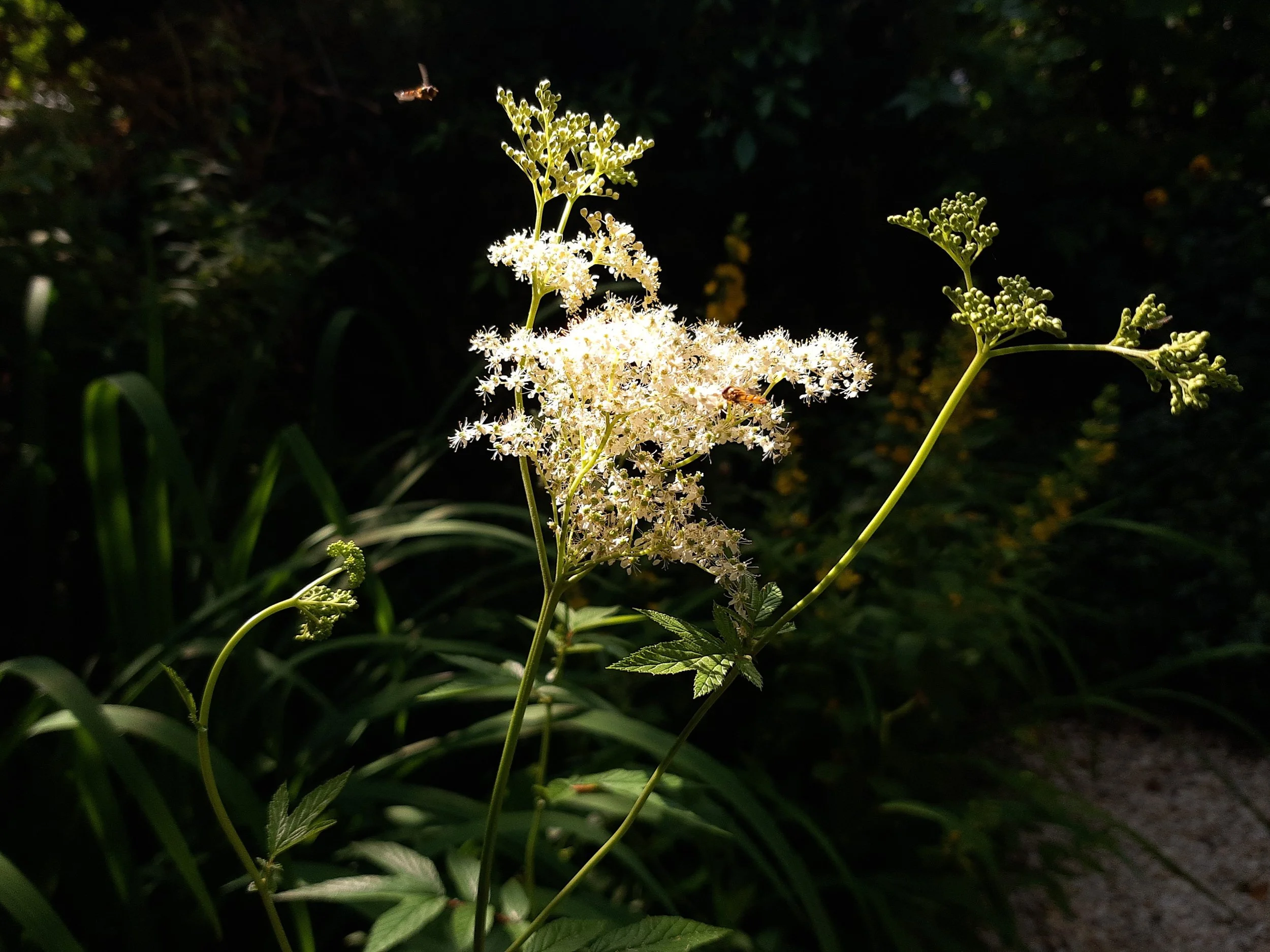
Gerda Arendt, CC0, via Wikimedia Commons
The Meadowsweet Personality : There are a lot of folks well-served by Meadowsweet, including highly sensitive people whose sensitivity and sensory overwhelm leads to digestive upset. Or the person who is learning to step into their power as a young adult, navigating the desires of their heart, mind, and body with greater ease and discernment.
But I want to focus on the Meadowsweet person could be described as disgruntled, even ill-humored. Their energy can be hard and closed off, which can be challenging to navigate for others in their life, but is often there as a protective measure because of the disappointments, even cruelty they have experienced from others. Having been bullied is a common Meadowsweet person experience and they protect themselves by keeping others out of their orbit as much as they can manage. Like many hard-edged folks, there is a soft, hidden core to many Meadowsweet folk that can be difficult to spot from afar, especially for the hard-edge person themselves who've tried to put as much distance between their sensitivity and how they prefer to be perceived. Their hardness can create symptoms of self-centeredness where they center their suffering before all else - there can be a need to learn to look beyond their own nose and develop the empathy they may have been denied when growing up. For some Meadowsweet folk, they develop an anger that leaves them exhausted and drained, making it difficult for them to imagine developing any other sort of emotional response to their circumstances. Often under this anger is a whole lot of anxiety laced with even more uncertainty about if they are wanted.
Working with Meadowsweet helps folk soften, open up, and learn how to respond to the world through emotions beyond anger, suspicion or dissatisfaction. Even better, Meadowsweet helps folks to greet the world with a glad heart. The herb helps us to acknowledge our own suffering and the suffering of others, without becoming afraid or dismissive of the beauty of the world that exists, too. It is a humoral-balancing herb, turning ill-humored dispositions into balanced ones, where sadness, happiness, grief, and hope weave and mingle without fear or distress. It is the plant ally that reminds us we can do hard things, helping us seek clarity over certainty, so that we can dream beyond what seems inevitable about ourselves and grow beyond the fear of change that a breakthrough brings. Meadowsweet folks, full of the sort of persistent bravery that emerges from working through anger and fear, bring the gift of creating atmospheres of sweetness and care where before all seemed gloomy and dull, ultimately helping folks to find their own bravery.
Contraindications : Avoid is sensitive to salicylates such as aspirin and with bleeding disorders. Caution in pregnancy and breastfeeding. Low doses or avoid altogether with asthma as the herb can cause broncospasms.
Drug interactions : Caution with anticoagulants.
Dosage : Standard dosage.
🌿
Looking for more plant profiles? Check out my plant ally archive which features plant profiles and guides for incorporating herbalism into your daily life.
You can also find all of my plant profiles - including printable versions - and more in The Plant Ally Library.
Thanks for joining me on this journey with Meadowsweet. I hope it’s inspired your curiosity to learn more about our plant allies and, even better, a gratitude for the amazing ways plants and people have been striving to take care of each other through the generations.

This post was made possible through patron support.
❤︎ Thanks, friends. ❤︎
📚
Footnotes
1. Angela Paine, Healing Plants of the Celtic Druids: Ancient Celts in Britain and their Druid headliners used plant medicine to treat mind, body and soul (Winchester, UK: Moon Books, 2018), 59.
2. The "wandering womb" and its reinforcement of the misogynistic ideas around women and hysteria that continue to shape modern health care is a good place to start.3. Julie Bruton-Seal and Matthew Seal, Backyard Medicine: Harvest and Make Your Own Herbal Remedies (New York: Castle Books, 2012), 97.
4. Elisabeth Brooke, An Astrological Herbalism for Women (The Crossing Press, 1992), 115.
5. Stephen Taylor, The Humoral Herbal: A practical guide to the Western Energetic system of health, lifestyle and herbs (London: Aeon Books, 2021), 327.
6. Captain Frank Roberts via Matthew Wood, The Earthwise Herbal: A Complete Guide to Old World Medicinal Plants (Berkeley, CA: North Atlantic Books, 2008), 255.
7. Maude Grieve, A Modern Herbal: Volume II (New York: Dover Publications, 1971), 524. A free, online version of A Modern Herbal can be found here.
8. Taylor, 326.
9. Taylor, 326.
10. Nicholas Culpeper, and J. J. Pursell, Culpeper's Complete Herbal: A Compendium of Herbs and Their Uses, Annotated for Modern Herbalists, Healers, and Witches (Portland, OR: Microcosm Publishing, 2022), 181.
11. Paine, 60.
12. Taylor, 327.
13. Brooke, 117.
14. Brooke, 115.
15. Scott Cunningham, Cunningham's Encyclopedia of Magical Herbs (St. Paul, MN: Llewellyn, 2001), 172. Traditionally, gender non-conforming folk are exempt from suspicions of thievery.
16. Grieve, 524. It's also worth mentioning that lesser known English herbalist Hilda Leyel (aka Mrs. C. F. Leyel), was not only an editor to A Modern Herbal (which would've been a huge undertaking), but contributed to the book as well. She founded The Herb Society in the UK, was an incredible fundraiser and organizer, and also wrote many herbal books herself as well as operating an apothecary called Culpeper House (and that's only a small portion of her biography). Leyel also seemed to be quite the character and I just love that she and Grieve worked together to leave behind such a profoundly useful legacy of herbal knowledge.
17. Taylor, 326. Alternatively, the "belt" might refer to Cú Chullain using the plant to alleviate the sores around his waist that he suffered because of shingles.
18. Paul Beyerl, A Compendium of Herbal Magick (Custer, WA: Phoenix Publishing, 1998), 246.
19. Bruton-Seal and Seal, 97. The angels were all about expansive pronouns which makes neopronouns feel less neo, more immemorial, dare I say, heavenly.
20. Philip and Stephanie Carr-Gomm, The Druid Plant Oracle (New York: St. Martin's Press, 2007), 74.
21. Druid, 74.
22. Brooke, 117.


_-_William_Catto_-_ABDAG016183.jpg)


