
Creating Your Own Ancestral Tarot Spread: A Guide for Tarot Readers
I love a good tarot spread.
When I was just starting out reading tarot, I poured over books of spread, copying many of them down in notebooks, and delighting in how there seemed to be a spread for every question out there. These days in the era of our tarot renaissance, I love how tarot spreads have become their own sort of vernacular, full of recognizable structures, but taking on the regional twang of their creator. I really enjoy getting to know a tarot reader through their spreads, the ways they lay out the cards, how the questions are designed, and the underlying weft and weave of a sturdy tarot spread. I've created and shared a fair amount of my own tarot spreads over the years and I always have scrappy notes of soon-to-be spreads lying about my workspace.
Tarot has always been a communal activity for me - it's meant to be read with friends with its secrets and insights traded freely amongst magickal folk. Creating for community, I hope that folks working with a tarot spread that I've written feel drawn back into something whether that is drawn back into a relationship with the seasons of the year or lunar cycle, with deep parts of yourself, and/or your community. Mostly, though, I hope that my tarot spreads bring a healthy infusion of inspiration to a person's life where working with tarot feels like you're working with a living, breathing, and useful tradition.
When it comes to personal practices like connecting with ancestors and the land we live with, I think all tarot readers benefit from learning how to create their own tarot spreads. And as much as I love creating tarot spreads, I love teaching others how to create their own even more. Beyond the benefit of creating a spread that is customized to your needs, the process of spread-crafting can reveal how we think about ourselves as a reader, the ways we prefer to interpret cards, and the frameworks that we are drawn to again and again.
So, with Samhain and festivals honoring the beloved dead just around the corner, I thought it would be interesting to explore how we can create our own tarot spread to connect with ancestral energies, both of the land and of your familial and cultural lines.
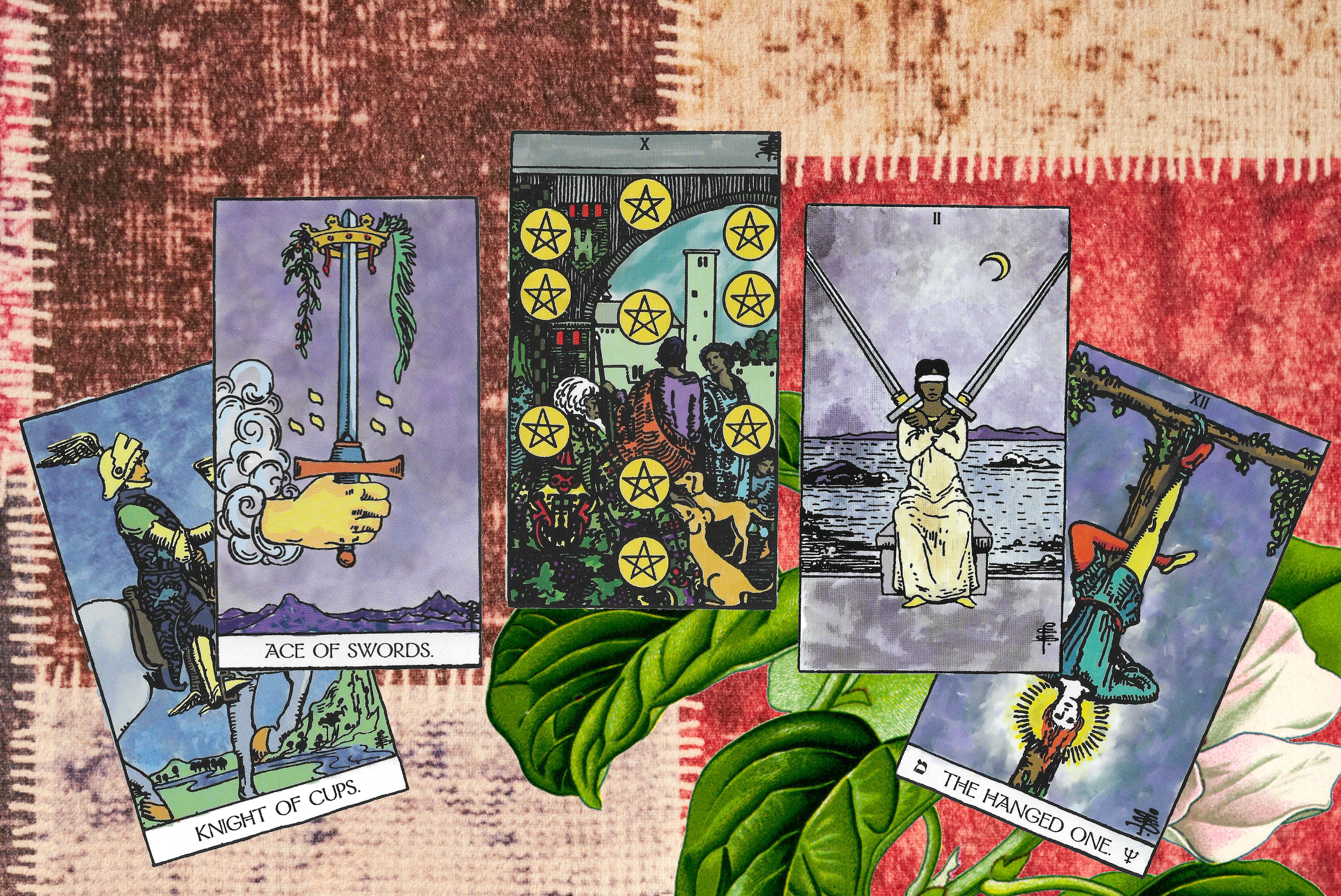
The Weiser Tarot (background image via @enginakyurt)
The Candle: A Guiding Light
As we begin, I wanted to offer an important bit of guidance since we're working with the vast tradition of tarot and the deep well of ancestral wisdom:
When creating this spread, remember that we are only working with benevolent ancestors. We already have to deal with enough living people who cause us harm, so let's not invite those sorts of energies into our divination practice. There is a time and place (preferably with the support of mental health practitioners and trusted community) to explore complicated ancestral lines but that's not the focus of this tutorial.
Inviting in benevolent ancestral energies can be as simply as stating at the start of any reading:
I invite in the energy of my benevolent ancestors to guide and protect me as we connect and converse. Blessed be.
The Roots: The Purpose of Your Reading
The basic format of an ancestral tarot spread is to choose the ancestors you want to connect with and then choose the questions or prompts you'll use to converse with them - but how you make those choices is where much of the work lies.
You might choose to connect with all three ancestral currents (described below), casting a large spread on an auspicious date (like Samhain). Or you might want to focus on one ancestral current such as the Mighty Dead to deepen your connection with a particular cultural practice or the Beloved Dead to find kinship with a part of your heritage you feel distant from. Maybe you've been exploring experiences from your childhood and want to connect with the ancestral Land of your childhood home or connect with the Land of your ancestors. It's always good before any divinatory practice to understand just what it is you're casting cards for but it's especially important for a spread meant to connect with powerful and personal ancestral currents.
With all that in mind, here are the ancestral currents we will be exploring with our tarot spread: the Mighty Dead, the Beloved Dead, and the Land & Beyond-Human Kin.
🌀 The Mighty Dead are cultural and social ancestors ranging from the very real (such as Marie Laveau or Scott Cunningham) to the mythic (such as Aradia or Morgan le Fay).
🌀 The Beloved Dead are the ancestors who were close to us before they passed - whether biologically, familially, socially. Our Beloved Dead can be our friends, family members, kind neighbors, your first grade teacher who always made sure you had something to eat at snacktime, and all of the animal companions we've known and loved.
🌀 The Land & Beyond-Human Kin are the places - real and mythic - as well as the beyond-human creatures who have shaped our lives. The creek behind your childhood home, the Maple tree growing outside your apartment window, the lake on your college campus, the mythical island that floats just beyond the furthest wave, that one very strange but delightful tree spirit you encountered when you were seven - all these and more are the energies of the Land as ancestor.
So why do ancestor work and try to connect with any of these energies? There are a number of ways to understand just what "ancestor work" is and why it's useful. There is the literal - you are connecting with your ancestors through thought, word or deed, whether or not you believe you are actually connecting with the spirit of the deceased in order to understand your roots or reconnect with family and/or cultural traditions. Connecting with ancestors doesn't require belief in spirits or even an afterlife - it can be about connecting with the memory of a person or learning more about their life and the context of the culture and time they lived through to deepen a feeling of kinship. There is also the physical nature of ancestor work - we are made up of the DNA of those gone before and share genetics with all life on our planet so there is something magickal about spending time acknowledging that.
Connecting with the land and beyond-human kin as ancestors adds another layer to strengthening the threads which connect us to the cycles of life, death, and rebirth on our planet. It is an act of peace, of respect, and of deep magick to purposefully and consistently honor the mountain as our ancestor as much as we honor our human ancestors, resisting narratives that would have us cut ourselves off from a relationship with the living earth and our own interwoven origins. We are tangled up in one another, and an ancestral practice that honors land and beyond-human kin is one of the ways we can explore what that means in our lives and communities.
Questions to consider for your ancestral work:
What are you hoping to achieve or feel through ancestral work?
What do you hope will be revealed?
What questions are begging to be asked?
How do you already practice ancestral connections in your life?
What ancestral wisdom do you want to cultivate more of in your life?
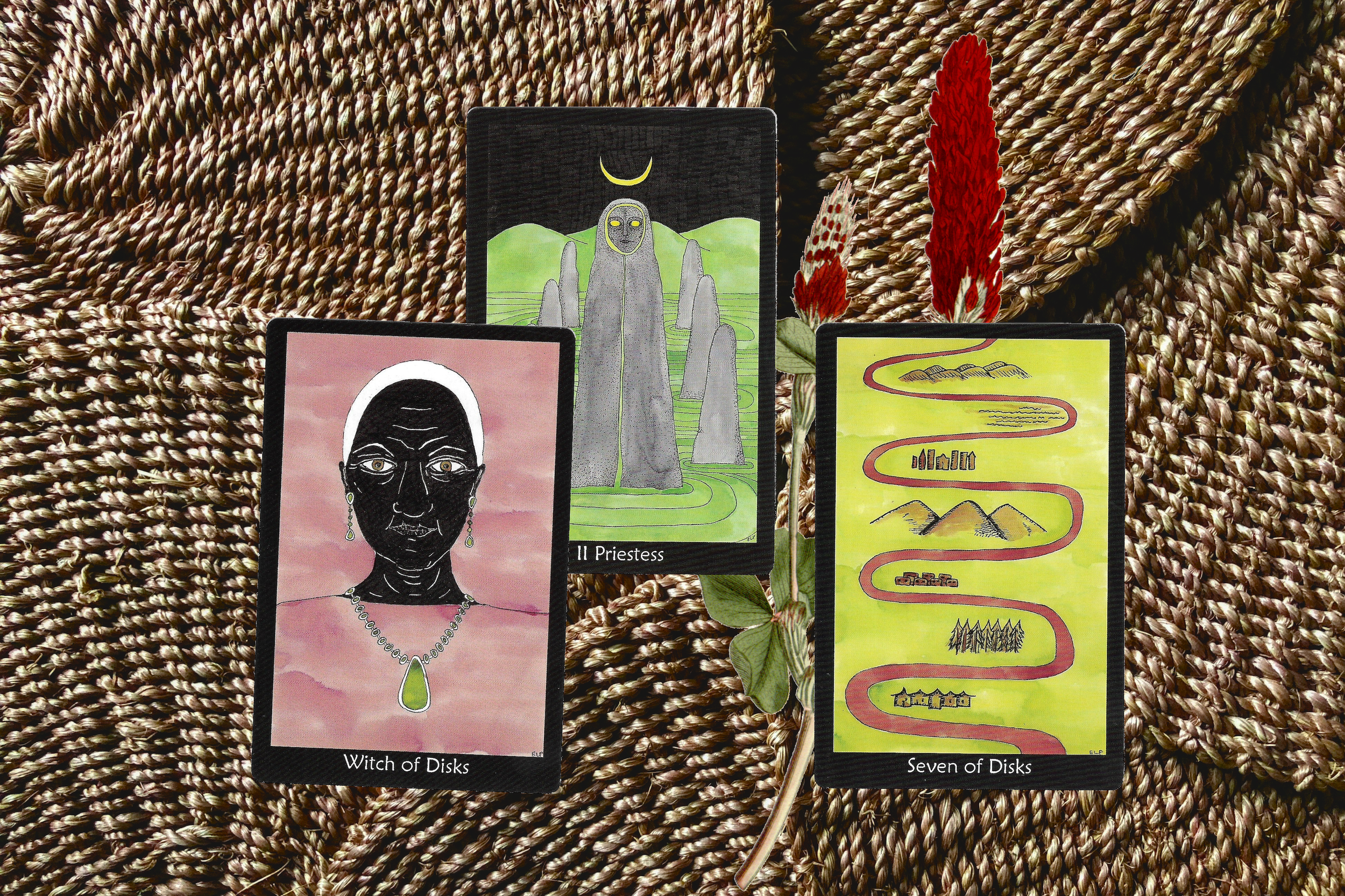
Tarot of the Crone (background image via @joashcastro)
The Bones: Casting the Cards
One of the other basic questions to consider when creating your own tarot spread is how many cards do you want to pull. How many cards feel like too much or too little varies from reader to reader, but sometimes when a spread doesn't feel like it's working (whether it's one you created yourself or one created by another tarot reader), is because the number of cards is tripping up the energy. For determining the amount of cards for your spread, it can be useful to draw upon meaningful practices or beliefs that already exist in your life. Examples include:
✨ Being guided by your elemental tradition such as a card for each of the cardinal elements and another one for spirit. In general, your spreads might incorporate 4 to 5 cards or only 3 if working within a tradition of land, sea, and sky.
✨ Being guided by your favorite numbers. If you love the number 7 and it always makes you feel lucky and in the flow, pull 7 cards for your tarot spreads. Similarly, if you avoid culturally unlucky numbers in your practice, perhaps stay away from them in your tarot spreads.
✨ Being guided by ritual practices. If you belong to a tradition that always does things in threes or important ritual actions happen in pairs, then use that energy to choose the number of cards you cast in your spread.
✨ Being guided by aesthetics. You love how nine cards look arranged on the table? Or the way a circle of 8 cards is deeply pleasing to your eye? Go with it!
What I hope to convey is that the number of cards you choose for your spread should aid your intuitive flow, not disrupt it. For my own tarot spreads, I tend to use multiples of three as three is a sacred number within my cultural practices. While not all of my spreads use multiple of threes, it usually forms the foundation to the structure I end up choosing since it is a type of number where I find my flow most easily.
As for the layout or the way your cards will be placed in a reading, let your preferences guide you. I enjoy creating spreads that reflect the mood and intention of a reading and the questions being asked. A spread that is about accessing the cauldron of memory will take on a cauldron shape, whereas a mirror spread for relationships is going to have a symmetry to it. Some folks like having the same layout, but just apply different questions for each position each time. Again, like with choosing how many cards you're going to pull, it's important to think about how a spread is going to read and whether it's too fussy and complicated or not enough of anything to be useful.
Take a moment to consider what feels like too many cards and what feels just right. As for the shape of your tarot spread, it can be useful to pull out your tarot deck and start laying out cards in a pleasing manner. There is both an art and a practice to tarot, and playing can be a good way of exploring the crossroads of art and practice.
The Rattle & Bell: Creating the Prompts of Your Reading
A good question or prompt can help clarity take root in a reading. I have all sorts of prompts and questions jotted down in notebooks - some will be used in tarot spreads, others inspire blog posts, and some might not get used directly, but point me towards a path I haven't explored yet.
As a reader, I fluctuate between using fixed spreads (such as the Celtic Cross) and coming up with one on the spot. A good reading, in my opinion, relies in no small part on a potent question or prompt being asked. Muddled questions can get muddled answers, so it's worth investing some effort in learning how to listen to what a querent is trying to ask. Pay attention to the types of tarot spreads you really love and the ways that questions are asked - take notes and build upon these types of spreads to create your own.
For our work of creating an ancestral tarot spread, I've listed both questions and prompts for you to draw upon or inspire your own inquiries. Some of the prompts have been written with the rhythm of three in mind, but they can easily be adapted or added on to if other numbers make more sense in your practice.
Sometimes pulling a single card for a single question may be the best path but other times it can be more useful to pull multiple cards for one question, allowing you to find a story in your answer that might be harder to divine with just one card. In other words, cards interact with each other and shape each other's meaning, creating a greater depth of perspective. Sometimes we find that depth from pulling one card for each question and other times we find that depth with fewer questions and more cards. Try both approaches and see what happens!
✨
Questions for the Ancestors to Speak On
These are broad questions, but feel free to ask more clarifying tarot questions such as advice for next steps to take as well as peaks into the past and future.
Where is {ancestor's} influence or gifts showing up in my life?
What have I forgotten about {ancestor} that would be useful to remember?
How are you your ancestor's daughter/child/son?
What burden of your ancestors do you carry or has shaped your life?
What do you have access to today because of your ancestors?
What are your ancestors hungry for?
What is it time to let go of?
Where are your ancestors guiding you to?
What are the ways your ancestors are proud of you?
What Ancestor of Land is coming through?
What Beloved Ancestor is connecting with me now?
What Mighty Ancestor am I connecting to now?
✨
Stories for the Ancestors to Tell
I love a series of prompts that let a spread unfold like a story. Prompts are slightly different than questions and if you sometimes struggle to answer a card position's question, you might find it easier to complete a card position's prompt.
It's time to let go of…
So you can embrace…
And become more…
Don't you remember…
We want your heart to hear…
We want your body to feel…
We want your mind to imagine…
These are the gifts we left for you…
Breathe in…
Breathe out…
Hold close…
Look for these signs to know we draw near…
The ancestors of land say…
The ancestors of sea say…
The ancestors of sky say…
In your most hidden of hearts we know of your beautiful desire for…
We see your fear of…
Consider this gift of bravery from us…
Remember that we always…
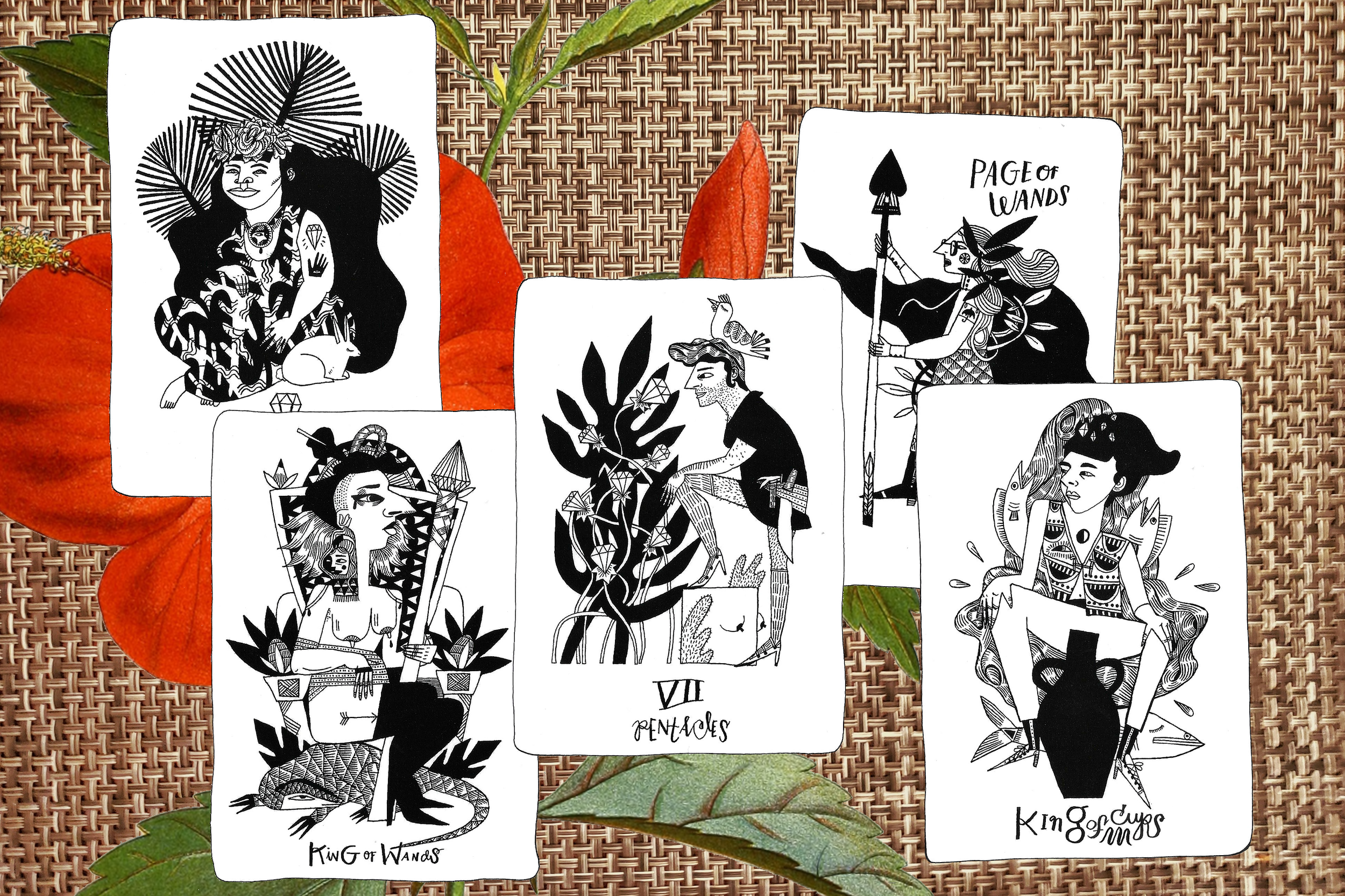
Many Queens Tarot (background image via @joshua_hoehne)
The Altar: Creating the Space & Inviting Your Ancestors
While completely optional, before you cast your spread, you might create an ancestor altar. Some of you may already have a regular ancestor practice with or without a dedicated altar or ancestral space to visit, but if you don't have one or you're working with ancestral energies you don't typically connect with, an ancestor altar might be something to try.
It can be as simple as a candle, a bowl of water (for "feeding" the ancestral energies that arrive and/or representing the pathway that the ancestors travel), and an image or item that represents the ancestor(s) you're trying to connect with. Additionally, it can be interesting to spend time meditating, making offerings at or generally hanging around an ancestor altar for a few days before you cast a spread, letting your ancestors know that you are wanting to communicate with them and giving them time to arrive.
Whether or not you create an ancestor altar, it can be a lovely practice to invite your ancestors in before you cast your cards with something as simple as naming them or a more elaborate invocation. When you don't know the name of an ancestor, but are seeking them, you can use honorifics or terms of endearment to call them to the table. Here's an example of an simple blessing and invocation:
Blessed and benevolent ancestors,
draw you near -
speak to me through the cards,
bright and clear.
If you have a couple of ancestral energies you work with on a regular basis you can even assign them (or have them choose) a tarot card to represent them - one of the court cards might be the traditional option, but any card will do. If each of the court cards in your deck, for example, is associated with an ancestral energy you can shuffle and draw a card just from the court to get a sense of who is showing up to connect with you during your reading. You can even place an ancestor's court card on your altar a few hours or days before doing your reading, letting them know that you want to connect.
The Casting: Putting it All Together
Once you've determined your intention, chosen the number of cards you are going to pull and how you'll lay them out, chosen your prompts and questions, and created a space for your reading, it's time to cast your cards!
You might find after your first reading that there needs to be tweaks and modifications to your spread - sometimes questions aren't as clear as you thought they would be or too many cards were drawn (draining your intuitive reserves). Other times a spread just flows and feels like a clear channel of energy. What I hope you'll feel is a sense of accomplishment and curiosity of what you might create next with your spread crafting skills.
After a reading is done, what are the ways that you have made space for the messages you want to carry with you from the reading to settle around you for a bit? Sometimes I'll keep a card or two from the reading that I want to reflect on further on my altar or in a card holder on my desk. Occasionally I'll journal about the reading. Most often, though, I'll practice a bit of breathwork after a reading, letting the images and ideas from the spread settle into the airways, roots, and branches of my body for me to carry forward in the days and weeks ahead. It's not about remembering exactly what a message is or what cards I've pulled, but to know that I've made space for those messages to settle somewhere in a body-felt way for me to draw on unconsciously again when I need them.
However you end your reading, I encourage you to take a moment to honor the presence of your ancestral guests. Say thanks, offer sacred herbs as incense, offer the water from your altar to a local tree or plant, and just generally wrap up your reading in a state of gratitude. Before you came to be in your body, your ancestors were dreaming of you - what a gift!
🕯️
If you’re looking for more resources to support your ancestral healing practice you might like Plant Allies for Ancestral Healing. I also have a whole archive of tarot spreads, but you might be particularly interested in the following:
And if you’re interested in a deep dive into the intersections of tarot, herbalism, and healing practice, come this way.
Friends, I hope your journeys in the slow magick of settling in and listening deep illuminate the path ahead. May the songs of our ancestors sing so clearly, that the next generation is carried by their noisy wisdom.
This post was made possible through patron support.
❤︎ Thanks, friends. ❤︎
📚
Tarot decks shown are:
The Weiser Tarot
Tarot of the Crone by Ellen Lorenzi-Prince
Many Queens Tarot by Lettie Jane Rennekamp
