

Welcome to the Path of Maps
✨ listen to the introduction ✨
After time spent on the path - with many trails tread and many roads roamed - we begin to see the land as not something we're on, but a companion we're with.
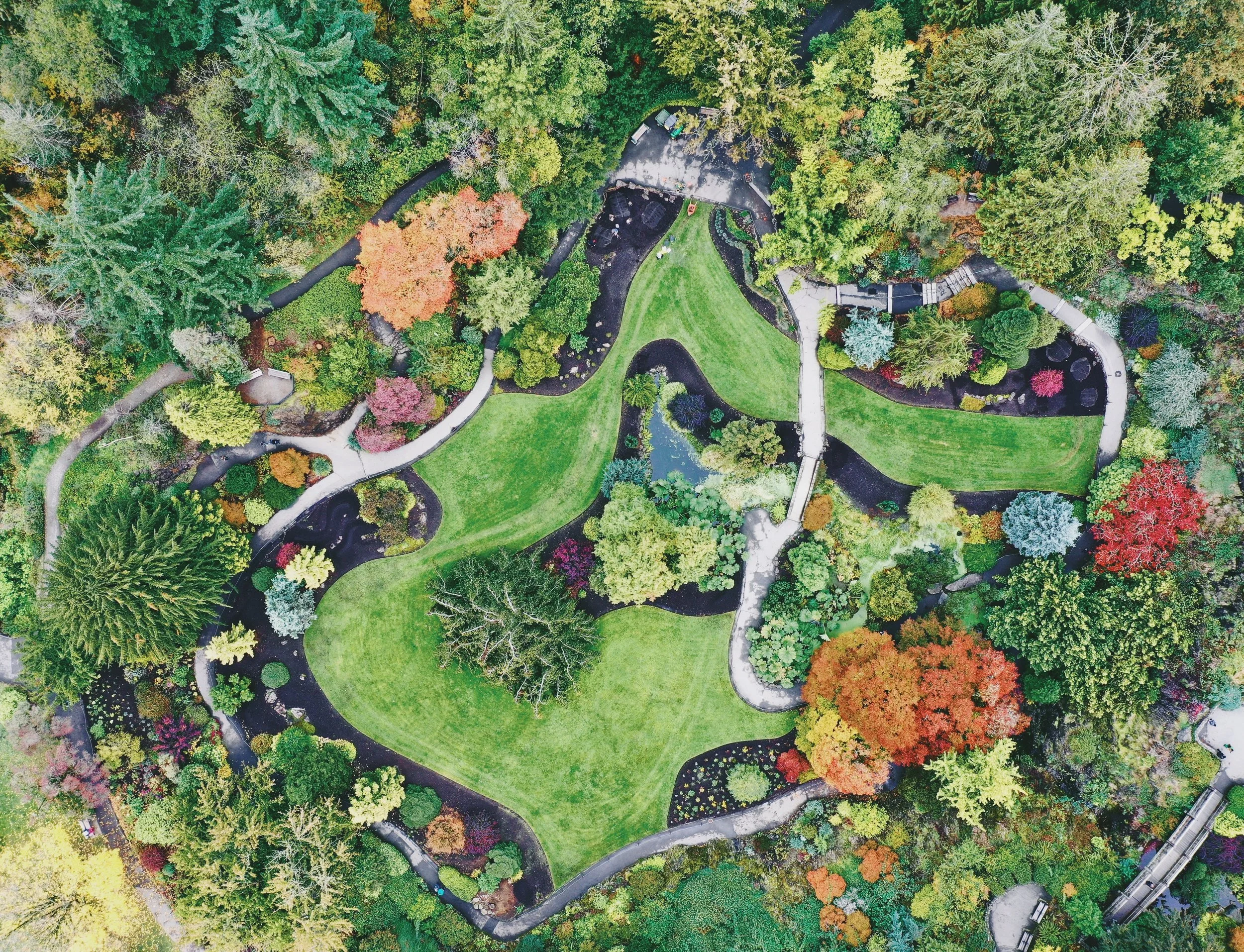
Traveling the land both literally as we travel from place to place and figuratively through our inner world and healing practices, a story unfolds. The land is alive with story, speaking through the topsoil, the tiny moss growing in the cracks of pavement, the wildflowers, the woodlands, and the rocky banks alongside riverways. Like our skin, the surface of the land acts like a porous and responsive organ, protecting the earth below, while influencing and being influenced by what lies beneath. Paths emerge on the land creating desire lines like tattoos across its skin, pointing us in the direction of where others have gone before us and where we might be headed soon ourselves. The seasons reshape the land and reshape us, too, though it can take a while to notice either is happening especially if we weren't raised within a family or social culture that valued connection with the land. At one point, though, as we journey along the path of the herbalist, the fog lifts and we realize that we've been surrounded by stories this whole time, a myriad of maps laid out before us ready to be read, reshaped, and added to. The land is speaking and while its language is complex, thankfully, being of the land, so are we.
What is your earliest memory of the land becoming a map and marking the change in the seasonal story of the year? I remember the day when the wheel of the year finally began to be something I felt in my bones, rather than just an abstract idea in a book. I was barely a teenager living in a town by the sea, near the end of October, and the marine layer had become a wild and whippy thing, crackling with the rapidly cooling energy of the autumn's rise. I was out on a trail, caught up in it, barely able to see a dozen feet ahead of me and I felt it - it felt like the season of Samhain was opening up ahead, the veil between the worlds thinning, and the energy of the otherworld starting to crackle and nip at the edges of our own. I remember standing there, lost in the fog, finding a new way of connecting with the world around me that had felt invisible before.
With this experience I now had a feeling that I could look for not only every October, but to notice similar shifts in energy throughout the rest of the year. In this moment I didn't suddenly understand everything about the way the land speaks their stories, but I had a feeling to guide me and to help all that the facts and myths I was reading about seasonal cycles feel like a real and living thing. I had finally begun to notice a connection with the land that many of our ancestors took for granted, laid out before me like a map, and it felt like coming home.
I've heard many a homecoming stories from herbalists and magickal folk alike where there is a moment in their studies that feels both like a path back to what feels familiar and like a new possibility opens up within them. One of the ways that we begin to translate the storied map of the land into a language that we can comprehend and share with others as herbalists is through the energetic systems developed over thousands of years by our ancestors. All herbal cultures have an energetic language to describe the conditions of disease, the constitutions and temperaments of people, and the qualities of plants. Within traditional western herbalism we have the tissue states, which evolved from the much older system of humoral theory (from the Greek word χυμός or chymós meaning "sap," "juice," or "flavor").¹ The six tissue states describe temperature (Hot or Cold), moisture (Dry or Damp) and tone (Relaxed or Tense) and are a relatively modern development in western herbalism, developing around the late 1800s and early 1900s through the work of the physiomedicalist community primarily located in the United States. The physiomedicalists tried to incorporate modern research and scientific understanding to the Thomsonian system, expanding it beyond its early limitations into something akin to a functional medicine approach while pushing back against the archaic and often toxic approaches of medical practices of the time (such as blood letting and the use of mercury as medicine).²
Energetic language, like other inherited wisdom traditions, are like maps through the land, helping us to find our way through the unfamiliar, to find language that helps us tell our stories, and to understand the hidden-until-its-not meanings of weather, water, creature, star, and cloud. Whether we're working with tissue states, elemental systems, humoral theory or doshas, all of these descriptive terms act like a compass when applied to the map of the land-body helping to direct us towards healing needs, elemental imbalances, and inherent strengths. Energetic language is one of our intangible inheritances as herbalists and plant folk - a way of perceiving the world and each other that makes our ability to read the maps of skin and water and stone legible.
In all of these lands, it is the skin that is most often encountered and read first. Just like when we enter a new garden for the first time, it is what lies on the surface that we see before we start taking note of the quality of the soil beneath. For much of our herbal history, our abilities as herbalists have relied heavily on our ability to read the land through both practical and energetic lenses. These land-reading skills include observing the land around us to be able to grow and find herbs needed to make medicine, reading the land-bodies of those we worked with to bring about healing, and perceiving the invisible land of relationships, social contracts, and society expectations between all of us that affects our ability to thrive.³ Even if an herbalist has to rely on senses other than sight, being able to touch and feel the quality of the skin remains an important early step in understanding the conditions of the land-body. Threaded throughout the practice of noticing the land and each other, however, is that poisonous cruelty of translating difference from something to notice with awe and curiosity into an excuse to enforce supremacist pseudoscience.
There is a lot of emotional weight, cultural story, and societal expectation around skin - much of it rooted in systems of control and oppression. As a species we argue about how much skin should be shown or how much should be hidden, endlessly moralizing about what the appearance of skin means and how we should act when we see it. The toxic stories of racism, colorism, ableism, and lookism that we wield against one another end up exhausting all of us, with those that have been deemed other or lesser than because of their skin at greater risk of harm. It's not surprising that we've applied these systems of superiority that we enforce on one another upon the land as well. Here the maps used to enforce supremacy are revealed to be flimsy and thin upon closer inspection, devoid of nuance but filled with personal convictions that try to pass themselves off as actual knowledge.
In our lives and our practices, we've inherited maps marked up with "Old Worlds" and "New Worlds," of empires and the victor's spoils, of theft and subterfuge. Hidden away within these institutional documents are what was there before lands were settled, people converted, traditions lost, groves cut down, libraries burned, and commonlands gobbled up by the insatiable hunger of the wealthy. One of the most powerful acts of re-membering the ancient pathways of the land, including the embodied sacredness of our land-bodies, is to name what we see instead of relying on what we've been told. Sometimes the stories that we've been told and what we see will align in a beautiful act of inherited wisdom flowing down through our ancestral and cultural lines, but other times we come to realize that we've been told that the wild meadow is full of vipers, when in fact, it's an awfully nice place to have a picnic.
As we retell and re-examine the maps of the physical, social, spiritual, and emotional landscapes we were brought up within, we can begin to draw out the stories of our skin that have always been there but that we were told to un-see, to hide from or be afraid of. We learn again or for the first time how to follow the pathways of our heart, as one amongst many hearts. And as the stories of our skin begin to change, we can begin to re-map the world we find ourselves in, learning to see beauty first and rejecting the cruel paths of supremacy for the desire lines of kinship.
If you're on the path long enough, the feelings of homecoming begin to shift and expand. Through practice and observation, curiosity and openness, the feelings of homecoming undergo a transmutation into kinship, where what has felt like coming home feels like coming back together. First, we learn how to observe the land and then we learn that we are also being observed by the land. An ancient Yew (Taxus baccata) tree becomes a living ancestor, here long before us and existing long after our lives have come to an end, but watching us move and grow and struggle and learn over hundreds, if not thousands, of years. Rivers notice the bear coming to hunt fish, the deer coming to drink water, the human finding an easy camp to rest for the night. Mountains have a much grander view of civilizations rising and falling, of birds circling their peaks and mountain goats balanced along their cliffsides. There is a peace in knowing that we go out and see the world, but we are also being seen (but not surveilled) by life all around us. Sometimes we are able to catch glimpses of a Yew tree's view, a river's perspective, a mountain's philosophy. And sometimes we mark these observations on the map of our practice, passing on this wisdom to others, exchanging this story for another.
As the Moon waxes from New to Full, pay attention to the land and its landmarks, shifting your view from the land around you, the land between you and others in the forms of your relationships, and your own land-body. Spend time observing, letting the mythic language of land arise within you like a newly discovered map before trying to analyze the meanings of what you've encountered, taking notes and sketches if you like but not trying to turn it into a firm understanding just yet. Notice what feelings arise in your observing, from the love for the wild hills you roam through compared to the feeling that shows up when encountering the hilly bits of your land-body or the confusion that sticks around like a thick haze in marshy parts of a particular relationship. If you like, spend time letting your skin speak to you like a map you've only just encountered. Let yourself see as much as you can as if for the first time or from a visitor's perspective - how would you draw a map of the land and your land-body to someone who has never seen it before?
As a witch, the map is a living grimoire full of well-charted locations that point to places of power to call upon energy, hope, and possibility to empower our magickal workings.
As an herbalist, the map is a story that can shift and change before our eyes, but which can be read through the living language of energetics, drawing out the desire lines of healing.
As a community, the map is a ritual of repair and remembering, where the intermingling power of grief for what was lost and joy for what was preserved creates the ink for a new future to be drawn.
Exploring the path of Maps, we'll connect with the energy of our skin as the expansive surface of our own land-body. We'll explore how to create healing salves to support the health of our skin and celebrate its resiliency all while spotting stories, symbols, landmarks, and treasures to mark our maps with. We'll use the tarot to help us map our inner and outer worlds more thoroughly, bringing it all together through our land-body map making ritual on the Full Moon. I've also added a new practice to our path together with a focus on community where we'll be creating our own blessing of land, people, and common magick.
I hope you feel encouraged to participate in the ways that feel the most interesting and inspiring to your practice, reach out to your fellow journeyers, and bring what you learn and love back to the land you live with and the communities you love.

📚
Footnotes
Though, there are plenty of traditional western herbalists who stick with humoral theory. And the humoral system had evolved out of earlier systems developed in places like ancient Egypt and Mesopotamia. Mostly, I love how sensory rich the original meaning of the Greek word chymôs is and I feel like it is more relatable to the modern practitioner than the term "humor" because it entangles us with the living world, describing the quality of the "sap" of our body much like we would describe the inner workings of a tree. "Sap" is also a more appealing and more accurate description, in my opinion, than what the humoral system is trying to describe with terms like "bile." Chymôs also feels akin to Hildegard von Bingen's veriditas, which I love.
The Thomsonian tradition was named for Samuel Thomson and if you want more of an overview of Samuel Thomson and energetics, listen to and check out the show notes for episode six of magick culture.
The latter skill especially reflects the early history and overlapping roles of herbalists as healers but as spiritual leaders or guides (who would help repair spiritual contracts between a people and the land through ritual), and general community leaders who helped with settling disputes or marking special occasions. Of course, there are still plenty of herbalists who have these overlapping roles, but it's not assumed or expected these days within traditional western herbalism.
᠅